
The concept of a process trail is likely novel to most. I first encountered the idea in the context of qualitative research. Qualitative research is a systematic inquiry that aims to understand social or human phenomena in depth, focusing on meanings, experiences, and processes rather than on numerical measurement or statistical relationships. It typically involves collecting and interpreting non‑numerical data, such as interview transcripts, observations, documents, images, or audio. To make findings and claims based on these data sources replicable, the researcher(s) must carefully identify the steps (processes) followed to translate the raw input. The first we did this, and then we did this, and then we did this, etc., represents a process trail. How was it that you turned something from the observations or documents into categories, and something that can be counted? Documentation of the processes involved is necessary so that others can duplicate your procedure or critique a step you took.
A similar documentation of the processes involved in an activity can be identified in other domains. I have written many posts about the processes involved in writing. And it seems that the concept of a process trail can also be applied to the completion of writing tasks. This seems similar to the Writing Process Model advocated by Flower and Hayes. Their model has had a significant impact on writing researchers and the teaching of writing, as it identified the subprocesses involved in writing, enabling researchers to investigate individual differences in these processes and their correlations with writing skill, and encouraging educators to target specific processes for instruction.
The dual benefits of a process trail
I suggest that those involved in the development of writing skills (learning to write) or the use of writing as a way to improve the understanding and retention of content from other areas of study (writing to learn) apply strategies that involve a process trail. A recent and very serious concern in these areas has been students’ substitution of AI for the expected thinking and content construction they are expected to apply. What I am suggesting by proposing that we expect a process trail is that there are benefits to both the development of writing and content study, as well as to the documentation that students have done the work involved.
What processes can be externalized for observation?
Rather than using a more complex model, such as the Writing Process Model, here is my simplified proposal.
- Read the content
- Identified what you think are important ideas in the content
- Process this collection of ideas to understand and apply
With most writing to learn projects, what you are writing about to demonstrate understanding has to come from somewhere. When the source is a book, document, or website, reading the content would seem obvious. However, with AI available, we know we cannot make this assumption. The second process involves identifying the ideas that you want to eventually include in your written product. Finally, how have you personalized and organized these ideas?
My thinking about processes has originally been based in my academic interest in note-taking and, more recently, in Personal Knowledge Management (PKM) and Second Brain strategies. These perspectives have nothing to do with cheating, but focus on improving the long-term connections between what we experience (reading, watching, listening) and what we eventually apply in some way. How do we store, understand, retrieve, and eventually apply knowledge?
So, I am suggesting that both accountability and performance can be enhanced using the same process trail techniques.
Hypothes.is – a simple and FREE tool for process documentation
My own process trail implementation relies on tools I am not presenting here mostly because my goals are more long-term and some of the multiple tools require I purchase subscriptions. Simple and free make more sense in classrooms. There is less investment required to learn the tool itself, and the suggested activities do not require a purchase that would strain already constrained school budgets.
I have used Hypothes.is in my own college classes, but the tasks in my case were focused on social annotation. The idea was that there would be value in comparing highlighting and annotations among students. What did others find important (highlights) and what thoughts did the content generate in other readers (annotations)? Recently, I have been more interested in the personal note-taking capabilities and the potential to allow the teacher to examine individual students’ reactions to what they have read.
What follows is a quick tutorial in how Hypothes.is might be applied as a PKM tool.
Hypothes.is is a browser extension that allows the annotation of any file type one can open with a browser (text, PDFs, images, web pages).
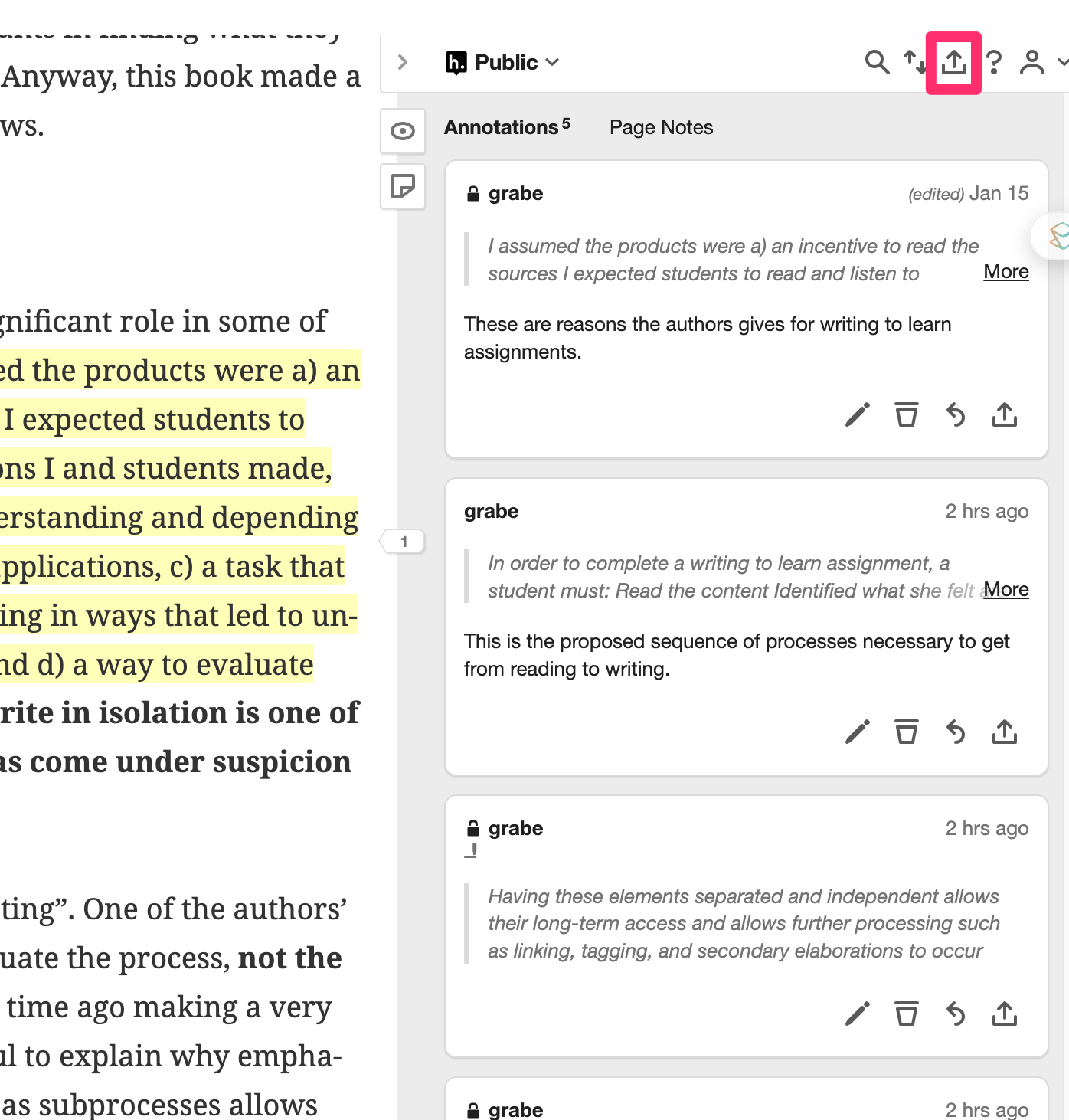
The following image displays the window with the Hypothes.is the extension activated? The left-hand column here, which is only shown partially, is the file of interest. The right-hand section displays the open Hypothes.is sidebar. Here you see at least a portion of each of the individual highlights and annotations. The full addition appears if you select one of the individual entries in this column.
The procedure I want to emphasize is how to export your highlights and notes. I have identified the key “button” in red.
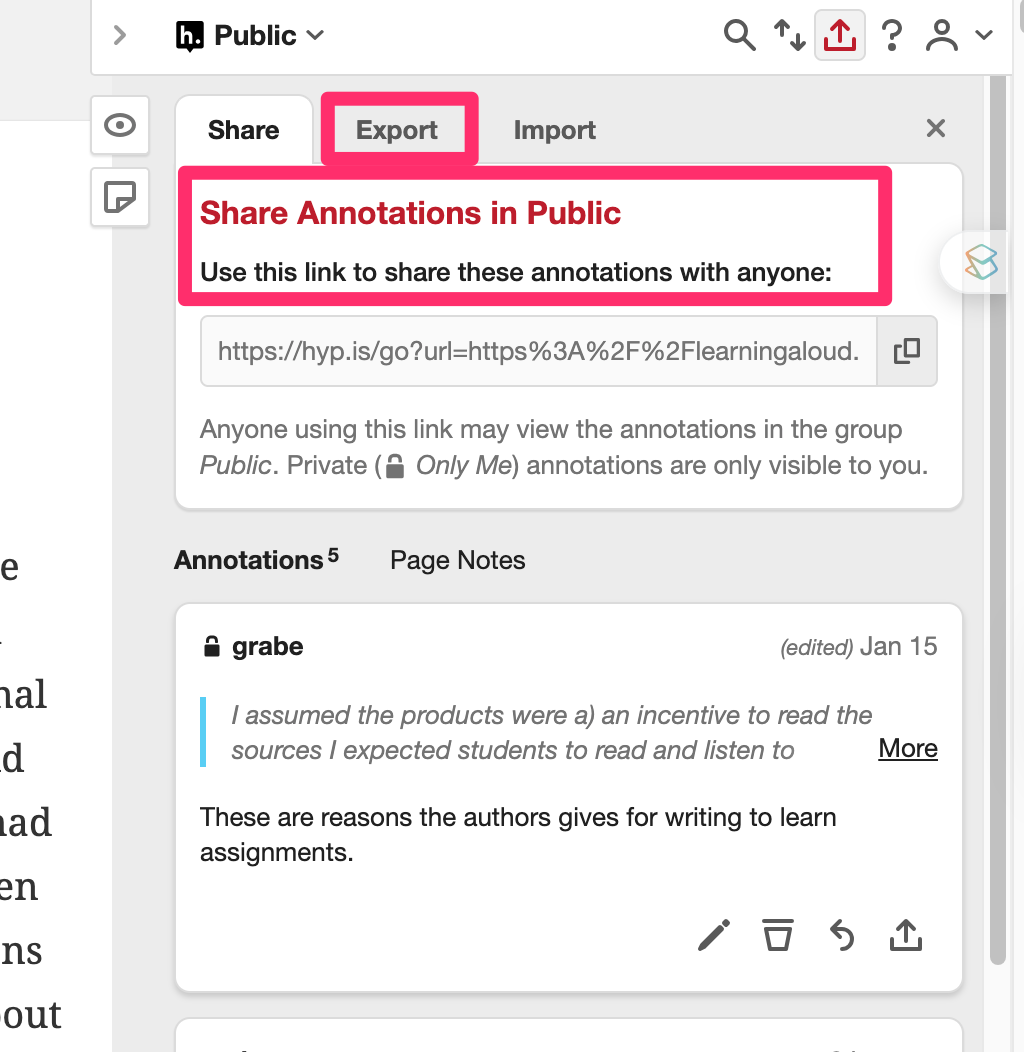
The button I mentioned opens up the following dropdown. Here you should find the button to export the entries containing highlights and annotations. Also, the link that allows public access to highlights and annotations. A similar link is provided if you set Public to a specific individual or designated group.
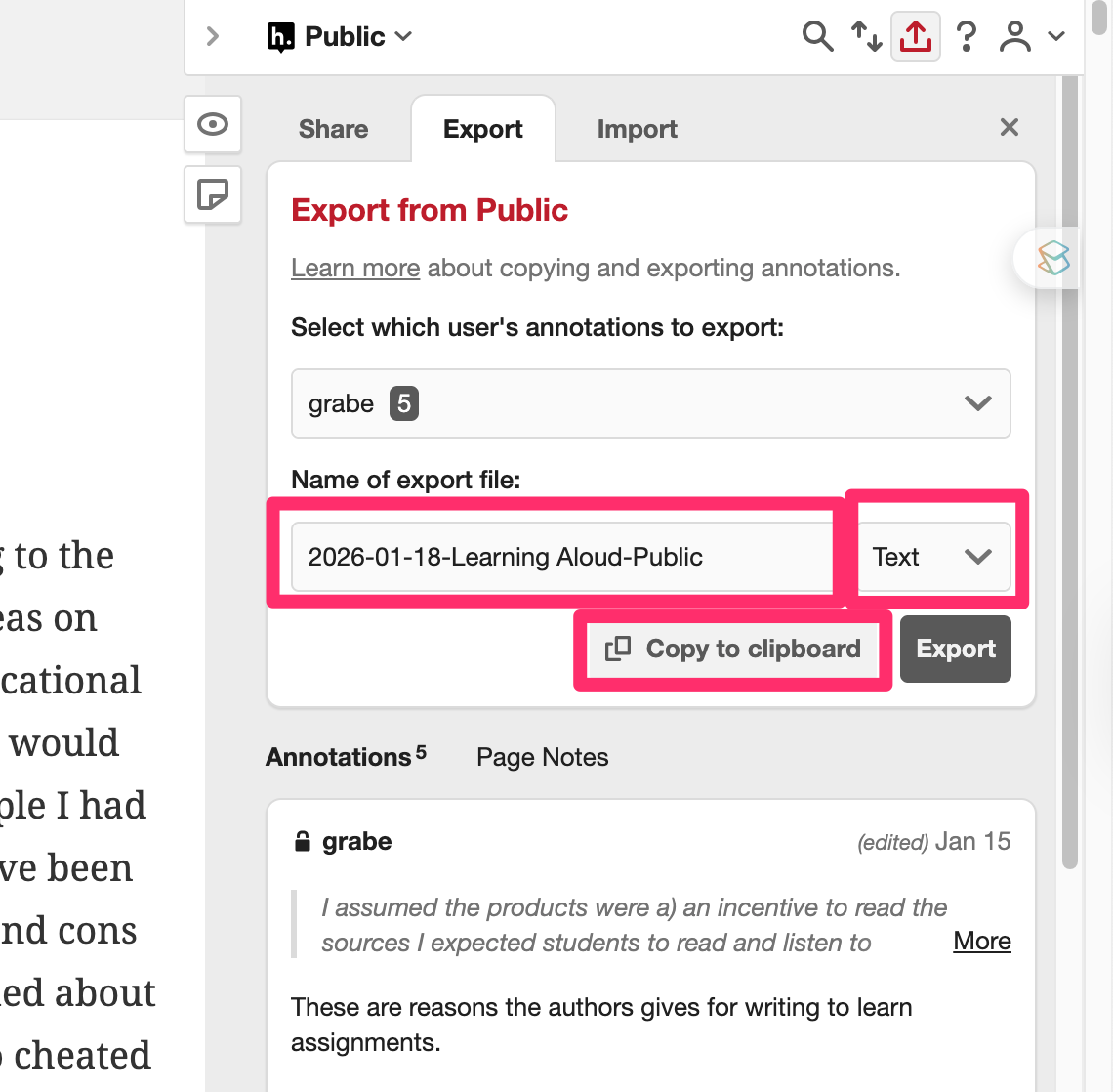
From this menu, you can assign a name to the output file (or leave as is), determine the format for this file (here set to text), and copy this content if you would rather copy and paste instead of outputting a file.
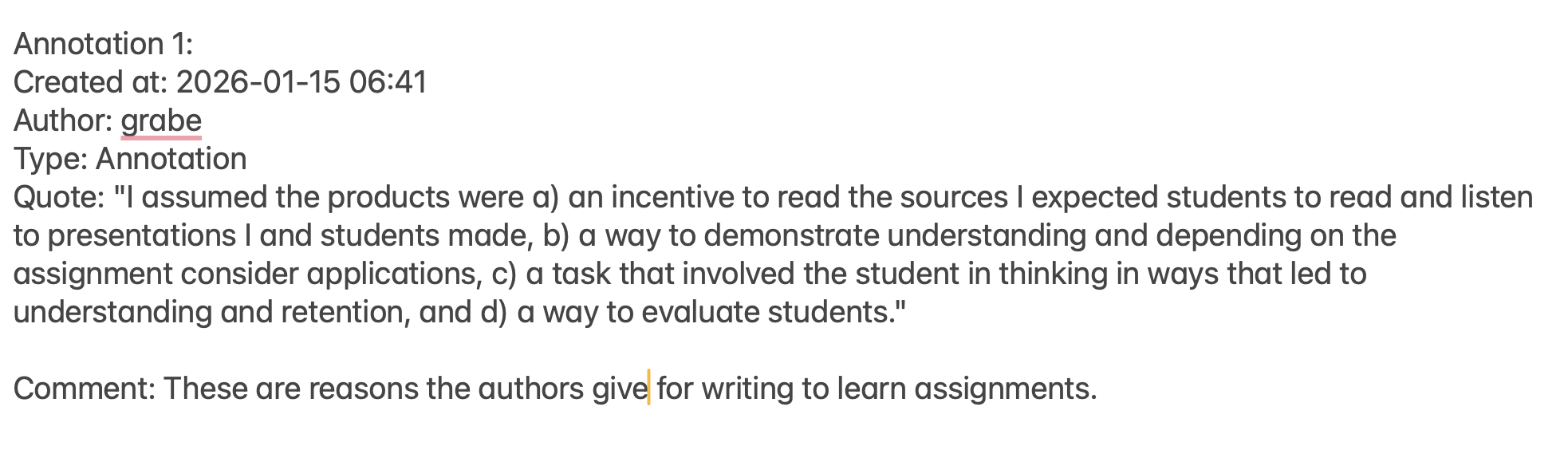
Finally, the following image shows the text content corresponding to the first highlight/annotation. Note that each of the additions to the content viewed through the browser is assigned a unique identifier. In this case, this is the first addition.
Use of this information as a process trail
I will work my way through the three processes I identified. First, the highlights and annotations stored demonstrate that the reader has worked her way through the document. Second, the reader has identified information she felt was either relevant to an assignment or important. The existence of the file or viewing the highlights and annotations in context as would be available via the unique link to provide access would demonstrate the effort in executing this process.
Finally, I think it makes sense for the writer to append individual content cut and pasted from the highlights and annotations file as endnotes to the written product. The unique identifier for each endnote could be attached to the section within the writing project where appropriate. The goal in this would be the same as any method for citing a source or sources. Here is the basis for this section of my paper. Here is how I have interpreted and integrated and applied this information. This final activity assures there was a connection between the annotations created and the written product.
Summary
This post explains how to deploy a three-stage process trail using Hypothes.is. This trail engages student in activities that externalize content identified by a reader as important or useful and then connects these elements to specific locations in the product written based on what students have been asked to read and understand or apply. The externalized content also verifies that the reader has executed this process rather than using AI to complete the assignment.
The intent here is not to discourage appropriate uses of AI. The intent to ensure the practice of key skills when practice of these skills is the goal of the assignment
Citation
Flower, L., & Hayes, J. R. (1981). A cognitive process theory of writing. College Composition & Communication, 32(4), 365-387.
Hayes, J. R. (2012). Modeling and Remodeling Writing. Written Communication, 29(3), 369-388. [https://doi.org/10.1177/0741088312451260](https://doi.org/10.1177/0741088312451260)

You must be logged in to post a comment.