
Most of what I write focuses on the impact of technology, with an emphasis on how it might be useful to educators and learners. While a blogger since 2002, I have recently begun searching the literature for research focused on what teachers do online and how they are impacted by these experiences. Researchers have a way of examining behavior and finding issues that may not occur to us and often a deeper perspective offers insights that may result in unexpected applications, in this case, for what I would call “professional benefit”. I will likely make an effort to provide an overview of teacher use in a future post, but I became fascinated by what I think best describes the passive/active dimension and how it relates to important issues identified in other contexts. For example, a “failure to measure up” issue has been identified in adolescent girls who are led to compare themselves to a false expectation of attractiveness by what they see online. There is an aspect of this in the research of the active/passive dimension of social media activity.
Recent research, particularly studies focusing on platforms like Instagram, suggests that the way teachers engage with social media—whether actively or passively—plays a significant role in determining whether the experience is a source of support or a driver of stress.
The Passive Trap: Information Seeking and Social Comparison
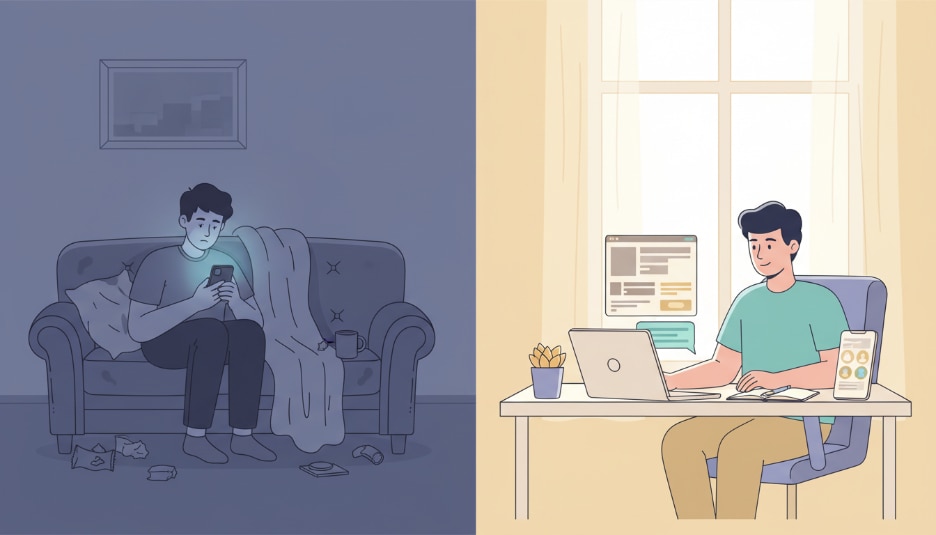
The most common way teachers use social media is passively. This involves “lurking” or scrolling through feeds to find inspiration, lesson ideas, or classroom management tips without directly interacting with others. I first noticed this differentiation as one end of a 3-category system – seeking information, sharing information, and co-creation – proposed by Richter and colleagues (2022). In a study by Meyer et al. (2025), a high proportion of teachers were identified as primarily passive users. I guess this doesn’t surprise me as I have always assumed educators in their professional role go online to search for ideas and learn how others get their work done.
While searching for information might seem productive, it often carries hidden psychological costs. Passive use is frequently linked to increased stress and decreased well-being. Passive scrolling exposes teachers to the “highlight reels” of their peers. When an educator who is struggling with a difficult class scrolls through images of perfectly organized, aesthetically pleasing classrooms on social media platforms like Instagram, it can trigger negative social comparisons. This effect can make one’s professional reality feel inadequate, leading to perceived stressors and professional burnout. This is what I meant earlier by a similar concern has been raised about the false impressions adolescent girls may form based on their social media experiences.
Thinking about passivity and psychological issues it seems that more would be involved than social comparison, and I will offer further comment on this at a later point. Sometimes, it seems a theoretical issue focuses researchers on a specific topic and the dependent measures they create focus on this topic possibly resulting in generalizations that are unwarranted.
The Active Advantage: Collaboration and Social Support
In contrast, active use, which includes sharing original content, commenting on others’ posts, and co-creating resources, seems to have a more positive impact. Active engagement transforms social media from a one-way mirror into a platform for teacher collaboration.
When teachers participate in active communities, they gain access to “digital social support.” This isn’t just about getting new ideas it’s about the emotional and professional validation that comes from interacting with a “more capable other” or a peer who understands the unique challenges of the classroom.
Active participation in professional learning networks (PLNs) allows teachers to move from “knowledge telling” to “knowledge building”. Interacting offers the opportunity to engage in what I refer to as generative, effective, and increasing personal thinking about a topic in the give-and-take with others. There is also a positive social benefit in feeling connected to others who share similar work experiences.
Again, as previously mentioned (Meyer, et al., 2025), efforts to quantify teacher online activity, more active involvement occurs at a much lower rate than passive involvement.
The “Messy” Reality of the Active/Passive Theory
While the theoretical distinction suggests that “active is good and passive is bad,” the reality is often more complex. A critical meta-analysis of studies by Valkenburg et al. (2022) found only weak support for this binary perspective. These researchers investigated this idea across multiple areas of interest, not just education. They argue that the impact of social media is “messy” and depends heavily on individual differences and the specific context of use.
For instance, a teacher might start with passive information-seeking (searching for a specific topic) and then transition to an active discussion. The key variable may not be the activity itself, but the intent behind it. Is the teacher using the platform to solve a specific problem, or as a mindless escape that leads to comparison? After reading these papers, it also seems that negative affect has multiple dimensions, which researchers have attempted to operationalize in their studies, making study-to-study comparisons difficult.
These researchers raise an additional topic that I think very important when investigating topics of this general type. Nearly all studies are correlational – variables are related as they occur naturally and are not investigated in a way that would involve manipulation. Hence, cause and effect is always an issue. This applies to nearly all of the research on the negative impact of social media. Is it that increased use of social media leads to negative psychological outcomes or that those with psychological issues are more likely to engage in greater use of social media. The researchers just mentioned did identify nearly all studies as cross-sectional rather than longitudinal. Longitudinal studies would measure the same individuals at different points in time, allowing the study of trends in the proposed dependent variables. The few longitudinal studies available showed weak or no relationships between social media and the psychological variables examined.
Navigating the Digital Staffroom
To maximize the benefits of social media while protecting their mental health, teachers should consider the following strategies:
- Audit Your Feed: Be mindful of how certain accounts make you feel. If “perfect” classroom accounts are causing stress rather than inspiration, it may be time to unfollow. Make an effort to engage with some tools that allow interaction.
- Move Toward Interaction: Try to shift from just scrolling to participating. Leaving a thoughtful comment or sharing a “real-life” classroom struggle can foster the social support that mitigates stress.
- Set Boundaries: As noted in research on problematic smartphone use, the constant “on-call” nature of digital platforms can lead to anxiety. I find in this time of great political controversy, I must set aside a fixed amount of time for my Facebook activity because although I am active, too much of the interaction is negative.
In conclusion, social media is a powerful tool that can either drain a teacher’s energy or refill their professional cup. By recognizing the pitfalls of passive comparison and leaning into the strengths of active collaboration, educators can ensure that their digital lives support, rather than undermine, their vital work in the classroom. Perhaps just having the issues raised here identified will lead to greater self-reflection and useful insights.
Sources
Meyer, A., Richter, E., Carpenter, J. P., Richter, D., & Kempert, S. (2025). Teachers’ perceived stressors and stress from Instagram use. Journal of Research on Technology in Education, 1-19.
Richter, E., Carpenter, J. P., Meyer, A., & Richter, D. (2022). Instagram as a platform for teacher collaboration and digital social support. Computers & education, 190, 1-15.
Valkenburg, P. M., van Driel, I. I., & Beyens, I. (2022). The associations of active and passive social media use with well-being: A critical scoping review. New media & society, 24(2), 530-549.

You must be logged in to post a comment.