This is a quick tutorial intended for a specific group. You are in this group if you listen to podcasts and want to recommend a specific segment of a podcast for others. For example, I listen to TWIT (this week in tech) and TWIG (this week in Google). There are often segments of these general technology podcasts that may be of interest to educators who would not typically listen to the entire episodes which are often more than two hours long. They might be willing to listen to a specific 10 minute segment if I could make access easy.
Pocket Casts is an app for listening to podcasts. It does cost a few bucks, but for those who love podcasts it has features that are worth the money. There is the sleep timer feature (not explained here) that allows the user to set the duration of a podcast you want to hear. When available, I love this feature in any audio app I use. I like to listen to audio before I go to sleep and the feature allows me to set a timer that will end the audio after a designated amount of time. It prevents the audio from running when I might have drifted off so I can easily start the audio at the designated point for the next listen.
What I want to explain here is the capacity to share the start of a specific segment from within a podcast to make listening easier for others.
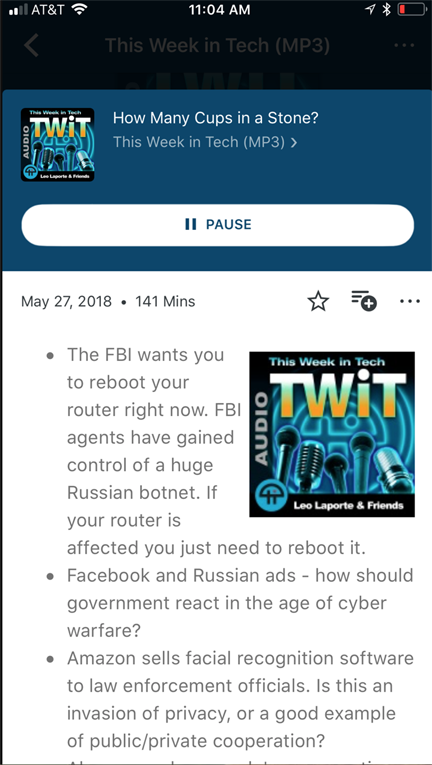
The following would be the Pocket Cast screen on an iPhone.
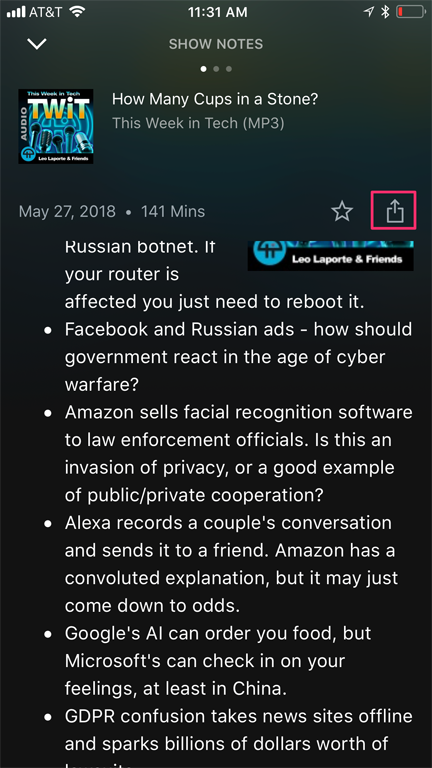
When you get to the segment you want to share, you pause the podcast and swipe right. This will bring about the program notes screen. On this screen, you use the share icon (see red box below) to open the share menu. [this is the procedure on an iPhone]
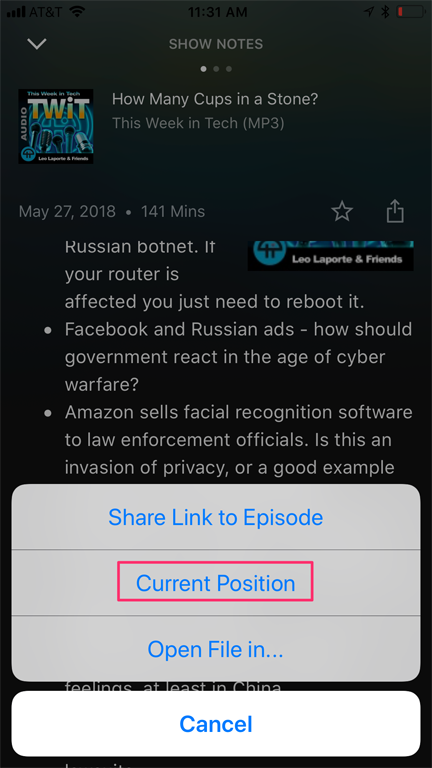
The share menu offers the options of sharing the episode OR share beginning at a specific point. I then send the link provided to myself and typically embed this link in a blog post.
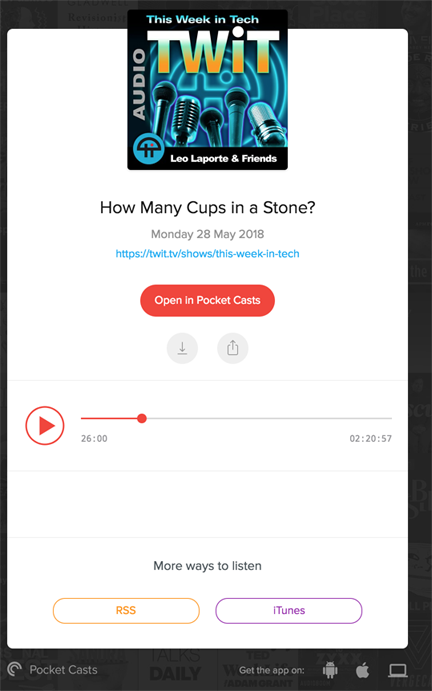
The link would look something like what you see below. The following link should be active.
There is no doubt higher education is changing. At first, I thought my experience in North Dakota was due to the downturn in the energy sector which in combination with the reluctance of Republican state legislatures to adjust taxes to compensate resulted in serious multi-year cuts to support for state institutions. I am retired, but the adjustments and my old institution seem to be contributing to a downward spiral. While what I have experienced and observed is partly attributable to local decisions, the general scenario seems more general.
In the spring of 2013, there were 19,105,651 students enrolled in higher ed; this spring, there were 17,839,330 …
and enrollment declines seem to be producing
the decline of research faculty, increased workloads, and more rapid adjunctification. And given how colleges have treated adjunct faculty, Alexander says, “it would be a humanitarian disaster”—one of higher education’s own doing. “We’ve done it to ourselves with open eyes since the 1990s. And we know about it, it’s kind of an open secret,” he says. “The Research I universities keep pumping out Ph.D.s, and they haven’t slowed down at all. And they know exactly what that means, you know, that the majority of these Ph.D.s are either going to leave academia or end up.
There are so many interrelated factors here. Universities have complex missions that include research. Doing research successfully results in the opportunity to compete for external funding (grants) which are part of the funding model for these institutions. To do research requires more human work than can be provided by faculty members and this is one of the reasons for training PhDs. When you get down to it, grad students are cheap labor for research and teaching. They work for such low wages because they eventually hope to secure a faculty position themselves. The development period is lengthy. Most grad students understand the risk of the investment they are making. Most folks who view higher education without understanding the realities have little idea of the risks and competitive environment that are the reality. It is more of an “if you think you are good enough, put in your time and find out” thing than most appreciate.
What I have just described is only part of the complex model. Of course, research addresses other goals besides raising money. It is part of the educational process – you learn about several disciplines by participating in the work of that discipline. The image of all learning taking place in large lecture halls is terribly uninformed. The primary reason for the research and creative scholarship is to move knowledge forward. Research done at universities address many areas that would be ignored if society had to depend on the R&D of business and industry.
If higher education is too expensive, all parties involved are responsible. Taxpayers are paying less and less of higher ed costs. Students want things in their “experience” that are unnecessary to learning, but institutions feel they must these opportunities to compete for these students. Living facilities and dining halls are impressive. Fitness centers are better than most of us have access to in our communities. Athletic facilities and teams are somehow tied in as part of the “quality” of the institutions students want to attend. Administrations become bloated relative to the size of the teaching/research faculty to provide the services, infrastructure, marketing, and student services that are expected.
As I look at the experience, I am not convinced that higher education is too pricey. It is not as efficient as it might be, but this is part of what is required to compete for the multiple sources of financing that are required. You want a world-class hockey program capable of winning multiple national championships and producing numbers of NHL players and Olympic champions in a state with the population of Omaha, you need a 120 million + stadium, high salary coaches, and a very, very large travel budget. Is this necessary? In North Dakota, this is part of the “experience” and a reason many alumni continue to support the institution.
Universities are far more than advanced versions of high schools (I guess even high schools have athletic teams). The missions are far more complex, but also interrelated. Focusing on any single strand of this complexity – the cost of textbooks, the large lecture experience, the time faculty spend doing research, the athletic programs, the full-service buffet meal services, etc. – misses the point. The combination is a pretty good deal.
Posted inUncategorized|Comments Off on Higher ed bubble
Trying to get a big company that relies on algorithms to understand a special case that their algorithms do not handle appropriately can be a real challenge. We have just refreshed our textbook (Integrating technology for meaningful learning) that is available from Amazon. No problem. The algorithms are prepared for modifications to an existing Kindle book.
After submitting the revised manuscript, an Amazon algorithm contacts me suggesting I also offer the book in paperback. I have not done this before because I believe in the advantages of an ebook (external links, user annotation, etc.), but it sounded easy so I decided to give it a try. It is not as easy as they make it sound. The ms. has to be reformatted and I admit a book written to be an ebook should probably be completely redone, but I thought I would give it a try. Perhaps some learners would rather hold a physical book in their hands.
The $9 ebook is being developed as a $12 paperback. This is not a good deal for the author. As the author, you pay for the “book at a time” printing cost. Printing and the 40% of the top that goes to Amazon leaves me with a $.79 profit per book. The profit on a $9 ebook is 70% minus a small charge for the online transfer. As an experiment, I am still willing to give it a try.
My latest problem is trying to work through an issue with the ISBN. Amazon provides a convenient way to assign an ISBN to their paperbacks. When I first wrote the ebook version of our textbook, I filed the paperwork and paid the small fee to get an ISBN. The Amazon algorithm informs me that these two ISBN as not the same and this difference must be fixed. I can’t really change the ISBN I secured for the ebook so I try assigning this to the paperback. This generated the same response from the algorithm. This makes no sense to me.
I have since noticed another issue. When Amazon lists my Kindle book, the ad indicates there is an existing paperback version available. This surprised me since I had just tried to create such a product. Using the link revealed it led to the last version of the book I published with Cengage. This edition was first available 6 years ago, the content has been revised twice since, and we negotiated the rights to our copyright when we could no longer agree on the format for our work with Cengage. It is possible the ISBN problem is the lack of agreement between the new paperback and the last version published through Cengage.
This mess is going to require a human to fix and getting Amazon to understand this seems an issue. There is a way to submit a request so we will see.
The new and improved ebook version is available. Buy it – I make far more than the more expensive paper version (in pennies) and the ebook version requires those interested in learning with technology to learn with technology.
Posted inUncategorized|Comments Off on Amazon algorithms
School administrations wanting to understand the pro-computer science position in K12 position might find this recent Google sponsored analysis of value.
Blikstein, P. (2018). Pre-College Computer Science Education : A Survey of the Field, 45. Retrieved from https://goo.gl/gmS1Vm.
Posted inUncategorized|Taggedcoding|Comments Off on Google sponsored CS education analysis
I read a lot about professional development. What is wrong with the way it is done? Why educators don’t find it to be of much personal value. Etc.
Here is an idea that came to me based on the opportunity for educator personalization, cost-effectiveness, and depth of information. This plan would not cover all areas of need, but I believe it would be beneficial in reaction to many of the complaints I have heard. To be honest, I think I read about some school somewhere doing something like this. I am afraid at the time I did not pay much attention and failed to identify the source. Most of the ideas here are my own.
I propose that administrators offer educators funding to read Kindle books this summer. The number I have in mind would be 10, but 5 would also be beneficial. Based on my own heavy use of Kindle books, I estimate the cost would be $120 to $150 per educator. As a comparison, I estimate a trip to the ISTE conference in Chicago this summer would cost me $2000 0r so and I doubt I would get as much out of the conference as reading 10 appropriate books.
I would match the funding for Kindle books with the expectation that each educator author multiple tweets related to each book read. These tweets might be tagged with a school identifier (#myschool). This would offer some limited information to other educators who might find a useful book to add to their own request list. I suppose the tweets would also verify that the reader had spent time with the purchased books. The Kindle app offers a nice feature that allows the tweeting of a short segment of text underlined from the book and whatever additional personal comment can be included in the tweet. Clicking on the link in the tweet produces an image, the underlined segment, and a link to the Amazon store allowing access to the book. (see below).
The more I think about this idea the more I think it would offer an opportunity for ebook publishers (ibooks, kindle books). Perhaps there could be some bulk plan made available to schools willing to meet a certain level of use – say 25, 5 book packages at $40 each. I have no idea such an idea might reach the ear of an Amazon or Apple executive.
Posted inUncategorized|Taggedkindle|Comments Off on My Kindle summer PD suggestion
Facebook is so popular that most users continue posting and visiting the site despite all that is known about the collection and sharing of information about personal online behavior. I guess I fall into this category of frustrated, but continuing users. I have made an effort to understand the privacy issues involved and what I can do to limit the damage. Online services argue they collect your personal information to improve your experience as a user. There is a degree of credibility in this claim. For example, if I receive ads I would rather the ads concern services and products I am interested in rather than random promotions. If I use a service to discover information, I would prefer that the information promoted for my consideration be something I might possibly find interesting. In addition, I appreciate that I am receiving a free service from these companies and recognize I must offer something in return.
Of the various things that concern me, I think one service with a specific focus (e.g., search, sharing with friends) using information collected about me from sites with different foci go too far. I don’t want other social services I use following my Facebook activity. A chrome extension – Disconnect Facebook 2016 – allows me this control. I can use Facebook to do what I want and not have this activity shared. When installed, an icon will appear in the browser icon bar allowing the isolation provided by the extension to be turned off and on (the color changes to indicate the present setting – red means sharing is being blocked).
I have used this service now for several weeks and I have experienced no problems. I have to trust that it is working as advertised.
We use cookies to ensure that we give you the best experience on our website. If you continue to use this site we will assume that you are happy with it.
You can revoke your consent any time using the Revoke consent button.




You must be logged in to post a comment.