Our effort to improve information literacy is far from adequate. The typical present perspective ignores significant factors that limit our efforts. Educators must get beyond believing media literacy is simply a function of effective critical thinking.
I think that educators interested in this issue will find this presentation by danah boyd as very informative. Skip approximately the first 10 minutes to get to the presentation.
Posted inUncategorized|Comments Off on Information literacy requires more than critical thinking
Every few months, I do Google Scholar searches to see if anyone has published research studies focused on Twitter chats. I am looking for someone who has come up with a way to track the quality of interaction or the value of the content that has been shared.
My opinion of twitter chats has not changed. I take a look at a couple of chats now and then to see what I think. I find it hard to believe there is much learning going on. Perhaps socialization and morale building, but little information shared or issues debated. I thought with the increase in length of tweets that is now allowed there might be more actually happening. The brief comments that could be exchanged was one of my original complaints. More can now be conveyed with a single tweet, but I seldom observe that this extra space is being used.
When I search for published material on Twitter chats, I find plenty of explanations for how to conduct a Twitter chat. I find a few suggestions for how to make chats more productive. I find proposals that chats can fill many specific needs. I just don’t find anyone analyzing what goes on during a chat (process variables) or what changes as a consequence (product variables).
I did locate a paper noting that Twitter chats could be used to support the needs of medical professionals and proposing possible benefits and concerns. My hope has been that researchers would take these potential benefits and concerns, operationalize these possibilities in ways that would be easy to identify, and see what actually happens before, during, and after chats.
Choo, E. K., Ranney, M. L., Chan, T. M., Trueger, N. S., Walsh, A. E., Tegtmeyer, K., … & Carroll, C. L. (2015). Twitter as a tool for communication and knowledge exchange in academic medicine: a guide for skeptics and novices. Medical teacher, 37(5), 411-416.
I keep suggesting that education graduate students take on this type of research. I keep thinking that some useful data should be easy to collect. Chats are often archived and available. There would be some questions best answered by observing chats in real time, but some basic quantitative information should be easy to generate by using archived data.
If this makes little sense, consider that coding systems for classroom interaction have been used for years (e.g., Flanders; Brophy & Good). Consider that Choo, et al. suggest that professionals can benefit from chats by sharing suggestions for practice, identify useful resources that may be unfamiliar to others, request tactics for dealing with an unfamiliar challenge, etc. It should be relatively easy to determine how frequently these things happen within a designated unit of chat time.
Measures of interaction were a major emphasis of the observation systems developed to study classroom interactions. Similar issues are relevant for Twitter chats. What is the frequency of questions asked beyond the standard questions provided to promote chat responses (is there much interaction)? What is the frequency of statements of support, challenges to comments made, requests for clarification?
Perhaps factors might be related to these variables. Have these variables changed when chats before and after the extended format are compared? Do groups selected at random and sampled multiple times have different cultures reflected in this type of variable? Does the use of an announced reading assignment result in different types of interaction than topical chats not involving preparation?
Why are these and related questions worth investigating? I think it is important to determine if the time expended is productive. Should this time be credited as professional development if the benefits are questionable?
Posted inUncategorized|Taggedtwitter|Comments Off on Ed Tech graduate students – someone do a content analysis of Twitter Chats
I struggle with what to recommend when it comes to encouraging social media users to escape the filter bubble. Facebook especially uses your own history of shares and likes to send them more of what they prefer. This may be satisfying, but not a way to consider arguments or expand a personal perspective. I know I will not convince anyone to abandon Facebook, I cannot do this myself. What I will recommend is that individuals recognize this challenge and find ways to compensate.
What I propose is that social media users discover RSS. My recommendation, which I describe below, is much easier to master than earlier approaches to RSS. Find individuals you respect and follow what they write.
Posted inUncategorized|Comments Off on RSS refresher
As you probably heard, we recently announced updates to the YouTube Partner Program (YPP). We made these changes to address a spike in abuse on YouTube by bad actors like spammers, impersonators, and re-uploaders. Our goal is to ensure a healthy ecosystem where original creators can grow and thrive.
As of today, your channel, Mark Grabe will no longer have access to monetization tools associated with YPP because it doesn’t meet the new threshold of 4,000 hours of watch time within the past 12 months and 1,000 subscribers.
I just received this notification from Google. While my videos are still available, I can no longer count on the $2 of income per month I was raking in. Google began increasing the requirements to be received some months ago. I did make the first cut, but I have no hope of meeting these new expectations. The most challenging requirements is the number of subscribers. I create tutorials from time to time on ed tech topics and tools. I do not generate a constant flow of programming that would likely attract subscribers. My hits come from YouTube recommendations and the embeds I add to my permanent online tutorials. If you are unfamiliar with how youtube works, embeds do not generate income.
I suppose I should be satisfied hosts my content. I am not. I could add the same videos to the server I rent without an increased charge. This approach would probably reduce access to the users of my tutorials, but I would not be paying anymore to make the video available. Google now benefits from my content, but the few cents I would be compensated are no longer shared. So much for the power of the long tail.
BTW – I am not a spammer, impersonator, or reuploader. I would think Google could tell the difference. I think this is more an indication google doesn’t want to bother with small producers.
Posted inUncategorized|Taggedgoogle|Comments Off on Ouch – abandoned by Google
I am exploring whether or not I can do my work without a laptop. I am spending a good part of the winter in Kauai. My MacBook Pro has stopped starting or at least I cannot keep it going for very long. It also tries starting on its own, repeatedly and in the middle of the night. This is very weird, but it has been reported by others. I have my iPad Pro with me, but the keyboard does not work. I have not bothered to take the iPad in because I seldom write long pieces on the iPad.
I have a camera that has WiFi so I have figuired how to get individual photos off the camera. This is not an easy process, but I can at least post a few Hawaii photos. Using Blogger is an issue if you want to include an image, because Google discontinued its own app and blocked several others that used to work. I finally found an app Google seems to accept. Reading research PDFs is a problem. I have yet to determine how to download journal article pdfs to EndNote or Mendeley. This is easy if you first add from a computer, but not easy from a mobile device.
I also have no alternative for Dreamweaver do the web site will have to remain as it is for a month. I understand starting from scratch some of these issues would not require a computer, but switching after becoming dependent is very challenging.
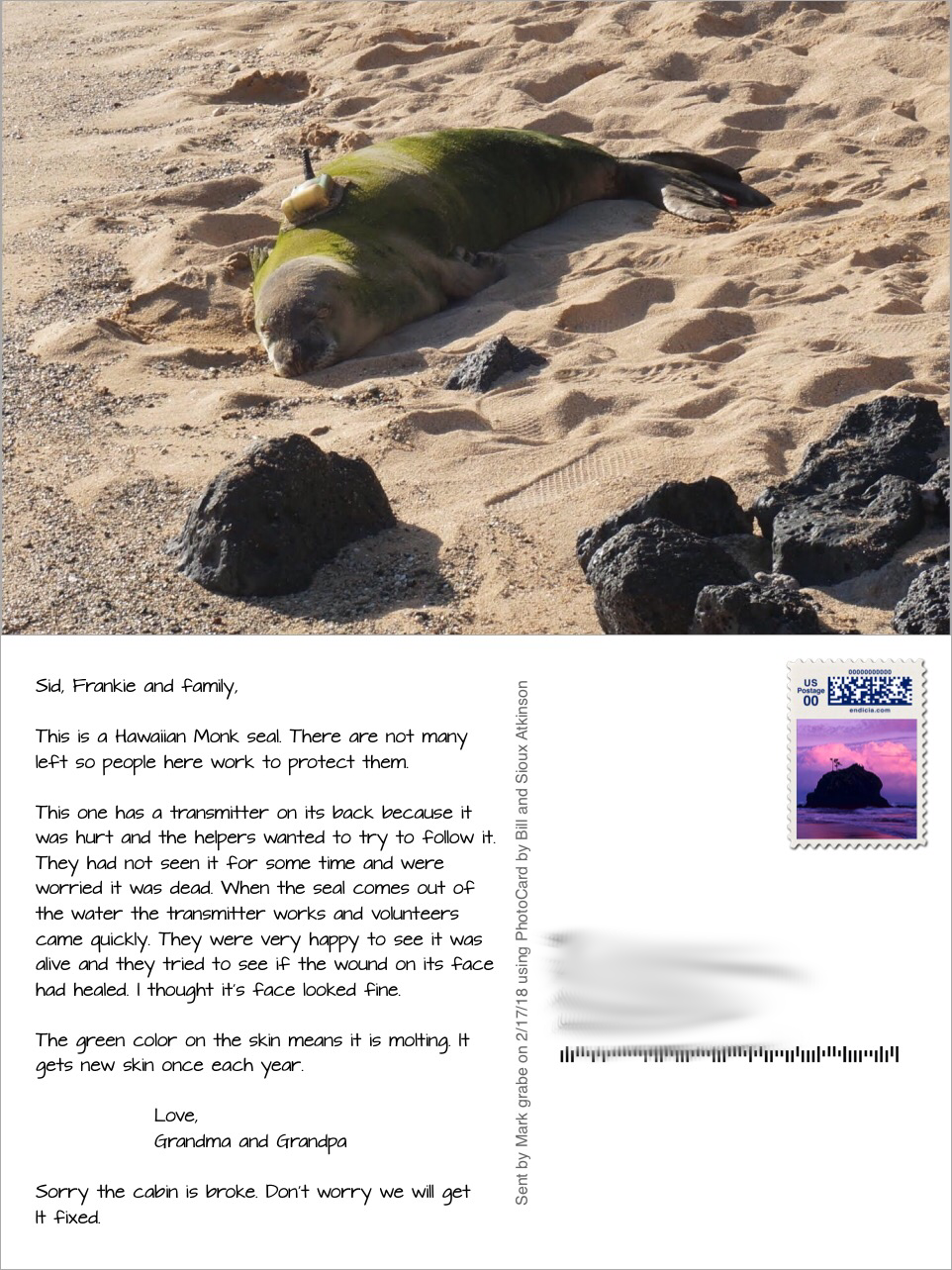
If you are an iPad user, take a look at Bill Atkinson’s PhotoCard. This app allows you to take an image from your photo collection, have it printed, and then mailed. The cost per card is inferior $2 and the results are spectacular. If you are cheap, you can send the cards by email, but this kind of subverts Atkinson’s mission which was to create more images in a physical form. Atkinson is concerned we are losing these physical artifacts and postcards are one way to preserve images with a message.
For those who may be unfamiliar, Atkinson is a legend in the Apple community working on MacPaint and HyperCard. Both were key products in the young personal computer industry.
Posted inUncategorized|Comments Off on Atkinson’s Photocard
We use cookies to ensure that we give you the best experience on our website. If you continue to use this site we will assume that you are happy with it.
You can revoke your consent any time using the Revoke consent button.


You must be logged in to post a comment.