I am a long time user of Flickr, but I have been cross-posting images to Google Photos. I am also starting to go through my old machines and storage media to find other photos I can load to Photos. I originally uploaded my best images to Flickr so there were many images available that had not been stored in the cloud. You get old and you begin thinking about passing photos on to friends and family.
Google Photos does not store images in the original quality as captured by a high-end camera unless you pay for storage. At this point, I do not. Photos has some other very interesting characteristics. It works on images you upload to offer you things you may not bother to explore on your own. It edits images in different ways. It combines sequences of images to create simple videos. It creates slideshows and photo books.
The feature that I find most fascinating is various ways in which I can search my thousands and thousands of photos. Traditionally search would require that I add tags to my own images. Some tags such as location might be added by a camera phone that stores such metadata. This is not how Photos works. It finds ways to identify the images and does a surprisingly good job.
I encourage you to create a corpus of images and try various searches yourself.
For example, I know I have an image of the arch from Saint Louis. As a demonstration, I asked Google for photos I had taken in Saint Louis. The arch was located even though this image was not tagged in any way. I remember taking this photo and thought there were other images I tool near the site of the arch. Sometimes such images would also be returned. Not in this case.
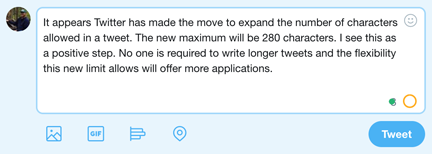
After a limited test, Twitter has decided to roll out the opportunity to expand tweets to 280 characters. This doubles the existing capacity. While some object based on their reluctance to read longer comments, I think this is a good thing.
I have been critical of a specific application of twitter – the twitter chat. A chat is a workaround attempting to use Twitter for synchronous chats. I have explained my issues in previous posts. After observing a significant number of such chats, I found them shallow. They just seemed unproductive for the time typically committed. This new capacity in combination with an adjustment in the number of questions could allow participants to craft more thoughtful contributions and engage with each other more frequently.
Posted inUncategorized|Comments Off on Twitter expands character limit
This is the time of year those of us in the northern U.S. take pictures of foliage. We taunt those in warmer parts of the company who are stuck with the same view all year. I guess they have their turn when the temps here head below 0.
The change in the color of leaves offers an opportunity to combine photography with a little science. What produces the different colors and why do different trees change in different ways? There is plenty of information online allowing educators to take advantage of this opportunity. I happened to encounter a relevant source offered through Newsela. The nice thing about Newsela is that same content is provided at multiple reading levels. You may find this link of some value.
Posted inUncategorized|Comments Off on Newsela explain fall leaf colors
I have not written about layering opportunities for some time. I just encountered a site focused on the use of layering tools in college classes – Annotation Tools. The site offers several different categories of information – tool descriptions, ideas for learning activities, and some research.
Posted inUncategorized|Taggedlayer|Comments Off on Annotation Tools – Resource for college instructors
In general, I am supportive of basing practice on research. However, when research is used to justify practices I disagree with, my first inclination is to examine the methodology of any research cited. Here is an example demonstrating my point.
Technology does not always demonstrate learning advantages and it can be fashionable to point this out. Two examples that occur to me involve the argued superiority of reading “paper” books and taking notes on “real paper”. I can argue the practical benefits of doing just the opposite, but my arguments rely on a broader perspective of why we read and take notes. The example I want to present here has more to do with traditional practice, but does focus on the quality of the research used to justify the traditional approach.
Here is an example of the use of research to justify traditional note taking. The example is focused on people in business taking notes, but I have seen the same research cited as guidance for note taking in academic situations. The study is cited so I read how it was conducted and I have the following reaction.
The study presented college students with TED talks to study and allowed students to use either paper and pen or computers to take notes. A test given 30 minutes later after a filled delay showed an advantage for taking notes on paper. I researched note-taking myself and I have a couple of reactions to the logic and the methodology.
My first issue involves the use of an immediate test (yes, there was a 30 minute filled delay). Note taking serves two potential benefits – active processing during the presentation and external storage. An immediate test without review is an evaluation of the active processing benefit of taking notes. Existing research shows that this is by far the weakest benefit of taking notes and for many taking no notes so that total attention can be paid to the presentation is the best approach. The major benefit of taking notes is to have a resource available for review (study). This may have been helpful even with a 30-minute delay, but it certainly would have been useful should the research have focused on the practical use of notes which typically involves delays of days and weeks. More complete notes are better with the delays typical of applied use of notes (see my final comments). It is quite possible there are competing possible benefits suited to different tactics – immediate testing would benefit from minimal focus on taking notes and delayed testing from more complete notes. Point 1 – the methodology does not allow a test of note taking that has much to say about real applications.
The issue of students using their technology to divert their attention to other things is certainly real. Having no access to technology would prevent this problem, but it is important to understand what the problem is. Any college instructor will tell you that taking notes on paper does to eliminate student access to technology. It is easy enough to watch this happen in pretty much any class. Again, the methodology does not match practice. Unless there is a strict “no technology” policy enforced, the use of paper for note taking really does not solve the distraction problem as students will simply pull out their cell phones.
I encourage learners to use technology for taking notes based on my reading of the research. I encourage them to use an application on a computer or tablet that simultaneously records the presentation (audio) and time-stamps notes taken to the audio. This may sound exotic, but there are many apps that do this and some are free. This approach allows for any active learning benefit of taking notes and provides an ideal record better suited to the major issue of quality external storage. When these notes are reviewed weeks later, if the notes are incomplete or confusing, the student can click on the text note to listen to the associated audio. This is very efficient and a far better solution to the real issue in using notes than would be available with notes recorded on paper.
I would argue my recommendation is more in keeping with the body of research on the multiple benefits of note-making, but also on a deeper understanding of how notes are used in practice.
Posted inUncategorized|Comments Off on Check the methodology
Access from home is still an educational issue for many. In those situations in which family income is the issue. EveryneOn.org may offer helpful suggestions. Enter a zip code and the site offers options.
We use cookies to ensure that we give you the best experience on our website. If you continue to use this site we will assume that you are happy with it.
You can revoke your consent any time using the Revoke consent button.





You must be logged in to post a comment.