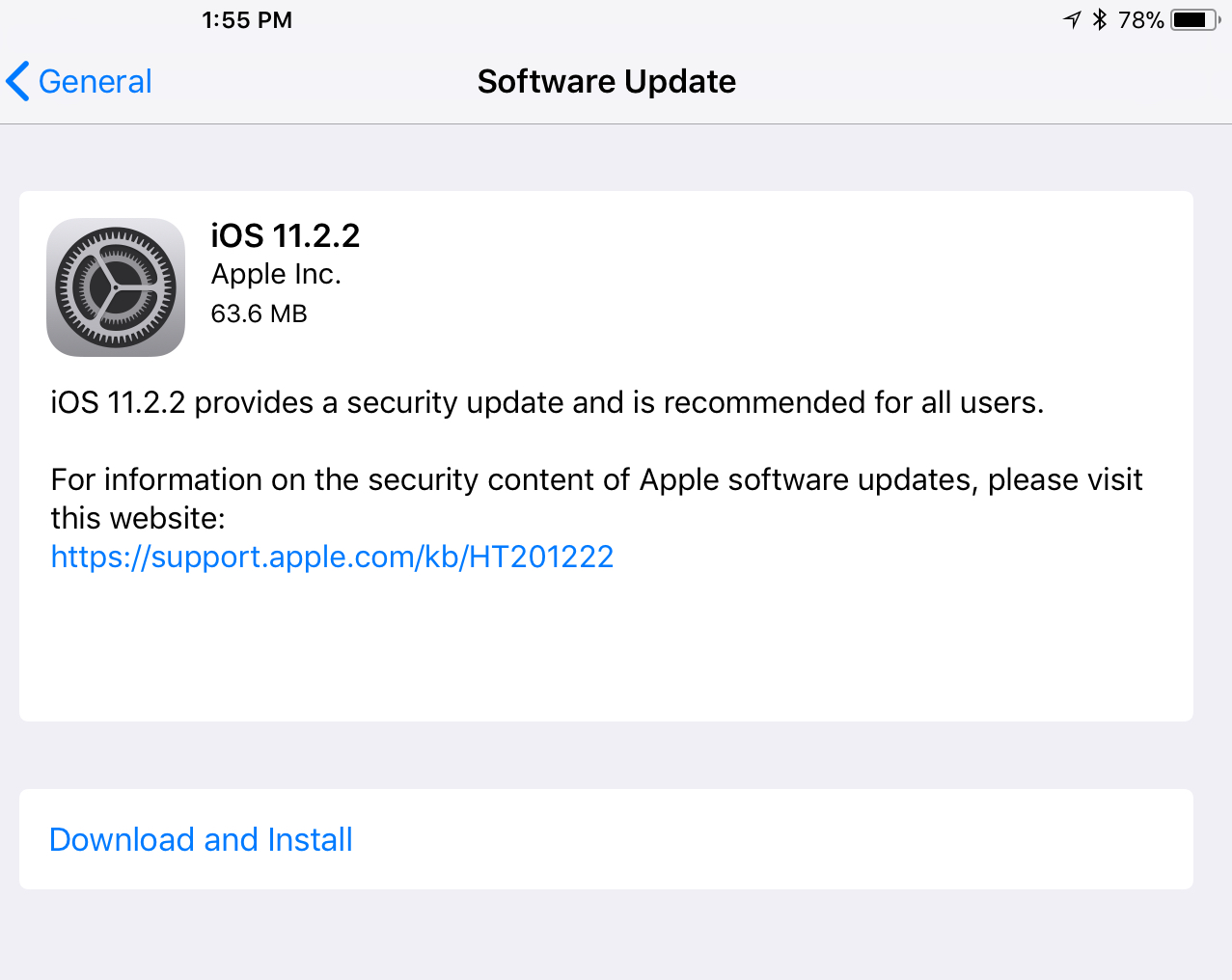
Apple has released a patch that addresses some of the CPU exploits making most tech devices vulnerable to data theft.

Apple has released a patch that addresses some of the CPU exploits making most tech devices vulnerable to data theft.
One of the most recent security flaws takes advantage of a CPU vulnerability. This means pretty much anything with a chip is potentially at risk. The vulnerabilities include the potential that passwords and other personal information can be stolen. Various hardware companies are working to push out patches and you may or may not have had the opportunity to make your equipment more secure as of this date. My impression is that most fixes have yet to appear.
Here is an explanation of the exploit provided by Google. I became aware of this problem when reading an expert explain that he felt compelled to block all ads even though he disagreed with the process of ad blocking because of the threat from this exploit.
You become vulnerable when using a browser online so modifications to browser software will likely be an initial response. Apple promises a patch to Safari that will soon be available (and may already be released). I am particularly concerned about chrome and the machines I use that run on the Chrome OS (see link to Google’s explanation above). My understanding is that this fix will be released in a week or so.
I did find an immediate adjustment you can make as a chrome browser user. I do not think it deals with all exploit related problems, but Google claims it deals with some. I have made this modification and I have noticed to problems (it is described as experimental). Note that the modification may seem unusual – you copy a line of code into the site address text window to execute, but it does work.
Older chrome devices may not be protected by the most immediate fixes that will be available and this may be an issue in settings (e.g. education) that keep equipment around for as long as possible.
This post generated by the Minnetonka Public School proposes that iPads offer a cost advantage in comparison to Chromebooks.
As of his most recent calculation, the total cost of deploying a five-year-old iPad 2 ends up being $0.38/day! Lower than their Chromebook counterparts.
….discovered that Chromebook’s lack of longevity and essential education tools makes them more expensive than iPad for their school district in the long run.
I must admit that I find this hard to believe having spent considerable time with both iPads and a quality Chromebook (first generation Google Chromebook). I like both devices, but for different reasons. The author claims that the lack of a keyboard was not an issue for students. This has not been my experience, but I write a lot. I purchased the iPad Pro with the keyboard which no longer works so my experience with a couple of machines has been very different.
The article does not break down the costs, but my guess is that cost issues have a great deal to do with how a district expects to use the devices.
only to find major limitations for the school district in the areas of educational apps, multimedia creation and editing tools, and even storage.
As a heavy Google user, I have never found storage an issue. I admit that multimedia creation is more challenging with a Chromebook. My personal preference for multimedia creation (with the exception of Explain Anything) is a conventional laptop. The price here for a Macbook Air would be comparable to my iPad Pro, but I guess the software would be a bit more expensive.
This post is an interesting cost analysis and it would be informative to have data from other districts with different instructional priorities.
I used the concept of naive science in my last post. I find this a very useful concept and thought I would try to explain just what this means and how I see it applying in the classroom.
 Naive science is a concept I became familiar with from the research on science education. Here is my understanding of what this means. The idea proposes that to function in daily life we must generate an understanding of daily experiences. These might be described as theories, models, principles or some such more familiar term. I like models. Unlike theories or models we might learn about in a more formal setting (school), we constantly generate our own models from daily experiences. The connection with science education is that these informal theories are often flawed because of misinterpretation, anecdotal data, or some other form of flawed reasoning. Educators face the challenge not only of teaching formal explanations for various phenomena, but also challenging the flawed models that many have built for themselves.
When I teach about naive science (and related concepts such as inert knowledge), I point students to the research, but also propose that we are also likely to generate our own personal theories about human behavior. I propose that is likely far easier to convince learners that formal models of physics or chemistry are superior to their preexisting ways of understand related phenomena than personal theories of human behavior. We just seem more comfortable with notions we have about human behavior because we see so much of it and we think we have insights into our own behavior than we probably have with the laws of motion, electricity, etc.
I do take liberties with naive science and propose that it fits other human limitations we now recognize as daily problems. I suggest we do not construct our models of the world completely on our own, but tend to be influenced by those we look to for support. This would seem to be consistent with notions of social constructivism. The problem, of course, is that it is very easy to look to others with similar world views making personal theories even more personally convincing.
What does the science ed research suggest is the solution? There is a tactic that is called conceptual change that proposes that to get a flawed model to change it works best to get an individual to apply this model to a real example and then demonstrate that the model does not work. The best example I can think of is to set up a simple electrical circuit with a light bulb and a battery and then have someone predict the reading with a meter on both sides of the bulb. Flawed models tend to see the current as something that is used up and to see it as water flowing in a pipe. These models kind of work, but are inaccurate. The meter will read the same on both sides of the bulb. Models of human behavior represent a far greater challenge as human behavior is far more complex than the simple properties of science concepts. Basic laws of human behavior, cognition, etc. exist, but can be modified by additional variables. It will always be possible to find anecdotal examples that fit a personal theory. This is pretty much why human research requires large sample sizes and methodological approaches (e.g., random assignment) to deal with variables that are not the focus of the research.
I was thinking about this issue today when Trump tweeted that the cold temps in the northeast should convince folks that global warming was not real. This may seem convincing, but it confuses climate and weather and offers a general, but flawed explanation of what global warming means.
I hope this explanation makes some sense. I have tried to avoid technical vocabulary and probably have played fast and loose with the deep meaning of these ideas, but I think I am close enough to present these ideas in a useful form. You can certainly explore naive science, conceptual change theory, and inert knowledge on your own.
My previous blog was meant as a caution to educators. I hope this post offers greater insight into why it is important to take this caution seriously.
The Internet comes with both dangers and opportunities. A major problem is the opportunity to align with a group taking a particular position supporting and strengthening erroneous personal biases. A personal bias is difficult to challenge, but a personal bias supported by a support group is particularly problematic.
I worry about this issue with educators. There are things about what some educators even describe as “finding their tribe” that I find particularly disturbing. The tribal mentality is a perfect environment for the type of bias sustaining environment I describe above. A component of some of the teacher tribes I observe is a kind of “teachers know best because teachers teach”. This perspective is sometimes encouraged by some ex-teachers who make their living writing, speaking, and providing in-service experiences. These folks tout their previous backgrounds as a source of credibility. I do recognize that educators may have insights focused on tactics they have found to be successful and that follow practitioners may not have considered. My concern is that personal experience can lead to what is called “naive science” when theories of how the world works are derived from personal experience. This term originated from the study of how learners understand scientific processes based on encountering these processes in daily life rather than through formal training. Just because you have a personal theory of how some aspect of the world works does not mean that this theory is valid.
What learning is and how learning happens are topics that people like me study for a living. These are not issues I try to understand as an individual, but as part of a community that investigates these phenomena from a research-based perspective. So, like climate change which can be associated with several perspectives, I can suggest that the preponderance of the evidence seems focused on specific conclusions. Getting from these models of learning to classroom implementation can be challenging, but some applications are simply inconsistent with what is suggested by the preponderance of the evidence. This does not mean that applications inconsistent with these findings will not work. Humans can processes pretty much any life experience to their benefit. What it means is that some applications will be far more successful than others.
So, depending on your tribe, you may be reluctant to hear that many project-based or problem-based learning experiences are relatively ineffective, but careful analyses indicates that this is the case. Perhaps some students will be motivated and benefit as a consequence, but some others will likely find many such experiences as busy work. When committed to a given personal theory, it is common to focus on the cases that suit this theory. Careful research commits to rigorous design methods to avoid such problems.
So, this is a suggestion that individuals recognize that their tribalism may encourage bias and promote the current shiny thing. In my opinion, researchers tend to police each other and demand that claims made be associated with data generated. This constant questioning may frustrate some who want simple answers, but over time, the demand for proof does reduce the biases that can creep in.
I follow the survey data from the PEW research center because the organization collects data on many issues I believe are important. PEW has just released a summary of the findings they thought were most striking from the surveys they conducted in 2017.
For example, they found that political party was far more influential in determining “political values” than other demographic variables (sex, income, education).

The surveys also indicated that Republicans felt that the news media was much less important as a political watch dog and that higher education was much less important in determining the success of the country.
I find these attitudes bizarre, but I suppose that is because I have more progressive political views.
You must be logged in to post a comment.