Andrew Keen has generated several books focused on the Internet (e.g., The Internet is Not the Answer) and seems to be saying that Internet companies operating in their own interest have to work against working in our best interests. They must find ways to attract our attention. The commitment of our attention is necessary for their success. When considering what can be done, he offers the following.
According to Harris, there are two critical strategies for fixing these problems. The first is for all of us to recognize that we are all vulnerable and for us to all “curate our own lives.”
And the second is for the platform companies to recognize that their users have “vulnerable minds” and for them to make a conscious effort to avoid feeding our “lizard brains,” Harris says.
Since the middle of the 2016 election season, I have fallen into the attention trap – I have started posting to Facebook. The way Facebook works is quite scary. It tends to tell us what we want to hear partly because of the individuals we friend AND it does not make clear what of the content we might see appears on our timeline. It is likely this combination influenced this election.
I have no easy technical solutions to offer, but I would make this logical suggestion. It amounts to accepting the lesser of two evils. If we can be misled by our own selection of biased sources and by the lack of awareness of the content Facebook selects to forward to us, it seems to me we would be better off at least eliminating the Facebook awareness issue. We would be somewhat better off limiting the problem to the personal willingness to select our content sources. We have abandoned what used to be the way to do this – RSS (my suggestion would be Feedly). This would seem similar to the proposed approach of curating your own life.
Posted inUncategorized|Comments Off on Limit the evils you are willing to embrace
I listen to Jeff Jarvis weekly because participates on a podcast we follow (This Week in Google – TWIG). He is a faculty member in the journalism school at the City University of New York. The YouTube presentation I link here is far more academic than his TWIG contributions, but his presentation of transitions in the media is quite interesting.
Posted inUncategorized|Comments Off on Facts, lies, propaganda, and fake news
The stock market hit another all time high this past week. President Trump’s claims this is a sign of his success. The statement reminds me of statements made about history – individuals experience history quite differently and the winners get to write the account of history. I stop short of accepting that Trump is a winner, but he is wealthy and the wealthy are certainly benefiting from present circumstances.
The impetus for this post was an article from the MIT Technology Review. Obviously, in addition to economics and politics, the article must have something to do with the role of technology and we all are influenced. This article is “heavy” and a challenging read, but it brings together the positions from several books I have been trying to understand (Thomas Piketty’s Capital in the Twenty-First Century and Erik Brynjolfsson and Andrew McAfees’ – The Second Machine Age). Both works present explanations for the widening income disparity in the U.S. and many other countries.
For example, consider the following statistics:
And the inequality has only gotten worse since the last recession ended: the top 1 percent captured 95 percent of income growth from 2009 to 2012, if capital gains are included.
This is the problem in using the present stock market as an indicator of success. Poor folks have very limited stock portfolios.
The article points to a barbell shaped labor market with declining opportunities for the middle class. There are plenty of opportunities for low paying jobs so there is little incentive to raise the salaries associated with these jobs. This particular barbell is quite misshapen and not symmetrical. Contrary to some who are beginning to doubt the value of a typical college education, there are still significant advantages for the well educated.
The gap between median earnings for people with a high school diploma and those with a college degree was $17,411 for men and $12,887 for women in 1979; by 2012 it had risen to $34,969 and $23,280.
Both books cited in this article question the view that the U.S. economy is driven by merit. Piketty blames the increasing disparity on held capital (often from inherited wealth) and Brynjolfsson insight and luck in taking advantage of technology (robotics, computer-supported efficiencies). Education alone will not sufficiently address the increasing disparity placing more and more resources at the disposal of the super rich – those capable of using their resources to increase and sustain their advantages through using wealth to manipulate political processes.
The article concludes that while not a total fix, finding ways to provide access to “high quality” education seems at least part of the solution. Presently, family income is one of the best predictors of access to the best institutions.
K-12 institutions also contribute to the increasing disparities:
Local governments, using property taxes, supply an average of 44 percent of the funding for elementary and secondary schools in the United States, helping to fuel the disparity in educational investments between poor and rich communities.
Despite the calls for local control, local input is also a major limitation.
I am not sure I or the authors make the case that education will be the solution to the increasing problem of inequities. I do not see this in the data and interpretations the economists provide. I do believe education is part of a solution, but educators cannot be oblivious to the larger context that probably only has a political solution. As part of the solution, I think it imperative that educators make it clear that they alone cannot address this problem.
As always, I encourage my readers to review the sources I identify. I am functioning at the limits of my background when it comes to issues of economics and political processes, but I believe it important to make the effort to understand.
Posted inUncategorized|Comments Off on Technology, education and income
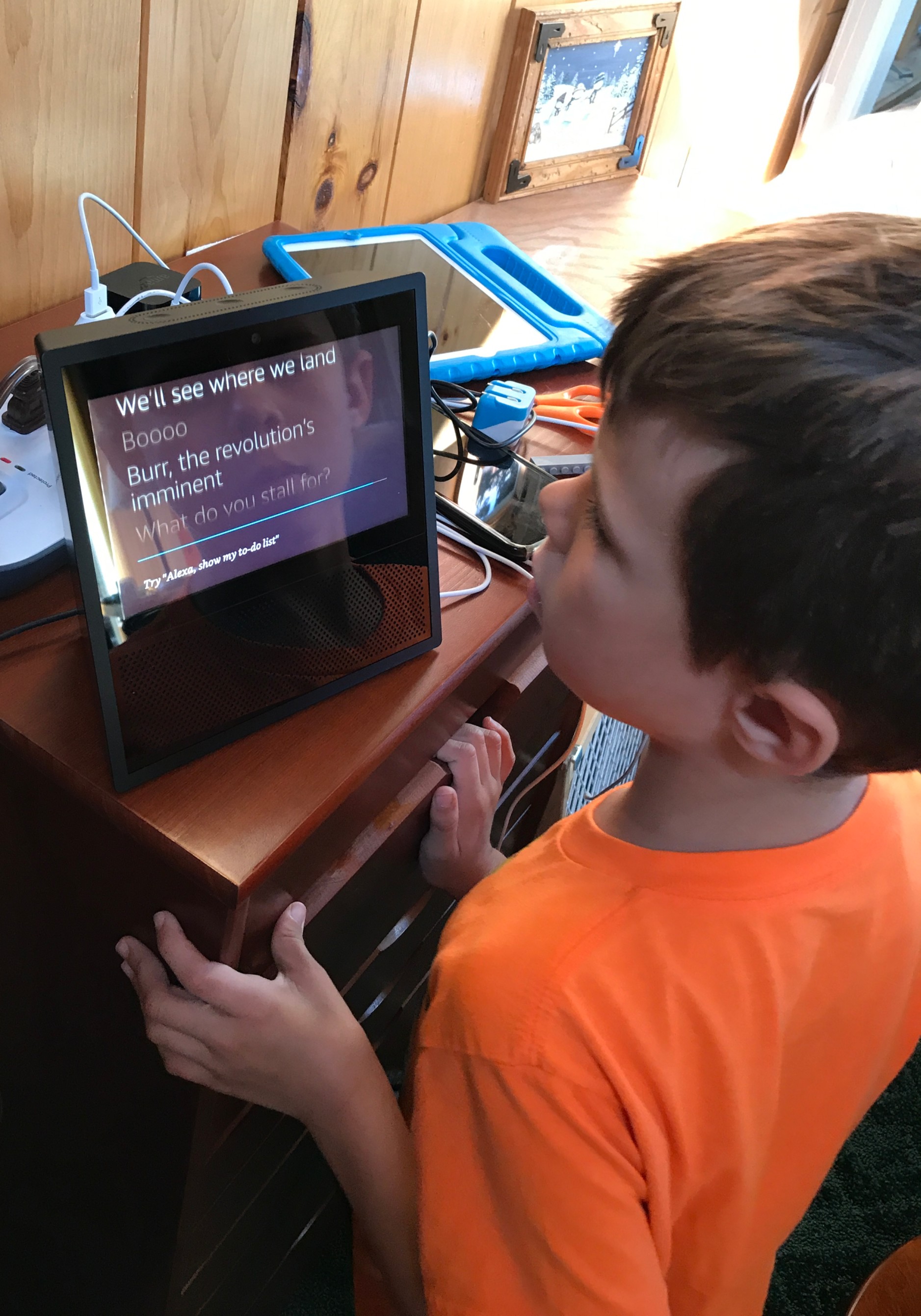
There must be an idea here. Reading along with the Hamilton soundtrack on the Amazon Show.
Cindy used to chart music from songs as a reading activity. This required a great deal of time. One way I like to think about the value of technology is that it often makes practical good ideas that have been around for some time.
I find the concept of teacher as instructional designer useful, particularly when it comes to converting online content into a learning resource. I was reviewing a blog post on this topic (Instructional Design Starter Pack) and reviewed the sources for understanding how people learn. Included was the resource by that name – How people learn – which I have read and recommend. I tried the link and it brought up a pdf. Free is good and this is a resource I recommend.
Posted inUncategorized|Taggeddesign|Comments Off on Access “How people learn”
I like question stems. Stems are helpful to educators as reminders of the different kinds of questions they might ask and stems can be offered to students as a way to help them generate ways to evaluate their understanding and strengthen retention. Locating collections of questions stems is easy using Google search, but I do collect collections designed for specific goals. Here is a collection focused on critical thinking.
We use cookies to ensure that we give you the best experience on our website. If you continue to use this site we will assume that you are happy with it.
You can revoke your consent any time using the Revoke consent button.


You must be logged in to post a comment.