Doug Johnson has been offering insightful blog posts for a while and I encourage your discovery of his blog (Blue Skunk – I have no idea what this means). His latest post includes an ed jargon bingo card that must have taken some time to generate. I would encourage those of you participating in edchats to apply this “gamification” activity to your next chat. I am guessing gamification had too many letters to fit into one of the bingo card boxes.
I have the same reaction to ed jargon as I do to Words with Friends (Scrabble). If you can’t use a word in a sentence, you shouldn’t be allowed to play that work on the board. If you can’t make your case in a blog post, you shouldn’t be allowed to use the word in a tweet.
Posted inUncategorized|Comments Off on Ed phrases for Twitter
So much has been written about the echo chamber effect with social media, I am not glad to see some social scientists collecting data to demonstrate the effect. I think demonstrating a methodology will be the first step in proposing and evaluating ways to change the problem.
This summary published in the Guardian describes a study following 2000 Twitter users who generated large numbers of political tweets and were identified by party (England).
A study of 2,000 Twitter users who publicly identified as either Labour, Tory, Ukip or SNP supporters has found they are far more likely to interact with others from the same party and to share articles from publications that match their views.
Ok, social psychologists and communications researchers get on this.
Posted inUncategorized|Comments Off on Twitter echo chamber
I just finished my second Kindle book and thought some might be interested in the experience of writing for Amazon rather than writing for a more traditional publisher. I have written books for both outlets.
I would suggest that from my perspective the most obvious difference is the prominence of the profit motive. When you write for a company, you must accept the reality that making money is what drives the decisions made. I do not mean this to sound crass because as an author writing for a publishing company you do need the company to stay in business. While obvious, as authors, my wife and I went through the company we wrote for (Houghton-Mifflin) being bought and sold several times. You want the company to have the resources to provide help (e.g., knowledgeable editors, lawyers, layout experts, a sales force). What you give up is control over taking the risks you are willing to take. The energy required to get your way is often more energy than you are willing to expend. You end up cutting content you thought was interesting and relevant because you are told that more pages mean a higher cost. You end up waiting until the edition has been approved to begin frantically writing again unless you want to work for free. You end up accepting that newer books in the same niche will be pushed by sales people because older books are available as used books and the company makes no money on used books – wait your turn.
So, we made the transition to writing for Amazon. We went from selling a book for $140 to selling an improved version for $9. We went from selling a book to selling a combination of a scaled down book and content available at no cost on the Internet. We went from all kinds of assistance to doing everything for ourselves. We went from making a reasonable return on the investment of our time to treating our writing as a hobby. Is the book we now write of the same quality? This depends on what you mean by quality. It is not as pretty because the Kindle format is quite restrictive. There are probably a few spelling and grammatical errors that may cause readers to question the writing skill of the author. Trust me what you read in the $140 version was a reflection of the same writing skill. I just had more help. The ideas are still original and are now less filtered.
I wrote the most recent offering because I wanted to write a resource I did not see as a textbook. Layering has a far narrower focus and is less self-absorbed in an effort to make certain no particular school of academic thought was upset by what I have to say. I pretty much explains how to do a specific thing (attach notes, questions, and other prompts to online content) and explains why I think doing these things benefits learners. You get my take on these issues for $3.
The challenge in writing this type of book for Kindle is that the traditional text-heavy Kindle approach is not suited to the inclusion of imagery. The type of book you read on the beach may be fine as a text-only effort, but a few images are helpful when it comes to explaining how to use technology tools. Kindle has created an “app for that”. They now offer a textbook creator that takes as an input a PDF file (sorry if this gets too geeky). What you get with pdf is the opportunity to fashion the appearance of each page. What you lose is the adaptability the Kindle apps normally provide in scaling the content to fit the app or the text size preferred by the reader. I think the new offering looks great on a computer or a chromebook. I am not certain I could read the pages on my black and white $79 Kindle reader.
I am getting to the point I am willing to make the argument that the limits of the present K12 education system have been reached. I say this considering the resources citizens of this country are willing to spend on education and an awareness of the variability along multiple dimensions that exist in classrooms. Those who promote innovation are typically focused on practices that amount to nibbling around the edges.
Here are some realities I accept:
Aptitude differences are real and result in differences in the speed of learning – time allowed is for all practical purposed fixed.
As a function of aptitude differences and factors both inside and outside of the classroom, the variability in what students knows grows year by year.
The variabilities in aptitude and background exceed what educators are capable of adddressing. This leads to frustration resulting from boredom and hopelessness. Frustration is one of several sources of motivational challenges that must be addressed.
Students need both a general education and the opportunity to pursue personal interests. The role of mandatory education is to assure a common knowledge/skill base. Complete student-centered learning is also foolish as both young and old appreciate the importance of a common knowledge base and can anticipate the needs of a future world.
Direct instruction and problemm-based learning opportunities each have important uses. The focus on one or the other because of turf wars miss the value of either efficient learning or learning to learn.
Technology must be part of the answer. Human resources are unable to meet the individual learner needs that are present.
What do I think should happen. I think public schools should take a more aggressive role in implementing blended learning. Allowing charter schools in this area immediately leads everyone into political controversy and poor sampling that allows flawed evaluation. I would think larger districts should be able to apply blended models in elementary classrooms and alternate middle courses of core areas (math, composition). I think we should immediately focus on these levels because waiting means the damage has already been done and secondary education already allows a greater level of individualization. I have been very busy the past view months researching and writing a book (now finished). I will take some time in the weeks ahead to expand the core ideas I h
Posted inUncategorized|Comments Off on We have reached the limits
I am working to put the final touches on a new Kindle book I have decided to title Layering for Learning. While a strange title, it does accurately describe the processes I encourage teachers and students to apply. I created this book recognizing that educators are using more and more online resources in place of traditional educational resources. Many of these resources are not created by the teachers who assign them. I think it is important to respect the copyright held by the individuals who created the content and the idea in Layering is that this copyright can be respected (the original content is sent from the host server) while adding instructional devices “on top” of this content. So, imagine adding questions, prompts, and requests before students are provided access. I like the idea of teacher as designer and we try to develop this perspective in the grad program I still work with.
Posted inUncategorized|Comments Off on Layering for learning
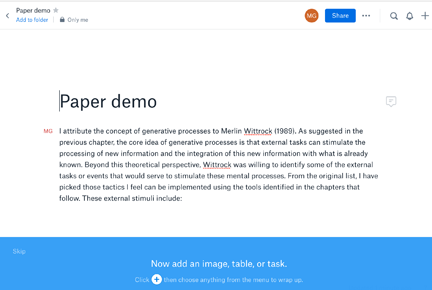
DropBox would like to compete with Google docs. I would not consider switching at present because I see no advantage, but for those use DropBox heavily this may grow into an option.
Posted inUncategorized|Comments Off on Dropbox writing tool
We use cookies to ensure that we give you the best experience on our website. If you continue to use this site we will assume that you are happy with it.
You can revoke your consent any time using the Revoke consent button.



You must be logged in to post a comment.