Tim Cook and Testing Machines

Buzzfeed offered a short post in which Tim Cook, Apple CEO, was interviewed about Apple losing its hold on the K-12 tech market to chromebooks. Excerpts from this interview generated a lot of attention from those making tech decisions in schools. Cook seemed to be claiming that the popularity of the chromebooks was driven by their popularity as testing devices.

“Assessments don’t create learning,” Cook said in an interview with BuzzFeed News Wednesday, calling the cheap laptops that have proliferated through American classrooms mere “test machines.”

It is difficult to know how accurately Mr. Cook’s beliefs were communicated or how we would prioritize the multiple reasons those making purchases might take into account when making a decision. He may not have intended this to generate much public attention. I hope he does not think suitability for online testing is a major reason most districts select a given device or if the devices must serve in this capacity that this is the only activity for which they are appropriate. Perhaps he has been influenced by the over the top rhetoric of the political season and assumes there are no consequences for statements. I would not doubt that some administrators made compatibility with the tech requirements for testing a factor. This would then encourage a closer look at netbooks, laptops, and desktops. Apple has several products in these categories.

I would suggest that misidentifying reasons for purchases has important consequences. Belittling decision makers by suggesting they are interested in little more than testing is no way to win friends and if you actually believe this you may be blind to limitations in your own business model.

I own pretty much every device Apple sells as well as chromebooks, a windows laptop, android tablets, etc. I do use iPads heavily, but I will say that until I purchased the Pro I found iPads limited for heavy writing tasks. iPad pros would be great in schools, but the cost is prohibitive. I don’t hear Mr. Cook saying much about cost.

I could generate a list of pro chromebook features for the classroom, but this work has already been done. Here is an great summary by Andy Losik.


[written on a chromebook]

Loading

Posted in Uncategorized | Tagged , | Comments Off on Tim Cook and Testing Machines

National data on classroom use

The Department of Education Office of Educational Technology has received a lot coverage for the release of its National Education Technology Plan. I am still working my way through the document.

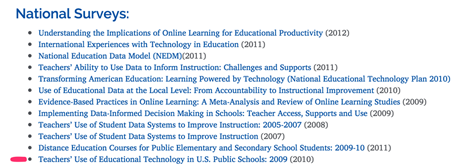
I wish the Department of Education would offer more insight into how technology is used in schools. The department used to conduct frequent surveys of various types and had a series focused on how teachers use technology in the classroom (and personally). I just do not see much data being collected and nothing on general classroom use since 2009.

techsurveys

Loading

Posted in Uncategorized | Comments Off on National data on classroom use

American RadioWorks

American RadioWorks produces audio documentaries for Public Radio. I was listening to a Dec. 7 Public Radio program contrasting Pearl Harbor and 9/11 and happened to notice the source for the content. In following up on the web site, I discovered a great collection of content included a great series on education.

Check this site for content for classroom use and for personal professional development. As an example, try this program on technology and personalized learning.

Loading

Posted in Uncategorized | Comments Off on American RadioWorks

Objection to the objections


A recent EdSurge post attempts to explain resistance to digital textbooks and lists four “issues”. As the author of a digital textbook, I feel the need to respond.

1. Digital textbooks do not offer lifetime access. – First, this is not true unless the digital content is leased in some way (BTW – most college book stores and textbook companies now lease/rent textbooks). Second, if you purchase digital content it is yours. With companies such as Amazon, you can actually redownload your purchases making the purchase more practically accessible than the book yet may have stored in a box ten years and three moves ago. Finally, very few students ever return to most of the textbooks they purchase. They sell them back.

2. It is more difficult to learn from a digital textbook. I would suggest that this depends on how the student uses it. I agree with the author that reading from a smartphone is not easy. It can be done, but this would seem a matter of convenience or cost savings. Digital textbooks are easily highlighted and annotated and more can be done with these interactions than with the markup applied to paper textbook. Depending on the source, mobility and access are also often better with digital content. The content typically can be loaded to more than one device and thus is more accessible than the book you left in your dorm room or school locker.

3. Digital textbooks may be expensive because they cannot be sold back. Note first of all that this contradicts the first concern raised by the author. Also, as I mention above, digital content can often be leased or rented just as is the case with traditional books.

4. Digital content is useless without Internet access. Technically this is true. I assume the meaning is without any access ever. However, once loaded to a device (or several devices – this can be important) continued Internet access is not necessary. Access can be argued several ways. As I suggest in response to concern #3, it is very possible to argue that digital content is actually more accessible.

Criticism of these criticisms is far too easy. Such concerns are more a matter of lack of information and experience than reality.

Loading

Posted in Uncategorized | Tagged | Comments Off on Objection to the objections

Paper vs Screen

If you are concerned about reading on devices, you may find this fairly extensive summary in Scientific American of interest. I guess the article comes down slightly on the side of paper, but does admit that the findings seem to be shifting over time (more recent studies are less likely to show differences). Experience may have solved early problems with reading on screen and the devices may have become more “eye friendly”.

I find some of the explanations baffling (biological interpretations that suggest we treat words on paper differently) and some explanations accurate but mostly due to a lack of experience (the ability to move about within text easily). I am also interested in the opportunity for multiple individuals to highlight and annotate the same content either for private use or for sharing. There are just some new opportunities that technology makes available.

I do think some reading activities that would clearly demonstrate the value of device-based reading exist and were ignored. For example, the ability to easily search within multiple sources and the ability to search for personal highlights or annotations. My interests are somewhat different from a casual reader. I have not purchased a physical book in several years but dozens a year for devices.

I suppose my bias here is obvious, but the article does offer a slightly different perspective if you are looking for arguments in favor of paper.


Loading

Posted in Uncategorized | Tagged | Comments Off on Paper vs Screen

More on individualization


Dr. Cuban frequently comments on educational research and the relationship between research and practice. Often his commentary takes a historical perspective.

In a recent post, he comments on findings from a recent Gates Foundation sponsored survey of teachers. An initial comment concerned a conclusion from the survey indicating teachers rarely individualize instruction (with the exception of grouping). Since my previous post commented on this same issue, I thought another perspective might be valuable.


Loading

Posted in Uncategorized | Comments Off on More on individualization