
Borrowing vs owning ebooks

I decided to research the advantages and disadvantages of owning and borrowing Kindle books. I am interested because I publish a Kindle book and also because I purchase an average of about one Kindle book a month.

As a reader

Amazon Prime $100 a year provides the opportunity to “borrow” one book from the Lending Library per month. Amazon claims there are 500,000 in the lending library. Not all books are available, but this is a pretty good collection. You do need to own an Amazon Kindle device and not just the app to take advantage of this opportunity.

Kindle Unlimited costs $10 per month. You can keep up to 10 books as long as you continue to pay the monthly fee.

I am guessing these three alternatives – purchasing approximately a dozen books a year, borrowing a book a month with Prime, or the Kindle unlimited plan would work out about the same for me. Presently, I have the books I have purchased. I seldom return to these books, but I could. It appears you can save your highlights and notes in all cases. However, when you own the book you can go back from the saved highlight or note to the page in the book should you need additional information. With Kindle Unlimited, you could take a look at more books and focus you reading time on what you found to be most useful.

The best plan for you could also depend on other factors. With Prime, you get free shipping and you could think of access to one book a month as a freebie.

While the unlimited plan seems attractive, I would say you need to be a heavy reader to make it the best choice.

As an author

What about the situation for the author? When someone buys your book, you receive 70% of the cover price minus a small amount for sending the reader the book online. This means I receive about $6.25 for a book sold in the U.S. When someone reads our book as part of a borrowing or unlimited program, we receive approximately 5 cents a page. I must admit that I read this online and the amount seems close. The report I get from Amazon is not clear. Amazon appears to set aside an amount of money and then divide it up based on the number of pages served through these various programs. I am also not certain exactly how the number of pages in a book is determined, but Amazon lists our book at 99 pages. This means we receive about $5 if someone reads the entire book through one of these lending programs, but does not keep the content.

 

Loading

Posted in Uncategorized | Tagged | Comments Off on Borrowing vs owning ebooks

Sharp tools, dull minds?

I have wanted scholars who take differing positions to be brought into a setting and argue with each other. This reaction was typically prompted by reading research reviews that invite written reactions. What if the interaction happened in real time?

A debate offers such interaction. Perhaps you experienced debate as a high school student. I have discovered a series of debates sponsored by NPR. One concerned the proposition – Technology makes us Dumb. I have read books written by those arguing for and against this proposal so I thought it would be interesting. Arguing for the proposition are Nicholas Carr and Andrew Keen. Arguing against the proposition are Genevive Bell and David Weinberger.

One frustration I remember as a debater was trying to shape the discussion so the parties involved were not talking about different things. In this debate, “dumb” seems defined as an aptitude, the capabilities of performance with and without technology, and the quality of self-selected behaviors. To me, these are different variables. So much for my believe that face to face interaction would result in clarity. Still the discussion was interesting.

The audience voted the debate a tie.

The phrase sharp tools, dull minds comes from Vivek Haldar.

Loading

Posted in Uncategorized | Comments Off on Sharp tools, dull minds?

eBooks in Higher Ed

I have been trying to comment on at least post from some author each day this month in a personal effort to model and contribute to the interactivity of online writing. Through Twitter, I encountered a link to a blog post written by a grad student (now professor) I worked with when she was a student. Her post is based on her experiences trying to change the way students experience a traditional textbook. I was unable to comment on the post because it appears her blog allows access only to members of her own college community. So, I decided to comment here. I do encourage you to read Dr. Christopherson’s post.

A little background, Dr. Christopherson is co-author of an Intro Psychology text. My own experience has been with educational technology textbooks. She presently has a book through a publishing company and I have had this experience, but decided to create a hybrid product with the textbook component available through Amazon. We have shared our experiences and both of us are looking to expand  the scope of the resources offered to college students. We have slightly different perspectives on what this new set of resources might look like. Obviously, my co-author and I are less constrained by the perspective of a host company so I am in a better position to act on my own ideas.

Here are some comments I offer in response to Kimberly’s analysis of ebooks and paper textbooks. I do not see annotation capabilities of a traditional textbook as superior to what can be done with an ebook. Kindle books, for example, allow highlighting and note taking. These personal additions can also be stored and explored online. I find the accumulation of such personal content as useful over time (I can now search and review my notes from hundreds of books). I also am interested in the potential of exploring the most popular highlights from multiple readers. As an option, popular highlights can be turned on within a Kindle text. As a variation of public highlights, I have highlighted my own textbook and offer this resource to readers.

My big advantage for ebooks, more potential than actual with ebooks from textbook companies, is the opportunity to continually update the content. One of our disagreements with our publisher was whether we could write continually. While a three-year revision cycle may be appropriate and efficient for Intro Psych, the traditional way of writing a textbook was not sufficient for a rapidly changing field such as educational technology. Kindle books can be updated whenever and pushed out to those who already own the ebooks. While probably not the ideal for a textbook, having an updated book each semester would be practical. With a traditional textbook, the alternative would probably be to offer additional content online. We found the sticking point with a publisher was the notion that authors would be on some kind of content on a continual basis. Publishers want to make a decision every three years. This delay is not good for the students or the authors.

Loading

Posted in Uncategorized | Tagged | Comments Off on eBooks in Higher Ed

This Week in Google – Ads and Future of the Internet

I found this issue of This Week in Google provides an interesting discussion (both sides) of the blocking of ads and the future of the Internet. The first section of this video is worth the time.

Loading

Posted in Uncategorized | Tagged , , | Comments Off on This Week in Google – Ads and Future of the Internet

Gaggle of GoPros

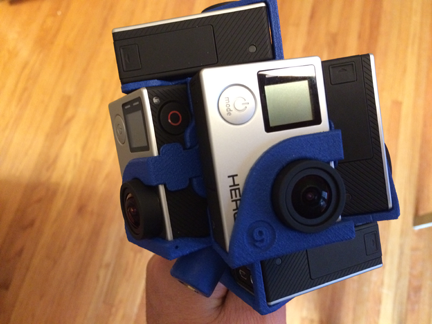
gpros

We were visiting our son last night and he showed us this video device he is using in his most recent project. This is a bunch of GoPro cameras precisely positioned to shoot overlapping video. The multiple videos are then “stitched” together to create a 360 degree “environment”.

We had talked with him about 360 video before after hearing Leo Laporte describe the gadget in a podcast. Sure enough – our son shows up with the device. If I remember, he said the cost of the collection is approximately $7000. To me, this seems like a lot of money. To our son, the cost is only a very small part of the budget for the final project and he seemed just a little nervous, but also excited about exploring the new technology in a real project.

The project should be completed in about a month and I hope to be able to post a link to show the result.

Loading

Posted in Uncategorized | Comments Off on Gaggle of GoPros

Digital Passport for Common Sense

Digital Passport (from Common Sense) is a series of modules focused on basic Internet skills (safety, search, responsible use) for students in grades 3-5. The web version is free and apps for tablets $2. The curriculum comes with a teacher’s guide and management system. Content is video based with suggested classroom activities and training for the teacher.

Loading

Posted in Uncategorized | Comments Off on Digital Passport for Common Sense