Learning is not a spectator sport

Learning is not a spectator sport. Who ever said it was? I am always surprised when I encounter a post explaining the new finding that a learning activity requiring the learner must do more than encounter content in order to learn. Somewhere along the line in higher ed or K12, we forgot about what might be described as a study requirement. Should students have homework? Should college students be given practice tests?

To explain the stages of the classroom process, I have always liked a descriptive model advanced by Alessi and Trollip. The model identifies four stages in what I find concrete ways (my interpretation follows):

  • Stage 1 – exposure to experiences
  • Stage 2 – processing experience for understanding
  • Stage 3 – extended practice / rehearsal
  • Stage 4 – evaluation

The model does not explain where each stage should be accomplished, who should be responsible for directing or motivating activities associated with each stage, what activity should/can be applied to satisfy a reasonable standard for each stage, etc. The model simply claims these stages are necessary. This level of detail is sufficient for some very important purposes.

I find this model an effective way to analyze learning experiences. It is a good way to identify stages that seem missing or weak. It can also be a way to evaluate assumptions of those offering or criticizing learning experiences. Does a lecturer really assume that the lecture experience was really intended to be sufficient for learning? This would seem to imply that the college student is obligated to a mere 12 hours or so a week of work.

Some of these issues might be addressed as issues of responsibility? A given issue can be spun in very different ways depending on the perspective applied. For example, the article to which I link seems to indicate the presenter has some responsibility for offering resources intended to support stages 2 and 3. A different perspective might argue that part of the process of education is to develop independent and self-regulated learners. Should college students be expected to have or to develop such skills as part of their learning tasks? Should instructors provide study questions or should learners be capable of self-questioning or peer quizzing?

A good part of my research as a faculty member concerned the development and evaluation of online study systems (some of my publications are listed here). I still have very mixed feelings about the responsibility question. I focused mainly on introductory college classes because I such experiences as a transition experience. High school students use class time to study with their instructors. Students enrolled in large college classes do not have such experiences. Even with this focus, I always wondered about the long-term implications of my work. When do learners acquire the skills to become self sufficient? Who is responsible for developing such skills?


Loading

Posted in Uncategorized | Tagged , | Comments Off on Learning is not a spectator sport

Stephen Colbert interviews Tim Cook

If you have not viewed the Colbert interview, here is the YouTube.

Loading

Posted in Uncategorized | Tagged | Comments Off on Stephen Colbert interviews Tim Cook

Finding a way to cheap out

One approach to lowering college cost is to take college courses in high school. There are various ways of doing this with AP courses and dual-enrollment being the most popular. In AP courses, students experience instruction and then qualify for college credit based on whether they can earn a “competence score” on an standardized exam. Dual-enrollment courses count for college credit without the requirement of a passing score on an independent examination.

It has become difficult in some locations to hire qualified instructors. This challenge has become more acute when there are additional expectations of those who teach courses for college credit. According to this article from eSchool News, these expectations are making it difficult to find instructors qualified to teach courses for college credit:

The commission decided that college instructors should hold a master’s degree in the field they teach or have a master’s degree in another field and 18 credits in the field they teach by September 2017.

The issue of qualifications is controversial, but I can certainly see the issue of educator qualifications when student learning is not evaluated against external standards. This whole situation smacks of finding ways to “cheap out” – take college courses in high school to reduce college costs, lower standards for instructors so that qualified high school instructors will be easier to find. It seems reasonable to me that colleges required to accept dual-enrollment credits would have a say in what these courses require.

Loading

Posted in Uncategorized | Comments Off on Finding a way to cheap out

See Doc Changes

I have encountered several reports that Google has made a change to Docs by adding a button that will show recent changes made by collaborators. (e.g., Gooru). This button is to appear just to the right of the Help menu header. I have been attempting to explore this new capability and I cannot generate the service as described (see below). What I see is not really new and it is not a button.

changes


My methodology has involved sharing a doc with myself through a different non-Google account. I modify this shared doc so multiple authors have worked on the doc. I assume this approach should allow me to produce the new feature. It is also possible that the feature is only available to those with a Google Education account. I cannot test this possibility on my own.

If you can solve my mystery, please add a comment to this post.

Loading

Posted in Uncategorized | Tagged | Comments Off on See Doc Changes

Please, just the links

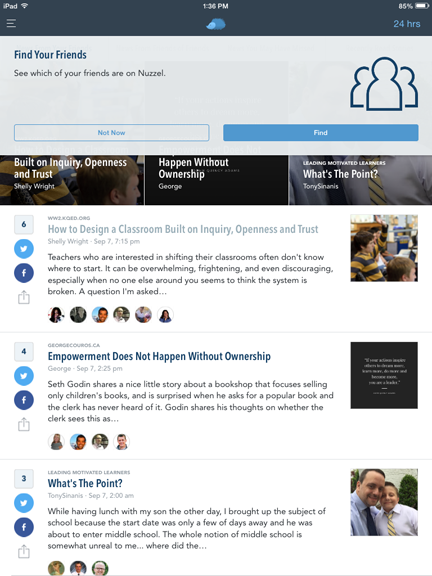
While Twitter users try to put the service to all kinds of uses, I see the major value in Twitter as a way to surface news stories I have not located on my own. What if you could magically ignore all of the other stuff and just review the links. This is exactly what Nuzzel provides (news nozzle) provides. Nuzzel is free and available through a browser or for iOS and android.

I am a limited Twitter (and Facebook) so Nuzzel is mostly useful to me because I fail to check in from time to time and I do miss some things. Nuzzel does allow the number of sources to be expanded by allowing “friends of friends” as an option.

Nuzzel allows the user to control the amount of time the feed covers. What it offers is the list of links friends have provided during this time and orders the list by the frequency of citations.
nuzzel

My work flow with Nuzzel is to open the links that look interesting from Nuzzel and then save this content to Evernote.

Loading

Posted in Uncategorized | Comments Off on Please, just the links

Facebook exploring offering K-12 online learning services

Evidently K-12 education appears to many as a field appropriate for innovation. Facebook is committing a small number of employees to develop software for Summit Public Charter schools. The Summit site provides a breakdown of a typical student day.  Note that students are expected to participate in multiple extended projects beyond the weekly curriculum.

The software developed by Facebook is intended to encourage student choice. Summit CEO says that the Facebook employees will help Summit develop software that:

allows students to work with teachers to create tailored lessons and projects. Teachers can also administer individualized quizzes that the software can grade and track.

Loading

Posted in Uncategorized | Tagged , | Comments Off on Facebook exploring offering K-12 online learning services