I encourage your reading of “Micro engagement is killing our edublogging community” from The Curious Creative. The post does a great job of expressing some of the growing frustration I have felt for some time (e.g., Finally, a positive way to understand edchats). The key point I take from the Curious Creative’s post is that what we describe as online social interaction tends not to be that social and not that interactive (my translation). The author offers an interesting chart illustrating levels of engagement. Production is the lowest level.
If viewing the issue a little differently (the goal of personal learning), I would modify the chart a bit. I would place Tweets below blog posts and probably reading other tweets. I value the integrative experience of writing an extended post over reception experiences, but I recognize few posts originate purely from thought without external inputs.
Perhaps the author is encouraging what I would describe as a SAMR model. I don’t in general regard SAMR as that profound as the notion of proposing a task analysis, determining where you are, and working toward the next step if fairly universal. What is interesting in cases where the sequence is not obvious is the model. Curious Creative proposes that writing posts in response to posts offers the pinnacle of opportunity for the community (and I would add for the self).
Posted inUncategorized|Taggedblog|Comments Off on Levels of online social engagement
I found this tutorial from iMore to be helpful for taking advantage of the power of iCloud. I admit despite the number of iDevices I own and use I have done little with iCloud. The service does seem to work well. Perhaps Apple is improving its cloud services.
Typically, Apple arrives late on the scene and offers customers a superior product allowing others to first explore possible pitfalls. Internet services have long been one of the major limitations for Apple and early attempts to catch up have not accomplished the typical measure of success. Getting consumers to buy in to benefits of an integrated approach (easy access no matter your location or the specific device) represents an obvious opportunity for a company with multiple products (computers, tablets, phone, watch). However, while I can appreciate the improvement in iCloud, just what would the advantage to me be of switching from DropBox or Box? I have experience with these other services, plenty of storage capacity, and I can work cross platform not just cross device. How about this Apple? You make your money on hardware. A terabyte of storage might get my attention.
Posted inUncategorized|Taggedapple|Comments Off on iCloud does seem to be improving
During the past year Cindy and I have attended 5 tech conferences – ISTE, TIES (Minnesota), FETC (Florida), TCEA (Texas), and a smaller conference at Thief River Falls, MN. We did this out of personal interest and paid all expenses ourselves. We are recently retired, continue to write in the ed tech field, and enjoy both the travel and the conference experience. ISTE and FETC have been regular visits for years, but the other conferences were more related to our recent freedom from other responsibilities.
For some time, I have been meaning to write a post identifying my favorite even and explaining why. The Thief River Falls conference would not be an option for most folks because it is smaller and does not offer the vendor hall typical of larger conferences. For the record, the quality of presentations at this conference was superb and I would recommend participation for anyone in the North Dakota or Minnesota area.
If I would have to limit my focus on one conference, it would be FETC. It offers a large vendor space which I find valuable to explore new services and devices. When you think about cost and efficiency, you can read and view presentations on nearly any topic. Because of the Internet the conference presentations are less important than was the case a decade ago. Keynotes are less interesting to me than to Cindy. The cost/benefit trade-off invested in “motivational” speakers does not strike me as important. In general, the paid speakers offer me little of interest. Recognize that these are not research conferences and I tend to be most interested in deep analysis of educational practices. I never pay for pre-conference instructionals because in the situations when I lack background, I can learn far more efficiently and less expensively what these sessions offer through other sources. The “one and done” professional development workshop so many educators complain about works no better when hosted by a conference. I am mostly interested in trends and classroom examples (in depth, not mentions).
Picking FETC over ISTE may surprise some. The FETC venue is magnificent and there may be some benefit to having the conference in the same location year after year. I find ISTE to be inefficient and growing worse. The number of participants overwhelm the capacity of the conference – many sessions fill meaning one almost has to plan to attend a session every other time period to find a seat. The lines are too long. I see no meaningful difference in the quality of the sessions. I have no solution for the experience, but I find I get more out of FETC.
Posted inUncategorized|Tagged#fetc, iste|Comments Off on Edtech Conference Recommendation
I do not post frequently from my iPad, but when I do I use Posts (sounds like a commercial). A couple of days ago I attempted to use this app because I was riding in the car and the app kept crashing. I concluded the app must have become corrupted and deleted it so I could download it again. I could not locate Posts in the store. Now I was in trouble. I searched the web and found the web site, but the purchase button back to the Apple store did not work and the date showing when the page was last updated was 2012. The last tweet from the company was 2013 and the company has not returned my email. I sense a pattern here and assume it is time to search for a new iPad blogging app (maybe a review will follow).
This experience seems far too common with services and apps I think are great suddenly disappearing. I started to consider why. This was a great product. it was not cheap – $10 which is a significant price for an app.
I think there is a general problem here and I contribute. I have gotten to a place where I feel little need to buy more. I have a large music collection. The equipment I own is more than capable of doing anything I want to do. The software, apps and services I use have more capabilities than I can use. Putting more money into the system just brings me little return. This is a “problem of saturation”. Those requiring a sophisticated app (and costly at $10) for blogging from the iPad are likely a finite or slowly expanding group so the revenue going to PICO (the company) was likely declining. This is the problem – app paid upgrades are often not necessary and many quality apps are free. In app purchases are only necessary if new capabilities are required. The flow of money probably just ends.
Those focused on apps that involve a backend (say online storage such as DropBox) or a service (music) can charge for use of the backend. Generating a body of users creates a long-term cash flow. I hate this when implemented by Adobe, but understand the necessity when it applies to small companies. I am not certain what the solution is for apps that require no external resources.
BTW – the only annoyance I have with PICO is the lack of information shared with users. If you are unable to contact those loyal to your company, at least take the time to explain your situation on your web site.
Posted inUncategorized|Comments Off on Disappearing apps
This is a follow up to a previous post suggesting that Sketch Notes will overload the cognitive processing capacity of learners attempting to store content from a presentation. I suggested that Sketch Notes could be a productive method for some learners to “post process” the notes taken from a presentation.
I think about notes as necessary to externally retain information from a presentation. External storage is required for study. A learner attempts to understand the presentation in real time, but not all concepts presented will be understood and even if understood will not be stored or explored on a personal level. Tech tools to generate an external record should be evaluated based on the extent to which the tools can provide a record and the cognitive “overhead” required to generate this record. It may be possible to reduce the demands of traditional paper and pencil note taking. It is also possible that the note taking technique may generate additional cognitive load. This load may be acceptable if it allows deeper processing during the presentation, but also unacceptable no matter the potential if the load required to execute the note taking activities overloads cognitive capacity. As I indicated in my first post, those learners most likely to struggle with conventional techniques are also most adversely influenced by demanding note taking activities.
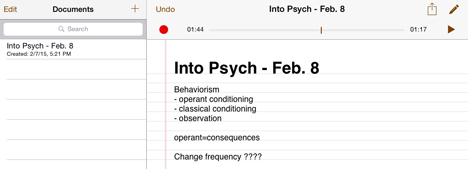
Here is an example of a tool and a strategy I propose potentially reduces the load of traditional note taking. Sound app is an iPad tool that audio records a presentation and allows the taking of notes. The audio and notes are coordinated such that when reviewing a student can click on a note and listen to the corresponding recorded audio. In other words, the notes are associated with a time stamp of the audio. Research indicates note taking is frequently flawed with important ideas missed or stored in an incomprehensible form. The audio is always there for review.
Here is how this tool can reduce cognitive load during the presentation. The learner enters text as possible. If the learner becomes confused or perhaps realizes the important ideas are not being recorded, the learner might simple enter some symbol (say ????) in the notes as a reminder to review the stored audio when studying.
There are several products of this type for tablets and laptops. The obvious limitation is the inability to include sketches in the notes. Presentations often include information best represented as an image – e.g., a flow chart. This is not the same thing as the Sketch Note approach which attempts to accomplish a more integrative representation. There may be apps for integrating notes, audio, and images in a sequential manner, but I have not made the effort to locate such tools.
Posted inUncategorized|Comments Off on More on notes
Sometimes I encounter an educational idea that conflicts with the way I have learned to think about things. I then assume it is my duty to explain why – in a nice way.
Sketch Notes (search online) as I understand the proposal suggests that students can learn from presentations more successfully if they sketch an understanding of that presentation. The examples are always cool and integrate words, drawn figures, and arrows. I do admit that the examples created by skilled “sketchers: are nice to examine. Here is kind of a resource site provided by Kathy Schrock if you want an introduction.
Here is my problem, I studied note taking strategies as a researcher and consider related proposals from this background. One model I have always found helpful proposes that notes serve two purposes – generative and external storage. A generative active causes a processing of content and is assumed to be beneficial. If you believe you benefit because you take notes (without looking at these notes again), you believe that note taking serves a generative function for you. The external storage is obvious to most learners – we study at a point in time separated from the original presentations and our memories are flawed. The content stored externally gives us something to study.
These processes are somewhat related. What learners store during a presentation limits later study and research suggests that many learners do a poor job of representing the information they receive. Potentially an improved recording method would also improve the benefits of working with that external record.
Here is the problem. The less learners know about a topic, the more difficult it is to understand a presentation about that topic. Obvious, but important to recognize. There are also individual differences in the capacity to process information. These limitations impose demands on what cognitive types call short term memory – our awareness at any given moment. Put simply – we can only deal with so much at a given point in time and pretty much any thinking activity uses up the available capacity. Taking notes takes capacity beyond just listening. For some learners, taking notes adds an additional demand to an already overloaded cognitive system. Some students are better off not taking notes, but generating no record leads to a problem when the students attempt to review (external storage). There are solutions (this is what I studied) to this dilemma. Note taking can be simplified or eliminated and complete notes can be provided (export notes).
Here is what concerns me about sketch notes. For those students who experience the greatest difficulty processing a presentation, reducing or eliminating the complexity of note taking is important. Increasing processing demands, even if processing improves learning, are not necessarily productive in a real time environment. Sketch notes seem more complicated that recording text. I could be proven wrong, but I am aware of no research to this point that would challenge this position.
Improvements to the process of learning from presentations – Cornell note taking system, mind mapping – are part of the study rather than the encoding process. If sketch notes have a role in learning, this is where it would seem to me the techniques might be applied. The activities I mention here are really ways to re-represent recorded content (the traditional notes). The real time demands of the original presentation are no longer present and as long as the content (in memory or represented externally) are available reprocessing can lead to better understanding and retention. Sketch notes as a different way of studying may be helpful to some learners.
We use cookies to ensure that we give you the best experience on our website. If you continue to use this site we will assume that you are happy with it.
You can revoke your consent any time using the Revoke consent button.



You must be logged in to post a comment.