
Vernier has announced analysis software for the Chromebook that allows analysis/graphing of data collected with probes and uploaded using LabQuest.

Vernier has announced analysis software for the Chromebook that allows analysis/graphing of data collected with probes and uploaded using LabQuest.
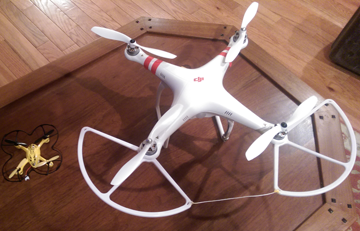
I am not certain of a role for quadcopters in K-12 education, but tech types seem fascinated with the devices. Still they are great fun and new is always the opportunity for learning. I thought I would pass on this advice from my brother.
Brother Dan has decided to make flying these devices a hobby and he owns several. He can afford the larger size capable of carrying a camera. However, he first purchased several of the smaller, less expensive models. He says flying a small drone is more difficult, but your mistakes have lower consequences. It is difficult to damage the cheap devices. The problem he says is developing skills that are automatized (my psych term – means you react without much thought). The quadcopters are stable when hovering, but it is easy to become confused – which direction is forward – when nearing a wall (we were flying the devices in the house) and move the stick in the wrong direction.
I think taking photos with one of these devices would be great, but I am afraid I would dump the thing in the lake or the woods.
I sometimes write about the issue of translating research into educational practice and what seems to me to be an oblivious state when it comes to recognizing the failure of research to support a specific practice. I would argue that recognition of this situation should be a concern to all interested in practice. Imagine public and policy maker concern should the same situation exist for medical research and medical practice.
From the ivory tower to the schoolhouse (Schneider, 2014) takes on this thorny issue. The book takes an interesting approach. Rather than focusing on failures of translation, the book takes a historical approach trying to understand what the author believes have been research to practice successes. The ideas the author regards as successful include multiple intelligences, project based learning, Bloom’s taxonomy and direct instruction. These are ideas that are not without controversy and that may even be contradictory (project based learning and direct instruction). To me, the author seems to be suggesting that the consideration of effectiveness and the specifics of when and where to do what must follow a common interest (academics and practitioners) in a practice. I see the potential in examining the problem from this perspective.
Larry Cuban wrote the Forward for this book. Here is the related post from his blog.
Andrew Keen is a technologist who offers a negative view of the Internet. In one of his previous books, Cult of the Amateur, he argues among other things that amateur online content is ruining the potential of the Internet for professional content creators. My simplified summary of the argument would be that amateurs offer free content creating a certain expectations among consumers who then are unwilling to support the work of those offering quality content.
Keen has a new book with similar themes. He appeared on a recent episode of Triangulation (a TWIT network program) and describes his most recent concerns with Leo Laporte. My take is this book outlines how the Internet has failed to live up to many of the original hopes online opportunities seemed to offer.
I find Keen’s analysis insightful even if frustrating.
A recent suit against Apple complains that the advertised storage capacity of the new phones were overstated. Seems pretty silly. The advertised storage capacity of any device has to my knowledge never been reported minus the part given over to the OS and other software installed by the seller.
However silly, this suit did get me thinking about changes in storage. The advantages of online storage in combination with the design approaches that seem to attract our dollars mean the storage available on the device is less important. Chromebooks are regarded by some as less functional, but to be accurate my Chromebook Pixel and my new Apple Air are very similar devices. Neither has a hard drive and rely on flash storage. The Air has the option to do more things off-line, but I can continue to do much of what I normally do on my Chromebook when offline as well.
Our interest in design issues may be as big a factor in this trend. We prefer light and thin. The hardware companies also seem to be moving toward the sealed box. Apple started this trend, but most new phones also cannot be opened by the consumer. My personal work computer, a five-year old iMac recently crashed. The folks at the Apple store tell me it is the harddrive and Apple no longer stocks the drives for a machine of this age. I must admit this is frustrating. My data are online. I no longer backup my “programs” because I can usually download what I have previously purchased at no additional cost. It just seems that the power in the machine is becoming less and less important so other means must be found to encourage us to make another purchase.
The 2015 prediction post is a staple so I will incorporate a prediction into a post with a more general purpose. My prediction is that the Hour of Code will prove to be another education fad.
This is an ed tech blog and this prediction may seem sacrilegious to the true believers so I should explain my logic. I would suggest that we have seen this movie before. A few decades ago we had the original coding push – think LOGO and Seymour Papert. There is a great literature out there for those who want to investigate. What are presently being promoted as benefits were carefully investigated based on educator attempts to teach LOGO.
Multiple goals were proposed for spending class time on programming:
Research (I am sorry but data does matter) demonstrated that most students exposed to the amount of programming schools could provide accomplished few of these goals. The “coding teaches about technology” argument was removed by the ed tech facilitators who began to promote the mantra – it is about the learning and not the technology. Computer literacy was assumed or argued to be developed as part of more content area based activities.
What I am describing here is not anti-coding in any way. I propose the programming be taught as an elective to those who are interested. Real courses allow sufficient time to meet some of the original goals.
Just to make a point and possibly to encourage educator reflection on personal motives I like to make the argument for a different “hands on” activity. I propose the teachers consider the educational potential of cultivating a school garden. It may sound strange, but it is more common than many might expect. Gardening removes some of the mystery of where our food comes from (a kind of food literacy) and deals directly with issues of nutrition (pretty hard not to accept the importance of improving general understanding of nutrition). Gardening works well as a way to investigate science (biology and chemistry) and can easily focus on data collection and analysis (math) and writing. For some, agriculture represents a vocational skill and some would argue exercise. It is a great life-long activity. From experience, I can suggest that one of the major challenges for teachers is maintaining the garden during the summer months. My point is that the relevance arguments can be made for multiple topics
The reality is the classroom time is limited. Efforts to increase time as might involve flipping the classroom and home work are meeting with resistance. Efforts to engage all students with shallow experiences – a little bit of this and a little big of that – are ineffective and wasteful. If you promote coding, the productive route would seem to be making the argument that coding should replace something. This seems to me to be the only honest approach. The enthusiasm of addition is naive unless the issue of the time available is addressed.
You must be logged in to post a comment.