I wish Google would add another option to commenting. The system as it exists seems optimized for collaborative writing. Adding a “commenting” option that would kind of fit between suggesting and viewing would be better suited to peer editing. Suggesting can be adapted for commenting, but the assumption is that a specific change is suggested and this change will be accepted or rejected by the original author. When educators read student work, they really want the student to do the work of improving the product rather than just accepting the teacher recommendation. I would think the best use of a peer editor would be similar.
The improvement of the textbook has been an interest for many years. Hence, when I locate an article on the topic I must curb my reaction which is often that the article offers ideas that seem novel but actually are not.
Here is a recent article from Medium on new ideas for the industry. My comments will make more sense if you first read “Tomorrow’s Textbooks”.
Here are my initial negative reactions:
1) The iBook from author does indeed offer flexibility in the use of multimedia that many think will improve the learner experience. As an example of a more innovative format, I would say I agree. However, until and unless Apple creates a product that is cross platform the iBook will not move the market forward. Few profs would knowingly require a book that also requires a certain type of hardware. The iBook is more likely to be influential in the K12 market as schools may provide iPads to all student.
2) The notion that students will learn on their phones has a surface appeal. Most students have a phone and most use them heavily. However, my challenge to the proponents would be this. How many books have you read on your phone? I can say I have read several just to evaluate the experience. It is a stretch to say extended reading on a small screen is an equivalent experience when what we are searching for are improvements. Maybe a phablet. I also think the focus on phones runs contrary to some of the other recommendations regarding learning content.
3) My area of research for quite a few years involved personalizing the reading experience. What I did as research seems similar to one of the final areas of development identified in the Medium article. The article describes the use of analytics embedded in the learning resource to help the learner make better decisions. “Computer control” in computer based instruction has been around for a long time, but seldom applied at scale to textbooks. My personal interest was in the use of diagnostic quizzing to encourage review of poorly understood content. I was interested in metacognition and what technology had to offer to those with poor metacognitive skills. The frustrating (and interesting) thing about this work turned out to be that those students with less capable metacognitive skills also turned out to be less responsive to suggestions for what they should review specific content (rereading could be tracked). Instead of “don’t know and don’t know you don’t know” it seemed to also be “don’t know and don’t care”. It was about this time in my research career that I reached the age of 65 and retired.
As I suggest in my initial comments, I think a focus on “learning materials” deserves more attention. I am encouraged by interesting ideas even when I am a doubter. I am more concerned with the textbook industry because I see the large commercial sources retarding the process of improvement. I do not see traditional companies as being creative or flexible enough to generate change. If I were to complain about profs, I would focus less on their insensitivity to cost issues and more on their lack of willingness to explore alternatives to the traditional book. Perhaps instructor evaluations should include items related to the learning resources that have been assigned.
Posted inUncategorized|Comments Off on A new type of textbook
Eli Pariser in a Ted Talk and book (The filter bubble) proposed that the way Google personalizes search based on personal preferences may mislead us into believing we are learning more when we are actually just hearing what we want to hear. To me (ex professional Intro psych teacher), this very much sounds like the idea of a confirmation bias. It is likely we do not need help feeding our biases (Pariser’s concern with Google). We do this quite nicely on our own. To illustrate this issue, I typically propose that most individuals have a “go to” news site (CNN, Fox, MSNBC) and may spend hours on this site without sampling from other sites. It do accept Pariser’s concern that despite the potential of the Internet to explore different points of view it may be our biases that are guiding the selection of the content we consume.
I have been thinking about this issue for some time wondering just how I might encourage myself to avoid the problem. Was there a technological solution? What made sense to me was to commit some time to services that allowed the designation of topics of interest, but then allowed the service to select content relevant to the topic. In theory it would be like exploring a current event but not requiring the take on that event be provided by Fox or CNN.
This is a goal in search of a perfect implementation. Here are my two current tools of choice.
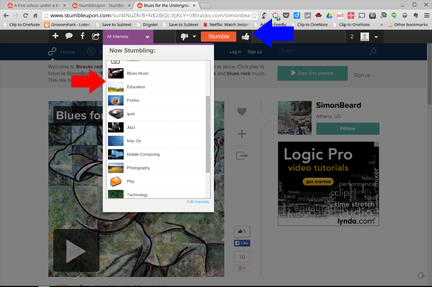
StumbleUpon has been around the longer of the two. The service allows the selection of “Issues” (red arrow). Stories are then presented related to these issues. If you thumbs up or thumbs down a story you can vary the frequency of receiving similar stories in the future (I hope this changes the topic of stories and not the perspective). Selecting Stumble presents another story without influencing future selections.
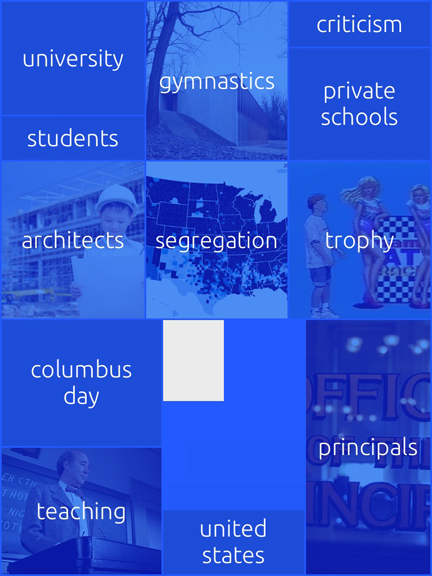
My most recent interest is called Random (iPad only app at present). Random is “more random” than StumbleUpon. Topics appear on the screen and change every few seconds until one is selected. Once selected, a story associated with that topic (by tag) appears. After reading (or not), tapping at the top of the story page brings up a grid of related tags. You can back out of a particular exploration by selecting the white space and this starts the process over. I could not find much on the algorithm behind this system, but what I could find indicated information is stored on your device in a way that would guide future content. From experience, I have yet to sense how this works. I find the app interesting to explore, but wish I could seed the process more directly (as is the case with StumbleUpon).
Posted inUncategorized|Comments Off on Bursting the Filter Bubble
Brett Dickerson cites recent SAT data to conclude the reform efforts focused on high standards and rigor have been ineffective. He describes the focus on rigor as an example of “white privilege”.
High expectations for a student’s education are effective only to the extent that the child and parents see the value of them. When high expectations are arbitrary, delivered by people who are remote from the culture of the children, and don’t make sense to the children themselves, then they don’t work. They really don’t work.
He proposes that what happens in a child’s life outside of school is still more important than what happens in school. I must say that each time I read such a conclusion it reminds me of the Coleman studies from the 1960s – home environment is largest determinant of student performance, but teacher quality matters the most for students from homes with fewer resources. Schools cannot be the only assumed remedy for inequalities that exist among students outside of the classroom.
Bing (bing.com/election) has organized information related to 2014 political races. A user can view the country as a whole or select a state and obtain a prediction for individual races. In addition, the return page for each race offers annotated links to multiple information sources. Microsoft has done a nice job with this resource.
Posted inUncategorized|Comments Off on Election Analysis
STEM subjects seem to be prioritized when it comes to K-12 education. This despite the importance of skills – e.g., communication and critical thinking – that can be developed in other content areas.
Way back when I began blogging (more than 10 years ago) I had the opportunity to work on some grant projects focused on teaching history. I admit this was a strange focus for an educational psychologist originally trained as a biologist, but reading about the topic generated an interest in what was and I suppose is called the “historians’ craft”. The craft is the process of “research” allowing the historian to generate a credible account of some specific aspect of history by cross-referencing and reasoning from primary sources. Two things struck me: 1) this work offers a great example of critical thinking and 2) learning history from reading what historians write is dull, but the work of historians seems very exciting. I have used this second many insight many times because it generalizes well to so many academic areas and begs the question why can’t we figure out what likely encouraged our study of a given area is not what we allow our students to do. We tell them what we know, but do not allow them to exercise the same process by which we came to this knowledge.
Anyway, these insights have always encouraged me to promote teachers to function as historians. Here is a great example from Peter Pappas. Included in the post are links to examples generated by his students.
We use cookies to ensure that we give you the best experience on our website. If you continue to use this site we will assume that you are happy with it.
You can revoke your consent any time using the Revoke consent button.




You must be logged in to post a comment.