The news this week has focused on racism in sport. Among the solutions proposed (at least on the news programs) has been greater diversification in front office personnel. Having this context, I happen to encounter a couple of articles claiming that the teaching profession is not as diverse as it might be.
Just because it seemed strange, the article contained a comment about North Dakota:
“Even in a place like North Dakota, where the students aren’t particularly diverse relative to the rest of the country, it’s important for our social fabric, for our sense as a nation, that students are engaging with people who think, talk and act differently than them but can also be just as effective at raising student achievement in the classroom,” he said.
Hence, diversity is about allowing students to see folks like them and to help students understand there are also folks who are different.
Posted inUncategorized|Comments Off on Diversity in teaching profession
I consider myself an education blogger, but I write about a variety of topics. I see these other issues as interconnected or at least connected to how I think about education. My more focused interest is in the role technology can play in learning. By seeing learning as an “all contexts”, “all ages” experience, I do have a concern when it comes to inequity in access and who controls reasonable access to online content. I see net neutrality as very important in the future of the Internet. I admit to some degree of personal concern as the future of the Internet may be away from contributions by the little guy. The roles each of us sees for the Internet is at stake here.
I have written repeatedly about political/business issues as influencing net neutrality, but the concept of net neutrality may not be clear to all. Here is a great resource (Moyers and company) I have encountered that explains net neutrality and implications of what we allow in terms of controlling the Internet.
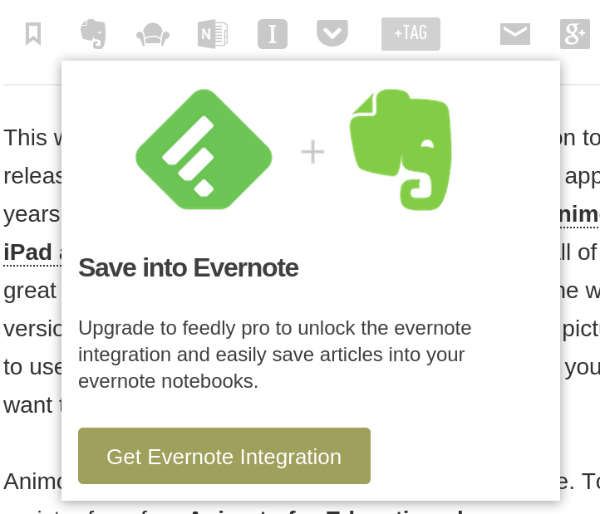
Feedly and Evernote are two of my most heavily used apps. Feedly is my RSS reader and Evernote is my scrap/note book. Recently Feedly offered an easier way to save content to Evernote. There was simply a button that executed this action. The Feedly feature I use presently takes advantage of an Evernote feature that stores information sent to an Evernote email address.
I do most of my reading using the iPad. When I attempted to use the Feedly to Evernote transfer I kept encountering an error message. No specific explanation for the error message, just an error message. I did eventually determine that you must purchase the Pro version of Feedly to enable this storage option. Feedly certainly does not owe me a free feature, but the app should explain the requirement for payment rather than generate an error message. It is obvious when attempting the same transfer on a laptop.
One comment about the Pro version of Feedly. I have this general complaint about many services – the gap between free and the lowest paid version of many services is too great. I am not going to pay $5 a month to use the automatic transfer to Evernote feature over the email method. I understand that other features come with the Pro level, but this was the only feature that seemed useful to me. Perhaps what I have in mind is too complicated to execute, but $60 a year for a more convenient method of interconnection of services seems too expensive.
Posted inUncategorized|Comments Off on Feedly to Evernote
If you are a Firefox user, you want to check for an update. I learned about the update from Mashable and sure enough my existing version was dated.
The Mashable description focuses on the new design. It will likely take you a little while to discover some of the capabilities you used before but are not located in a different place. Mozilla also emphasizes the security advantages of Firefox. I assume this is to differentiate their product from Chrome and Explorer.
The average college student spends $655 on textbooks each year, according to the National Association of College Stores.
As I have indicated on multiple occasions, it is far more complicated (sometimes for fun and sometimes seriously). First, students resell their textbooks so the $665 cost over time actually is reduced by half. Economists probably have a term for the “actual” cost in contrast to the initial cost. Second. a textbook and other resources serve different functions. A textbook provides an integrated structure. Various YouTube or Merlot resources address topics. To equate a book with unrelated resources is comparing apples and oranges. While advanced students are expected to be able to impose a structure on multiple sources, this is a serious challenge for beginning students working outside of their areas of interest and knowledge. Anyway, it is complicated and simplistic solutions have more political appeal than educational benefit. As an instructor, I am far more concerned that students read the textbook they have purchased than what the book cost. Of course, if you do not read the book or attend class, the cost of the course and the book is too much.
I do not want to come across as defending the cost of textbooks. However, I do know far more than most about costs having written a commercial textbook and having offered low cost alternatives. Hence, I am always annoyed when those with little actual experience make pronouncements. Take any area for which there is a general public need – say medical care – there are always those who claim the costs are too high and someone must be compensated more than is appropriate. Why is it we complain about textbook costs as a political issue and not how much we had to pay for an x-ray the last time we visited the dentist? If these issues are real, it is worth a careful rather than a superficial look.
Posted inUncategorized|Comments Off on The textbooks are expensive thing again
I came across this blog post referencing a British Journal of Educational Technology article (actual article is published in the May issue) complaining that academics do not take advantage of social media to make findings available to the public. The journal article is pretty much a review, but it does reference publications with data. I wrote a post some weeks ago on this same topic. The general concern is that academics would do well to explain the significance of the work to the public who often are asked to support their work.
The blog post (not necessarily the article cited) laments the low statistics on academic professional tweeting (15%) and Facebook use (39%).
Greenhow finds that “troubling,” she said in a statement, since universities are trying to increase access to publicly funded research. “Only a minority of university researchers are using free and widely available social media to get their results and published insights out and into the hands of the public, even though the mission of public universities is to create knowledge that makes a difference in people’s lives,” she said. “Simply put, there’s not much tweeting from the ivory tower.” (the excerpt from the article appearing in the post).
Hmm. – first, I think there are notable exceptions. For example, in my interest area (technology and education), I would point to the blogs of Daniel Willingham and Larry Cuban as counter examples. I also hope some consider my comments as serving a useful purpose.
It occurs to me that Twitter and Facebook are not well suited to bringing scientific advances to the attention of the general public. As one commenter suggested in response to the post I am referencing, Twitter can not bring scientific findings to the attention of readers in that links to significant papers would be blocked by journals expecting readers to pay for access. Aside from the potential of steering readers to useful explanations via links, I find the limited commentary allowed in a tweet to make Twitter pretty much useless for meaningful discussion or explanation. In general, the “friend”-based approach of Facebook makes this social service of limited value for general presentations.
I propose that blog posts or Google+ posts would offer more practical benefit for public exposure to scientific discussions. While I would not be optimistic that these outlets serving the intended purpose, I also do not understand the focus of the blogger and the researchers on Twitter and Facebook.
Posted inUncategorized|Comments Off on Real academics don’t tweet
We use cookies to ensure that we give you the best experience on our website. If you continue to use this site we will assume that you are happy with it.
You can revoke your consent any time using the Revoke consent button.



You must be logged in to post a comment.