This post from MacWorld claims California students are protesting poor AT&T cell phone reception. The “fastest 3G” network – if you happen to be an area that has coverage.
Possibly more people in Santa Clara than North Dakota so I am guessing my complaint is irrelevant.
Posted inUncategorized|Comments Off on What – Poor cell phone reception in Santa Clara
My brother Dan sent me another picture of deer captured with his trail camera. He says he has been watching this buck mature as the summer progresses. I find this fascinating. One hardly ever gets a good look at deer and he is collecting a series of images over time that shows the growth of the antlers.
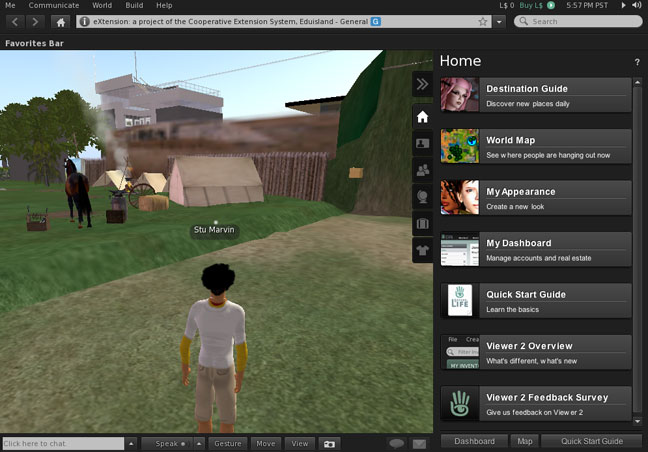
A new (beta) viewer has been released for Second Life. This online social environment has kind of faded from view, but it is hard to maintain attention in the rapidly changing Web2.0 world. I don’t know. I still don’t get it. The potential is certainly there for interesting simulations, but a) I seldom encounter something I see as an improvement over other web experiences that rely less on the artificial, b) I think Linden may understand the interest of many individuals in adult content and fail to respond in a way that would make Second Life a suitable educational environment, and c) the overhead of movement, learning skills, and the use of knowledge of each to create a caste system does not impress me. I would rather see students engaged with each other and with the real world around them via other far easier to use tools.
I do like to see advocates make what they can of technology opportunities and I do think we need to explore some options. My biggest concern is the adult content – at present it seems futile to invest time when the money to be made favors adult content rather than educational experiences. Compare what Linden facilitates with Apple’s recent decision to remove questionable apps from the iPhone/Touch store. These seem to be very different business decisions made by two companies.
The NYTimes has an article about the Macmillan decision to publish some books in a format (DynamicBooks) that will allow instructors to make alterations. OK – I understand the advantages of custom print (print only those chapters you will assign), but this new format has me confused. I can see instructor authored study guides and syllabi, but these would seem most efficient if kept separate. Most institutions will not allow instructors to sell their own materials. Perhaps the advantage is in formatting materials for portable devices.
Posted inUncategorized|Comments Off on Macmillan will allow instructors to modify books
The impending release of the iPad will likely raise issues of eye-strain. Because the iPad uses a different, but more versatile technology, some may assume that lengthy reading tasks such as reading text book will cause eye strain when compared to devices such as the Kindle. I do like the Kindle, but I had thought the advantage was a much less reflective screen surface allowing me to read in more and brighter settings. A recent NYTime article addresses eye strain and as I understand the main arguement the issue with eye strain is more an issue of the reader having to adjust to the position of the device rather than the device to the position of the reader. I would interpret this to mean a tablet device should be less of a problem than reading from a laptop or desktop display.
Posted inUncategorized|Comments Off on Eye Strain and E-Readers
We use cookies to ensure that we give you the best experience on our website. If you continue to use this site we will assume that you are happy with it.
You can revoke your consent any time using the Revoke consent button.




You must be logged in to post a comment.