
Cindy is doing some work in Russia and is beginning to post about her experiences. Here she gets a little too close to a camel.


Cindy is doing some work in Russia and is beginning to post about her experiences. Here she gets a little too close to a camel.
So, here is the scenario. My wife is in Russia for a couple of weeks. She normally pays the bills. I am capable of writing out checks and addressing envelopes, but she has a system I can’t understand.
MCI has been calling every half hour. Actually, it is some robot. Evidently, according to the robot, we have updated our credit card and they need to know the new expiration date. I call the number they provide and the robot asks me to enter my credit card number. It is true that I have a new credit card but I do not give my credit card number to a robot. I try to figure out how to call a human. Now I encounter a different problem. I do not know our PIN number.
So, it appears that MCI is concerned I am trying to somehow break into my own phone account. But, they want me to offer up my credit card number without even talking with a human. Here is how I think it should go. You give me my credit card number – you know what it is or how would be you be able to verify the number if I give it to you. If you can do that, I will give you my expiration date. This seems a logical approach with some protection for both parties.
I don’t think we even need an MCI account. We use cell phones and have some kind of deal through our cable provider. Perhaps this is for 911.
I have an email in to my wife for assistance. I hope the stop calling at a reasonable hour.
Don’t call – send email. The phone is for digital immigrants. 😉
I have been reading Bonk’s “The world is open”. It is well written, but much like too many other books I have read lately – a mash-up of “The world is flat”, “Wikinomics”, “Here comes everybody”, and perhaps a bit of “The social life of information”.
The idea of openness is intriguing – we clearly have open source software and some open source information resources (e.g., wikipedia). I am still grappling with a core concept associated with “openness” – what products or resources do we assume should be free? Clearly, many of these authors see a world in which software, educational content, and educational experiences should be free. Just what about these services and products prompt such expectations.
I have too many vegetables growing in my garden this time of year. Should food be free. I don’t mind giving stuff away now – I might as well. I can only eat so many tomatoes and the zucchini are far past the point at which I even bother to pick them. They just grow into these large things I am thinking of carving for halloween. Now, a month ago, I would have thought differently. I even had to make purchases at the farmer’s market to put vegetables on the table. By the way, those farmers are still there selling stuff. Do you think they would be offended if I put up a table and just gave stuff away? I could call this open source food. There are probably lots of hobby gardners just like me. Is that what makes an open source movement? Hobbyists? People with too much stuff or too much time?
One of the concepts in Wikinomics is that consumers become prosumers when they co-create goods and services. This I think is not appreciated. This sounds like a co-op or maybe a barter system to me. The problem with the way many understand the open source movement is that it is too much like a “free lunch”. Try walking out of your local co-op with an open source tomato.
<p><a href=”http://openinternet.gov/read-speech.html”>FCC Chairman on net neutrality</a> proposing that ISPs not be able to filter or block by content type. Propose same guidelines for smart phones.</p>
<blockquote><p>The typical 2030 faculty will likely be a collection of adjuncts alone in their apartments, using recycled syllabuses and administering multiple-choice tests from afar.</p></blockquote><p>This quote is from a Washington Post article on the “<a href=”http://www.washingtonpost.com/wp-dyn/content/article/2009/09/11/AR2009091104312.html”>brewing virtual revolution in education</a>”. I am watching it happen around me. We just added 3 new lines to my department – all non-tenure track because of new opportunities in online instruction. This is a big percentage change. I wonder if we will ever expand the number of tenure track lines and what the long term implications of “the growth income being in online students” will be.</p><p>Reminds me a lot of the Jeff Jarvis predictions for educational change in “<a href=”http://learningaloud.com/blog/2009/05/30/the-relevance-of-college/”>What would Google do</a>?” The search for more economical ways to do things ignores the value of a composite. Isn’t this essential what “university” means? Now, any piece that can be improved is isolated to pursue greater efficiency. What remains after the removal of the easy money pieces are the admittedly valuable, but expensive parts that now are no longer subsidized. What remains may be too expensive to continue.</p><p>For me and my own little world, it translate like this. Everyone is willing to teach Introduction to Psychology. High schools want to teach it for AP or dual-enrollment credit. Every junior and community college wants to teach it. These institutions do not have the means to offer degrees or if four-year institutions to engage in graduate education or commit time to major research programs. They specialize, pass these students on and the potential concern is that what is left are specialized, upper-division courses. The courses are expensive to teach because of the expertise required and the small numbers enrolled. So, how will this work. Certainly, states and tax payers are backing away. The percentage of higher education budgets paid by the state is declining everywhere. What happens to the cost of instruction when upper division courses are not subsidized by large introductory and general studies courses? I assume tuition will have to be adjusted. I suppose we will be blamed for this, but few want to understand why such adjustments are necessary.</p>
I just finished writing about new ways to process aggregator content and I learn that there is something more to explore. Google has released a new service called “Fast Flip” that offers a new way to “flip” through content from popular sites. You can explore recent content within categories selected by Google or search.
There is also this interesting claim:
How do you personalize results on Google Fast Flip?
We are able to take the cues you give us – such as the stories you read, recommend and e-mail – to present sections, news sources and specific authors tailored specifically to your interests. To enable personalization of the articles you see, you must sign in to your Google Account. You can easily create a Google Account on this page if you don’t already have one.
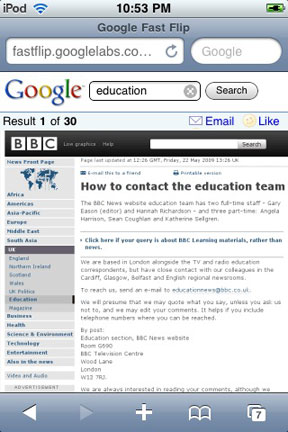
I can’t say I know what this personalization accomplishes yet, but I will continue to explore. BTW – the site knows when you access from a mobile device (see image below) and adjusts. On the iPod Touch, you use the familiar swipe to move from one page “image” to the next and the click to expand. This is not an app, but a web site that is device aware.
You must be logged in to post a comment.