
The finches are back.


I wonder about the assumptions we make when we propose turning the tools of popular culture (e.g., Facebook, games, cell phone) into learning devices and learning environments. It reminds me of a comment a prof made in a sociology class I was taking (long ago). The comment was based on the premis that adolescents use popular culture as part of their approach to define their identity creating some separation from the adults who have reared and attempt to guide them. The comment basically complained that adolescents were being driven to do weirder and weirder things because adults kept adopting the musical tastes, clothing, etc. of teenagers. In other words – it is healthy to give adolescents some areas in which to explore and call their own.
I think we can successfully take advantage of the participatory web and the devices suited to it while not attempting to define every space and tool as suited to the purposes of formal education. This is my reaction to Facebook and at present also to cell phone (probably smart phone) use. It is true that many K-12 learners have cell phones. It is also true that smart phones have capabilities that allow both download and upload of content allowing participation. However, not all K-12 students have cell phones and many do not have the data plans that would make the cell phone an entry level participatory web tool. I also feel the cell phone has limitations as an input device – I don’t really care that some Japanese middle school girl can enter text on a cell phone faster than I can type. Unusual skills are hardly the basis of recommendation for the many.
If we want to commit to a device that can really make a difference and we believe that access to such a device should be the responsibility of educational institutions, I would urge we explore netbooks. Cost out what a one-year data plan + device costs in comparison. You can easily purchase a netbook for what I pay each year for a smart phone. Consider input capabilities. Consider the inequities promoted when we focus on special opportunities for special tools.
We are clearly moving toward mobile devices and it is interesting for those of us with a budget and time to explore what future capabilities might offer. However, as a practical starting point, I would prefer we follow the netbook toward the phone rather than the phone toward the netbook. I certainly hope my Blackberry is not the learning tool of the future.
We watch Twins basseball. We started doing this at the lake and now we can’t stop. A week or so ago the broadcasters decided to start posting to Twitter – updates on the game and such. They let the folks in the truck tweet too. I think it lets everyone on the staff feel like they are part of the show.
Once you start down this road, you have to decide to take it seriously. I am not certain that those folks at FSNORTH understand this yet. Today, the Twins were playing the Yankees. The Twins were up 4-3 in the eigth. The Yankees came back to tie the score 4-4. The game went into extra innings. I was in Fargo at the bookstore following the game on Twitter. It was the bottom of the 11th (an away game so the Yanks were batting) when FSNORTH sent the last tweet. Tied going into the bottom of the 11th. Of all the members of the staff, no one could send a tweet explaining what happened after that. Several hours passed. On the way home I hear on the radio that the Twins lost. Perhaps no one had the heart to tell me.
I don’t know. Once you make a commitment to your friends you must follow through. Don’t tweet if you don’t mean it.
Business types.
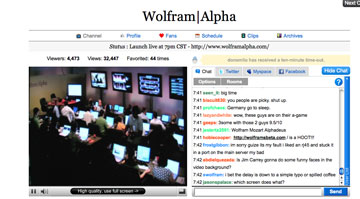
Image from live Wolfram/Alpha launch. Friday evening – connect if you encounter this post within an hour of the post time.
Home page when functional.
Anyone using a free online service that stores information in any form should read this article
The idea that Amazon would disable text to speech at some time after purchase is disturbing.
Is this the entire story? What were realistic assumptions at the time of purchase? If one purchased a book or even the Kindle assuming in good faith the one could LISTEN to a Kindle book, changing the rules is just wrong. Audiobooks are a unique market and I understand purchasing a product specifically for this purpose. Amazon obviously has a much larger selection than Audiobook (which is the service I use). Text to speech seems a reasonable alternative to professional narration for reasons of cost or availability.
This issue with the Kindle has been confusing. I had once thought that the speech function had been disabled and I was surprised to learn that the option was still available. This ambiguity is problematic. Perhaps a clear disclaimer would do the trick, but retroactive actions seem a really bad decisions by Amazon.
Kindle Issue
You must be logged in to post a comment.