On Personal Interest in Research

People interested in science often have experiences in their childhood that predict their adult interests. There is reference to this in “Outliers”. I came across a Ted Talk that describes the same phenomenon on a personal level (when did the scientific method originate and a personal story from Kary Mullis). Note comments on postmodernism.

I grew up on a farm and had an interest in science. There were various manifestations of this. One thing I remember that sounds strange now was that my parents let me experiment with chickens. I used to feed them different types of food and count the number of eggs they produced. I cannot remember exactly what I thought I determined, but I do remember keeping a notebook with a daily tally of eggs collected. Mom and dad did not care as long as I was willing to donate the eggs. Now, this story is not as spectaular as shooting frogs into space (Mullis\’ story), but I wonder how common such early experiences are?

BTW – Mullis does have what may be a less politically correct take on global warming and that makes him interesting as well.

Loading

Posted in Uncategorized | Comments Off on On Personal Interest in Research

Don’t bother me with the data

I am in my office preparing for my grad class tomorrow evening. I am reading a 2003 paper by Burkhardt & Schoenfeld that offers suggestions for improving educational research and the difficulty of influencing educational practice via resesarch. It is assigned reading for the students in my class. At the same time, I am running a Twitter feed on my computer and most of the comments coming in are from the Educon conference. Just consider me one of those multi-taskers. It is an amazing contrast – I wish I could capture this comparison as an object lesson and bring it to class.

From Burkhardt & Schoenfeld (citing the 2002-2007 strategic plan of the Department of Education):

Unlike medicine, agriculture, and industrial production, the field of education operates largely on the basis of ideology and professional consensus. As such, it is subject to fads and is incapable of the cumulative progress that follows from the application of the scientific method and from the systematic collection and use of objective information in policy making. (p. 48)

From Twitter:

How do we get rid of the tests? How do we collect authentic data with teachers who don’t know what it is? Parents love their children.

Asking that those in an argument offer evidence is one of those tests of critical thinking used to evaluate credibility and being willing to examine data and the responsible methodology is one way to avoid ideology.

Those of us who are educators (and parents) ask for data in order to evaluate your proposals. Requesting evidence in support of recommendations is about understanding the history of our discipline and owning up to the reality that time and time again kids ended up being exposed to unproductive ideas that were later rejected.  Requesting evidence is simply prudent and complying with such requests is evidence of true commitment.

Loading

Posted in Uncategorized | Comments Off on Don’t bother me with the data

Doing it like Wikipedia

It appears that Britannica has given in to the popularity of participatory authoring and will allow users to edit its own online version.

Mr Cauz said that any changes or additions made to Britannica entries online would have to be vetted by one of the company\’s staff or freelance editors before the changes were reflected on the live site.

Britannica is particularly miffed that content produced by the organization does not appear prominently in Google web searches.

I tried the Britannica website this morning, but found no obvious change. Maybe you have to go through the registration and login process before you can participate.

BTW – the Britannica blog is kind of interesting. I found this old post on web 2.0 classrooms.

Loading

Posted in Uncategorized | Comments Off on Doing it like Wikipedia

Inauguration from space

[Satellite image by GeoEye] – perhaps one of the most unusual photos from the inauguration. This image captured by the GeoEye-1 satellite. Offered according to GeoEye publishing guidelines.

Loading

Posted in Uncategorized | Comments Off on Inauguration from space

Whitehouse.gov (the real one)

WhiteHouse.gov has been updated and extended. One addition – a blog. No, the President does not update the blog (at least to this point).

Loading

Posted in Uncategorized | Comments Off on Whitehouse.gov (the real one)

Shared Experience

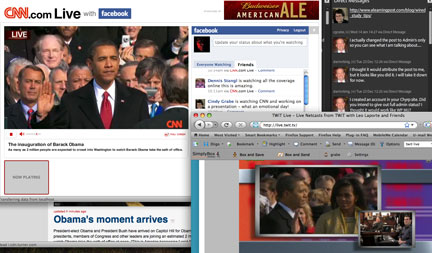
I watched the inauguration from my office. I had the CNN feed (plus Facebook), tweetdeck, and twittv running at the same time. I was surprised by the participation of others via Facebook. My wife, my son, colleagues – others were doing a similar thing without a coordinated commitment. What a unique way to share what must be a unique and historical experience.

Loading

Posted in Uncategorized | Comments Off on Shared Experience