
Stress testing assumptions about tech in the home

Educators have always known the importance of the formal (homework) and informal (e.g., casual reading) role of learning in the home. There is plenty of data on the relationship between achievement and books in the home. The importance of technology in the home and how it is used has also received attention. 

One outcome of attempting to educate students at home during the pandemic has been increased awareness of the technology equity gap that exists home to home. The awareness that has resulted from this heightened awareness is what I mean by the pandemic as a stress test. This article from CNET offers insights similar to my way of thinking about what schools learned from the pandemic. 

I think our understanding of tech in the home became more nuanced than before and advanced beyond who had Internet access and who did not. The CNET article suggests that schools now have better data on where specific gaps exist and this is far better than a general map of where broadband is available and where it is not. The article proposes that federal programs such as Biden’s suggested 100 billion to improve broadband as infrastructure might tap into what schools know about how students were able to connect.

Loading

Posted in Uncategorized | Comments Off on Stress testing assumptions about tech in the home

Zoom exhaustion

You know Zoom exhaustion has become a serious problem when academics start generating questionnaires complete with factor analytically differentiated scales. Why would this be a reasonable activity? I assume the scale would provide a common instrument to be used in other research projects. What variables predict greater exhaustion? Why consequences can be related to score differences on the exhaustion scale.

The pdf containing the questionnaire is available from the following source.

Fauville, Geraldine and Luo, Mufan and Queiroz, Anna C. M. and Bailenson, Jeremy N. and Hancock, Jeff, Zoom Exhaustion & Fatigue Scale (February 15, 2021). Available at SSRN: https://ssrn.com/abstract=3786329 or http://dx.doi.org/10.2139/ssrn.3786329

Loading

Posted in Uncategorized | Comments Off on Zoom exhaustion

Future of online conferences

I have two online conferences on my scheduled and as a retired academic I think it likely this will be the way I continue my own professional development. For me, the online conference is now to some extent a financial matter. When I was still working, I supported the majority of the majority of my professional travel, but at least I was subsidized. Retired academics, emeritus of not, don’t continue to receive this perk. 

I have written about the future of the academic conference before, but the present post was prompted by this post in Tech & Learning. Much of the content that that post focuses on the ISTE conference which is one I have already sent in my money to experience remotely in a few months. I would add one insight to the commentary provided by this author, online access allows a user to take in more presentations. Here is the problem I constantly found with the face to face version of ISTE. ISTE is a very large conference and the interest in many sessions often exceeds the capacity of the room and what is probably a fire code. An ISTE worker is stationed at the door to cut off admission when this capacity has been exceeded. In anticipation of this problem, participants line up outside rooms to gain admission when seats from the preceding session exist the room. This often meant that when you left one session and headed to the next you would arrive too late to be admitted. This resulted in two inefficiencies – staying in a room listening to sessions for which I had only moderate interest in order to listen to a session for which I had high interest or skipping every other session to make certain I would have a set for the sessions I really wanted to watch. No problems of this type exist when you participate online. 

There are clearly disadvantages. I like to ask questions at the end of sessions or after a session. While those software supporting online access have attempted to find ways to provide some type of interaction with speakers or other attendees, these approaches have a long way to go in terms of the technology and the conventions that would make this effective.

Loading

Posted in Uncategorized | Comments Off on Future of online conferences

Nuzzel is gone

Nuzzle has gone the way of other free services I found useful. Nuzzle would scan your Twitter feed and rank the top submissions from those you followed. This was handy because you typically follow those who offer content you find useful and if several of this individuals would tweet something containing a common link there is a good chance you would want to it out. It was simply a check when you didn’t have the time to constantly scroll through your feed.

I noticed when I checked my Nuzzel app that there was nothing new since May 4 and after investigating I found that the service had been terminated.

Nuzzel was purchased by Twitter and the word is that it may be repurposed as a newsletter. The newsletter format has become a revenue generation format for some services and content creators, but this would mean a new version of Nuzzle would become a subscription service.

TweetShelf has been developed to provide some of the same services. There is a free and a $7 per month pro version. I have not purchased the pro version so I have no opinion on whether the extra capabilities justify the cost.

Loading

Posted in Uncategorized | Comments Off on Nuzzel is gone

Reading is best

I seem to find myself arguing against research showing the disadvantages of digital content. First, there was the research arguing students learn more effectively when reading from paper in comparison to the screen. The data are always the data, but the methodology is key to understanding. I wonder about the time learners have spent learning from paper versus learning from a screen. We spend a lot of time reading from a screen, much of this experience is focused on short reads and reading for enjoyment. Reading extended documents is far less common, but I guess it could be problematic for other reasons. I keep coming back to why I read long form content on a device. Mostly, I do this because I am interested in reading in preparation for something else. In service of the future use of what I read, I highlight and annotate knowing that I have reason to return to resources at some time in the future and the notes and highlights are very helpful for this purpose. I think there is a difference between reading and studying lengthy documents.

I encountered a recent review of digital content that brought up the paper versus screen controversy, but went further to express concern that academics were using video and audio recordings in place of reading. The author of this summary proposes that students would rather watch or listen than read, but cites research showing that reading results in superior retention. I agree with this conclusion partly because the position agrees with my personal experience. My personal observation is that it is far too easy to lose focus while listening or viewing and this does not seem as possible while reading. The audio or video continues to play even when you are daydreaming or focusing elsewhere, but the flow of text stops as soon as you stop paying attention.

I believe that video could be used more effectively. Services allow layering questions and annotations on video. Digital control of listening or viewing can make scrubbing back to revisit content when you lose focus. It is not the same as being in a classroom when the live presentation continues whether you are paying attention or not. Like highlighting and annotating digital text while reading, the more active engagement with video or audio is possible, but requires a commitment to what is possible. There are several services you might explore – YiNote makes a good example.

Loading

Posted in Uncategorized | Comments Off on Reading is best

Google 15GB warning

I happened across a blog post with what seemed like a dire warning (Your Gmail, Photos and Drive could be deleted as Google introduces new rules next month). Reading further, there was no need to panic, but Google has instituted a warning that inactive accounts and free accounts with more than 15GB of content may eventually be deleted. Note you have more than a year to take action.

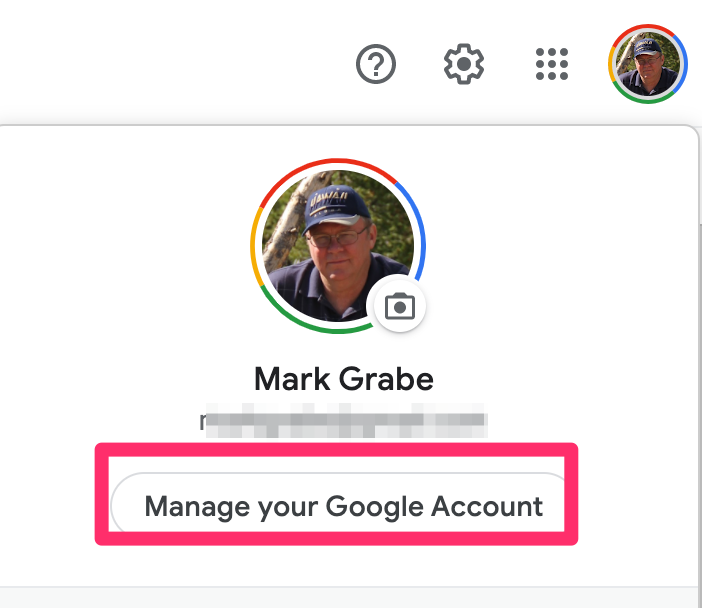
It is easy enough to check you Google data consumption. If you login to any of the Google services you use, you should find your picture in the upper right-hand corner. Select this picture and you should see the link to manage your account.

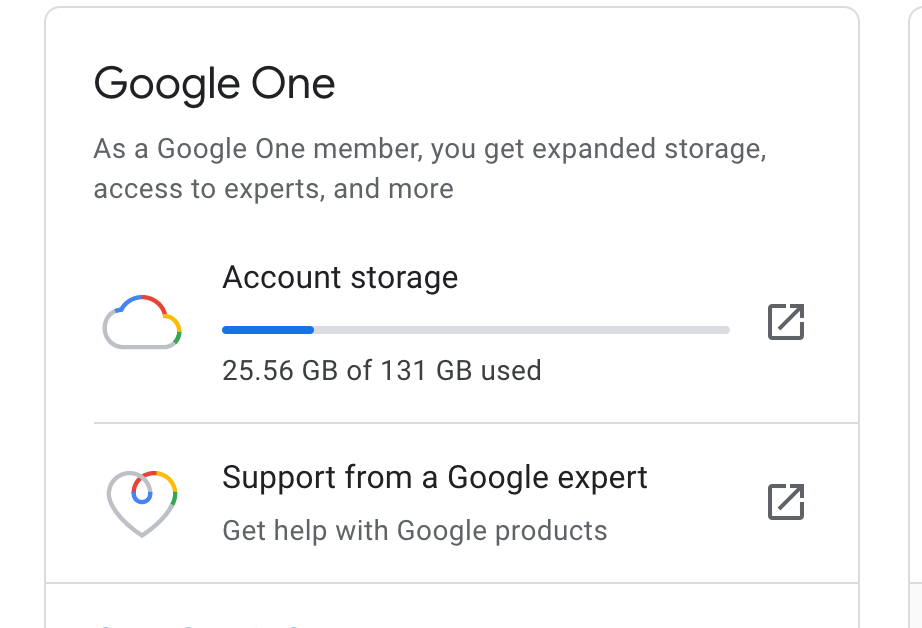
This link should reveal a source summarizing the total of your stored data. You can obtain additional information if you are interested. Multiple services you use (Gmail, Drive, photos) contribute to this total so you may not recognize the cumulative amount. I purchase an extra 100 GB for $2 a month. I see I coud double this allocation for $30 a year.

Loading

Posted in Uncategorized | Comments Off on Google 15GB warning