Hypothes.is revisited

I have been writing about layering services since 2015 and continue to encounter new services and increased interest in the capabilities layering offers. Layering is the term I have tried to use to create a category of online services. There is always a challenge when you decide to create a category others probably don’t recognize. My use of the term implies both a capability and a method. By capability, layering refers to the ability to take existing online content and add elements to (on top of actually is more accurate) this content. The simplest example is highlighting. Many layering services allow a user to highlight the content they read on web pages. Layering services may allow the addition of other elements – e.g., questions, links, discussion opportunities, comments.

The second component of the way in which I use layering involves a method that allows these elements to be added without modifying the original content as intended by the content creator. This would include the opportunity of that creator to serve this content and receive recognition for each time the content is viewed or ads are displayed. This could be very important should the content creator depend on server “hits” or ad views for revenue. I think of a layer of elements that is added as the content from the server used by the content creator passing through the server of the layering service before being sent on to the viewer.

The first layering service I used was Hypothes.is. I remember the motto – annotate the web – but that may have come from another source. While my focus on layering has been on the opportunities layering provides in teaching and learning, my initial experience was of tools for communicating with others about some online content. You could add elements reflecting your perspective using highlighting and annotations and other users of Hypothe.is could see your additions if they had Hypothes.is active when viewing the web comment you annotated. By the way, the spelling with the embedded period is accurate to allow the “is” to represent the final component of a URL in the same way com, org, edu are final components of addresses.

Hypothes.is allowed public annotations (as described above), private annotations, and a system for designating specific individuals who could view annotations(groups). The group function met the type of privacy required for use within classrooms and folks began to use the service for educational activities.

I have no idea if Hypothes.is was the first service with such capabilities or not, but it was the first with the features I was aware of that seemed suited to educational use and the first service I used with a college class. I have since explored other services (some designed more specifically for video annotation) and began writing about these services on a regular basis (use the tag for this post or this address to see related content.

The Hypothes.is community has continued to grow and evolve and developers have added new capabilities, e.g., DropDoc.  If you are new to this type of service, I thought it might be useful to point you toward Hypothes.is and some relevant resources.

Hypothes.is site for educators 

Liquid margins – videos from educators exploring the use of hypothes.is 

Loading

Posted in Uncategorized | Tagged , | Comments Off on Hypothes.is revisited

Text Craft

TextCraft is an online text and logo maker. It offers many options for interest fonts you can use to create headers or signs for various projects.

One of the more popular fonts in Minecraft. The popularity of this service would make it a useful font for teachers to use for classroom projects. I could use the following for the header in one of my other blogs.

Loading

Posted in Uncategorized | Comments Off on Text Craft

Interoperability may be the solution

I like the proposal that finding a way to open up competition would be the best approach to addressing the downside of social media. While options exist and some options may appeal to some users as superior, the network effect of existing users limits the likelihood of individuals switching from one service to another. The network effect roughly means that the value in a network increases as more and more users are added. The typical example is that of a fax machine. If you have the only fax machine, the fax machine is of little value. If one other person gets a fax machine, you now have one other opportunity to send/receive a fax. As another person is added, you now have two options for sending a fax, but that other person also has two options and everyone has more incentive to stay within the system.

The core problem with social media platforms is interoperability. The lack of interoperability enforces the network effect. Interoperability means that you pick one platform, but can still interact with others on a different platform. Think phone numbers. You can change phone providers, but still use your number to call someone with a plan through the provider you abandoned. Instant messaging systems make another good example as many of us have lived through a time when we did not have interoperability and then we could use different IM services and still reach others using a different service.

Obviously, the content we add to Facebook, Twitter, Instagram is more complex than the text of IMs or the audio of phone calls. Other systems might work. When I post this blog entry, this blog platform sends out a tweet. Of course, a tweet can contain far less content than this post, but the tweet ends up saying something like – New Post: Title of the blog post, first words from the post as allowed within the Twitter character limit, and a link to the post. Anyone following me on Twitter would see this tweet and could read the full post if it seemed interesting. I don’t use such a service, but there are plugins that provide a way to send content in the opposite direction – Twitter to blog.

What if communicating among Facebook, WT:Social, and MeWe were possible. If such kludgy methods can achieve a crude level of interoperability, it just makes sense that far more elegant systems would be easy enough for social media providers to offer. The big services simply have no incentive to do so. Regulation from the government may be necessary. If the complaints that consumers have regarding the functioning of social media companies lead to regulation, a remedy based on interoperability would make more sense than worrying about breaking up companies, attempting to designate what information a company can collect to target ads and offer the service at no cost, etc.

The idea might be that customers can select Facebook which collects personal information to provide targeted ads, and allows unlimited images and video or Company B which charges $3 a month, displays no ads collects no personal information, and allows images, but not video. Companies would be competing with features to attract users. With interoperability of identity, consumers could select the company that best met needs and interests and still reach the same population of users. 

I read about the basics of interoperability in The Hype Machine – the discussion in that source is far more detailed and my take on what is possible is intended only to convey the basics of the concept.

Loading

Posted in Uncategorized | Tagged | Comments Off on Interoperability may be the solution

Funding social media

I am a supporter of the position that many of the problems with social media would be solved if there was more competition among social media providers. This is similar to the position taken by Sinan Aral in Hype Machine. However, once a few social media services come to dominate the market it becomes extremely difficult to establish competition. This challenge is a function of the network effect which makes existing services with a large number of participants far more valuable simply because this is where the opportunities for social interaction exist.

I have been exploring social services for some time. One of my favorites, WT.Social, I joined in late 2019. There are no ads on WT.Social, which might be argued to be a competitive advantage, but the site has to overcome the network effect and the challenge of finding a funding model.

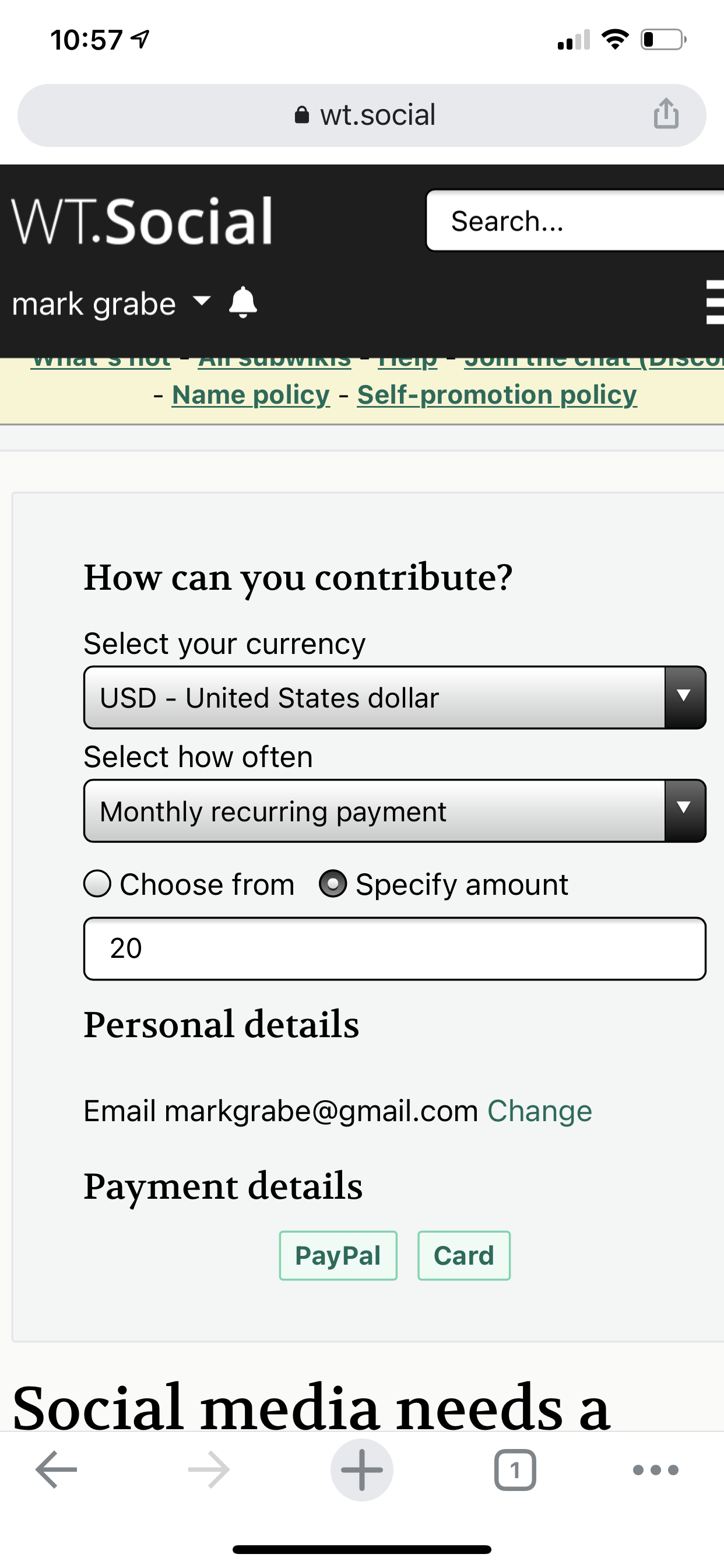
WT.Social is free, but encourages contributions from those who see the benefit in the site. When I joined in 2019, I felt I was contributing more to the site than I was receiving in benefits. This was because I was providing content, but because of the network effect, I received little in social interaction. I also objected to the support model WT.Social was pushing. It expected the commitment to a subscription model. I would have preferred I contributed what I felt was a fair amount given the benefit I received. I wrote to the site several times explaining how I felt and indicating that I was willing to contribute if I was allowed to control how frequently and how much I gave. I reasoned there should be an alternative to free or more than I thought I should provide.

This has now changed. WT.Social has added one time contributions with the opportunity to set the amount provided. Now, I will hang on to see if the service gains in popularity.

Don’t misinterpret my approach to this service. I think there is a real possibility here and it is worth making a contribution or contributions depending on your personal resources.

Loading

Posted in Uncategorized | Tagged | Comments Off on Funding social media

Newseum lives – sorta

I have visited Washington, DC, a couple of times. It has been the site of conferences I attend and we took my parents there because they wanted to visit the Capitol. There are many great attractions, but my favorite was not one maintained by the Government. The Newseum serves in recognition of the importance of the press in our democracy (freedom of the press is codified in the first amendment). I have written previously about the Newseum in recognition of its resources for educators.

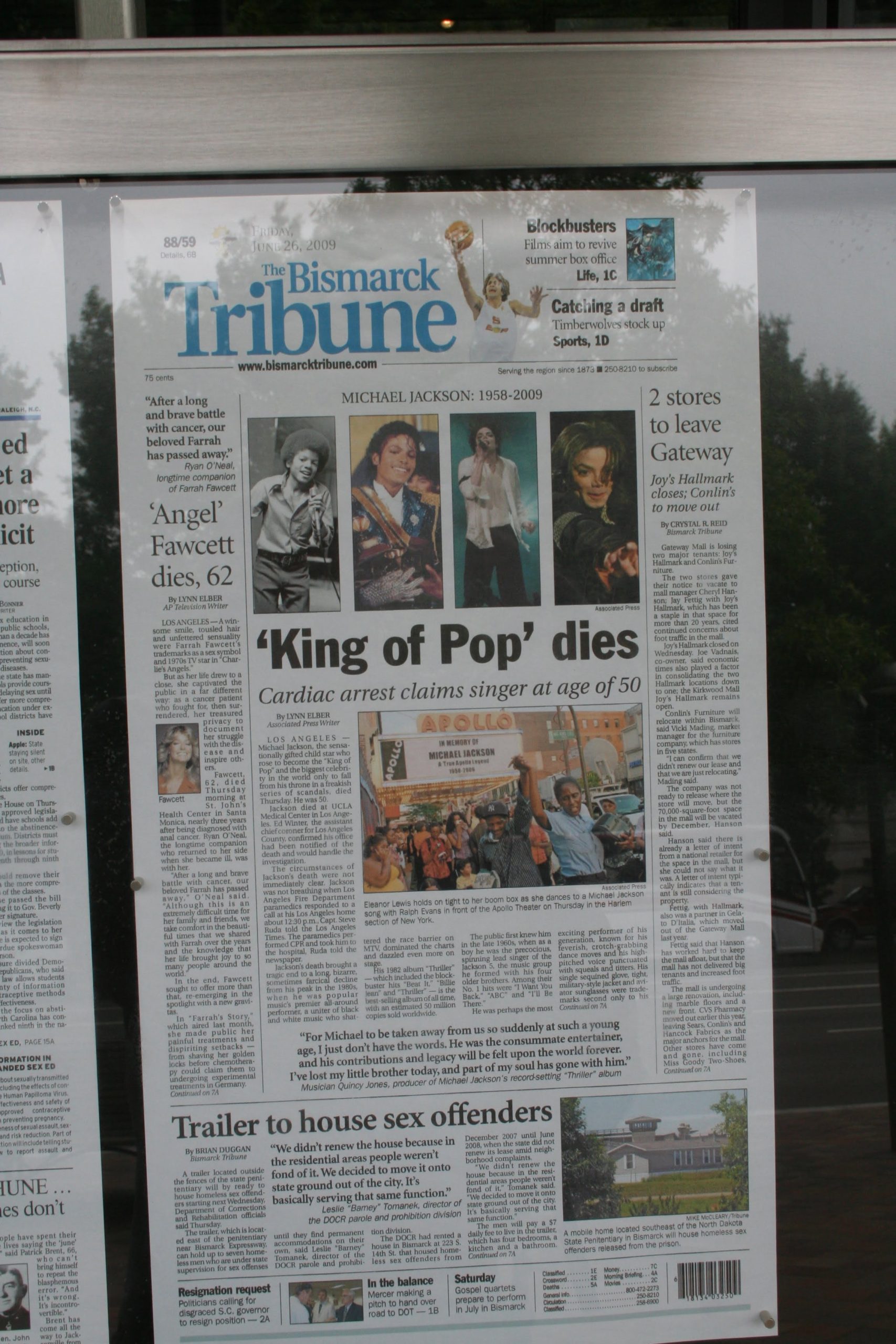
The Newseum offers a display showing the front pages of multiple images of that day.

We happened to visit on the day in 2009 when the front pages all carried the news of Michael Jackson’s death. This was the paper we could locate from North Dakota. Cindy proposed that a great project for students would be to view how the same story was covered in different sources (the front pages are available online).

I remember taking this picture – it is part of the Berlin wall. The other exhibit that impressed me was the memorial to journalists who had died doing their jobs.

You may know that the Newseum was closed. Privately funded with the cost of rent in D.C., it could not meet the costs of maintaining the facility and staff. I generated this post because I read something about the Newseum and learned that it is still functional. The collections of the Newseum and some of the services are held by an organization called the Freedom Forum which is an organization championing first amendment rights. The organization hopes to be able to open a new Newseum if a less expensive and suitable site can be located. The resources created for teachers and classrooms are still available online and work for the educational mission is continuing.

Loading

Posted in Uncategorized | Comments Off on Newseum lives – sorta

Storyline Online

Cindy and I belong to a Zoom group that meets once every two weeks. The group consists of individuals all worked in the Iowa State University hall system as students or grad students nearly 50 years ago now. Most are just now coming into retirement or are already retired (it depends on whether the participants were ungrads or grad students at the time). It is a very interesting group, accomplished as adults, with mostly all small town or farm backgrounds as kids. I am kind of an honorary member as a spouse, but I did live in the Residence Halls with Cindy because her job came with room and board. For older folks, this was the time at which there was a transition from “house mothers” to professional residence all staff – probably way before most readers’ time in higher ed to make sense.

Anyway, we take an hour or two and socialize, but also have a theme we discuss. Selecting the theme rotates. Cindy came up with asking each individual to list three things they had discovered during the pandemic. Mine were Ice Bugs, the Moka Pot, and the Brave Browser. Many folks offer television programs or movies or books.

Last night someone described the value of reading to children with many in the group having been doing this remotely during the pandemic. As part of this discussion, Storyline Online was suggested. Storyline Online streams videos of typically recognizable celebrities (e.g.. Oprah, Kevin Costner, Betty White) reading books. It is a great opportunity for kids to spend some screen time on a literacy activity.

BTW – I had nothing to do with the organization or conceptualization of this group, but it was a brilliant idea and perfect for the forced isolation we now all endure. The mix of a common origin and very different life experiences creates a remarkable experience and an ideal example of the wisdom of crowds.

Loading

Posted in Uncategorized | Comments Off on Storyline Online