More than blogs

I have come to the conclusion that when it comes to encouraging participation and interaction blogs are not enough. I don’t think this should necessarily be the case because the comment feature would allow give and take. If folks ever used the comment feature much, the rise of social media services seemed to siphon off whatever interest in interaction existed.

Facebook has been the social media go to site for most. I do have a presence on Facebook, but I have not invested in posting the education-oriented content I write there. I have an objection to the business model Facebook used to gain widespread acceptance offering a free service that users pay for with their personal information. This personal information does provide for more useful ads, but it also allowed large scale manipulation that has done a lot of damage.

There are quality alternatives to Facebook and I have explored most of them. The challenge they all face is the network effect. The value of social sites over blogs is the interaction that social sites prioritize and once membership builds up to provide this interaction, it has proven very difficult to get Facebook users to even try other services. A quick experiment exploring other sites is likely to be disappointing as there will likely be few opportunities to find others with similar interests.

I have decided to give a couple of other social sites a year commitment and I invite you to join me. I have created a group on these sites and cross-posted content I first added to my blogs so there would be content available for anyone who took a look at these groups. I can’t say I have had much success. I can generate some views of my content, but I can’t get others to post to the groups. As far as total views go, I would be better off focusing on my blogs. Just because I created a group and posted multiple items to these groups does not mean I want the focus of the group to be on what I write.

So, the intent of this post is to offer an invitation to others. Ignore me as the originator of the group. If you are a blogger, take a look and cross-post your material. React to my posts or to the posts from others if such posts materialize. Give it a month or so and see what you think.

K12 EdTech on Wt:Social

Educational Technology on MeWe

Loading

Posted in Uncategorized | Tagged | Comments Off on More than blogs

FCC nominee offers positive opportunities for edtech

President Biden’s pick for FCC head offers positive opportunities for edtech. Jessica Rosenworcel is pro net neutrality, supports extending high-speed access to underserved homes, and specifically identifies learning opportunities in the home as issues she intends to support.

Loading

Posted in Uncategorized | Tagged | Comments Off on FCC nominee offers positive opportunities for edtech

Revisiting what I thought in 2006

I happened across this blog post I wrote in 2006. I was and continue to be a champion of the opportunities for participation the Internet has provided. What I failed to anticipate was the rise of social media services such as Facebook and Twitter which make it easy for individuals to participate on a common, easy to use site. I have mixed feelings about the lack of control this requires.

Read/Write Web Under Threat

Is the read/write web moving toward extinction? Lawrence Lessig argues the negative position from his unique legal perspective. His focus typically involves commercial moves to block creative repurposing of content. The example in this article is kids being asked to desist from creating music videos by adding their own art to commercial music. To tell the truth, I can see the position of the music companies – if I can access a music video and I can strip the music why should I not anticipate that the people who invested to produce the music would not object. I assume this is the concern. Should the companies be concerned? I can’t say – the work to create these products would seem to limit how many are actually available, but perhaps the concern is that such student activities will spawn related ventures and where will the line be drawn?

I think the real threat, if threat can be considered the correct word, is that of commercial resources – e.g., blogs, podcasts from CNN, New York Times, etc. Those individuals hoping to “have a voice” and “participate in the dialog” will likely receive less attention. I am not sure this would bother me. I am still of the opinion that we produce content because we value the experience and, if we feel the need, we find ways to generate our own audience – perhaps by interacting with others who value the social experience as much as accessing the content provided by commercial “experts”.

Loading

Posted in Uncategorized | Comments Off on Revisiting what I thought in 2006

Momentum

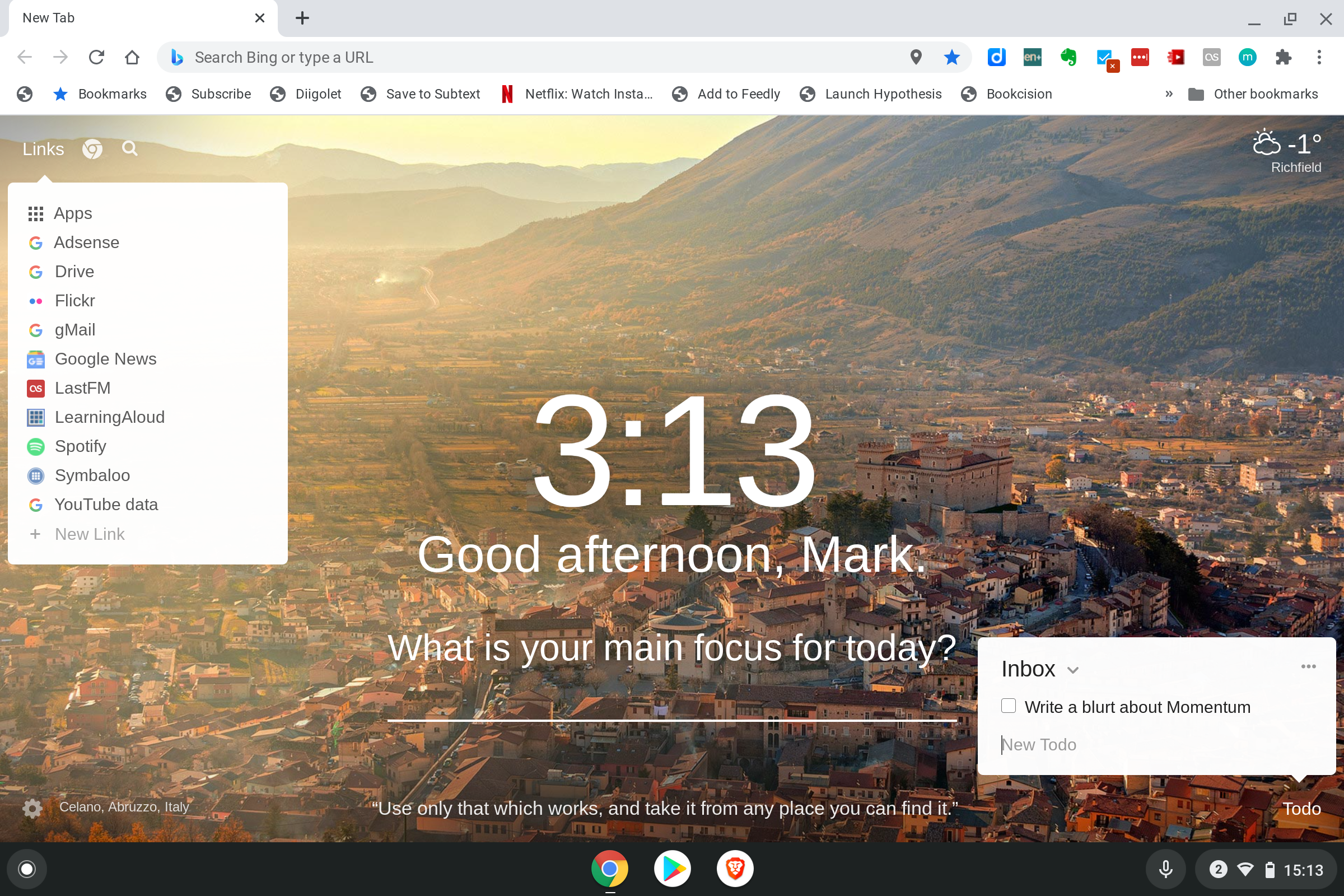
The following images shows my new Chrome start page. The page is generated by an extension called momentum.

I am using the free version at present, but it has most of the features I would use. You can see an interesting background image (the paid version allows you to use your own images. The time and weather (upper right hand corner). A todo list and a list of the links I use most commonly. The paid version is a little over $3 a month and while there are a few features I would probably like, the free start page is nice and I don’t like subscriptions of this type.

Loading

Posted in Uncategorized | Tagged | Comments Off on Momentum

The hill we climb

The poem read by Amanda Gorman at today’s inauguration had to make an impression. PBS already has used the poem as the source for classroom projects and reflection. Why do you think Gorman used the dual meanings of morning and mourning?

Loading

Posted in Uncategorized | Comments Off on The hill we climb

Note-taking and note-making

I happened across this post differentiating the processes of note-taking and note-making. The author suggests that note-taking is most likely the process employed while listening and note-making is more likely possible while reading. I studied note-taking and had not heard of this distinction, but once I understood how the author was using the terms I was able to map the distinction to the older explanations that were familiar to me. The author here describes the difference as something called the generation effect which translates as whether the learner could do more than store information that might improve understanding.

The differentiation between listening and reading as related to note-taking and note-making is mostly a function of the learner being able to control the input to meet working memory requirements for processing. A learner can pause the input of content while reading, but typically not while listening (see my concluding comments for a suggestion). So, if taking notes while reading, the content recorded can include generated additions or modifications such as questions the input causes you to propose, examples the input makes you think of, and even paraphrases of the input that make more sense to you. These additions may result in better understanding.

The research from my past studied note-taking as a potential source of a representation for later study (external storage) and a mathemagenic effect (an activity that generates understanding or retention – mathemagenic implies giving birth to knowledge). The need for external storage may seem obvious, but there are alternatives (e.g., expert notes provided to students) so the question of whether personal notes or expert notes offer an advantage makes some sense. Research did show that a mathemagenic or generative effect was difficult to generate. I am surprised that the author I reference claims that the Cornell system is a note-taking system and creates little benefit. I would classify one approach to the use of the Cornell system as note-making. The Cornell system involves a page divided vertically into two columns. As I understand the intended use, traditional notes are taken in the right-hand column and the left-hand column can be used in various ways. When I describe the possibilities of using this column I would claim it provides opportunities for additional processing – highlighting important ideas, identification of confusing sections that might require asking for help, interesting examples that come to mind. These ideas would seem nearly ideal examples of note-making.

Anyway, I have been promoting technology-enabled note-taking I propose allows learners to overcome the limitations of taking notes on paper. This type of tool allows a learner to overcome the issue of working memory limitations that plague note-taking while listening. There are multiple tools that are examples of what I have in mind, but the one I have used for years is SoundNote. This tool records audio and simultaneously allows note-taking. The notes are automatically linking to the point in the recorded when the keyboard or stylus enters a note. So, when studying, if there is something confusing about the notes, clicking on a note allows a review of the associated audio content. Working memory overload is avoided by separating the taking of notes from the need for external storage. You end up with a complete audio recording and your notes. The notes would be more personal and efficient to review. The audio is always there as a backup. You learn to even enter a placeholder when you miss something you did not understand well enough to summarize in a note – “confusing stuff” or several question marks ???. The digital notes can also be upgraded once class is over. If you review notes immediately, you often think of things you did not record. You can also create a more complete set of notes later by reviewing sections of the audio.

Loading

Posted in Uncategorized | Comments Off on Note-taking and note-making