Diversify Social Media Commitments

I encourage people to participate in social media experiences other than Facebook and Twitter. I have a general issue with platforms that approach monopoly status as this gives these platforms too much power and limits innovation within a given sector of the economy. I like to spend some of my online time with platforms that don’t depend on ad revenue and the collection of my personal information. I admit it is a struggle because folks don’t like to make such changes and become comfortable with the social group they have on dominant platforms.

Here are a couple of suggestions for alternative platforms.

Wt:Social is a Facebook alternative developed by Jimmy Wales. It has a general feed like Facebook that provides access to posts from individual subwikis a user joins. I am not certain why the wiki label is used to describe these interest groups. Users can collectively modify posts if the original author designates a post for that purpose, but most posts are intended to be static with attached comments from other users. This post from LifeWire provides a nice overview of this platform.
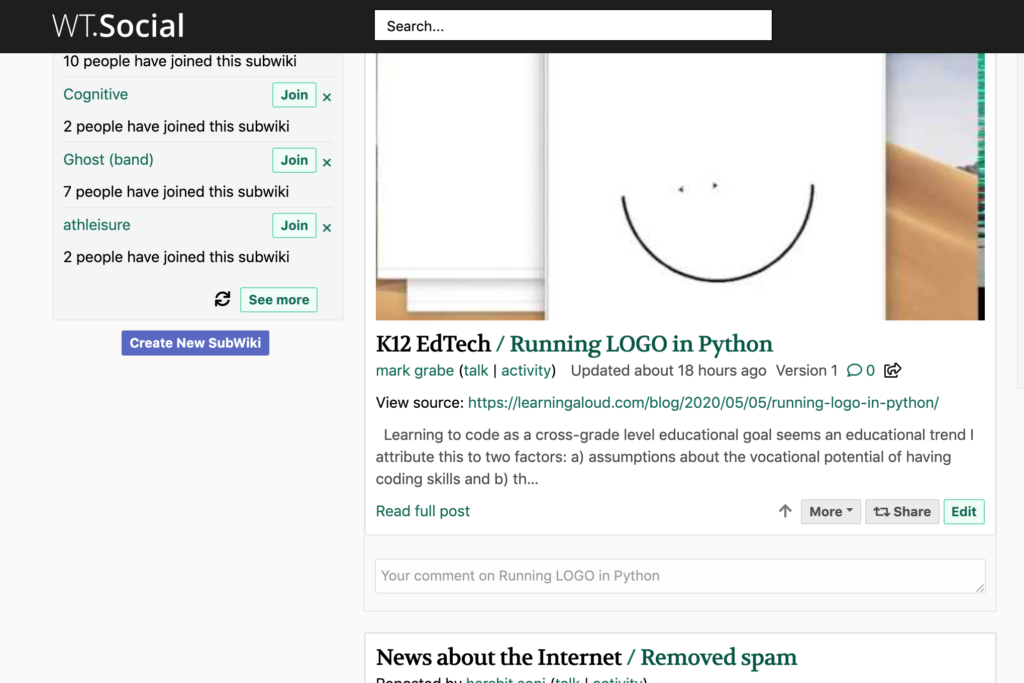
I admit I have been a bit discouraged with the social experience to this point. The technology itself is great, but subwikis that sound interesting often have many members, but few posts. I have not had much luck attracting others to a subwiki I started, but I am sticking with it. I mostly cross-post things so I see this an effort to get Wt:social going. If you give wt:social a try, search for your interests and join a few subwikis to get started. Make certain you post and comment.

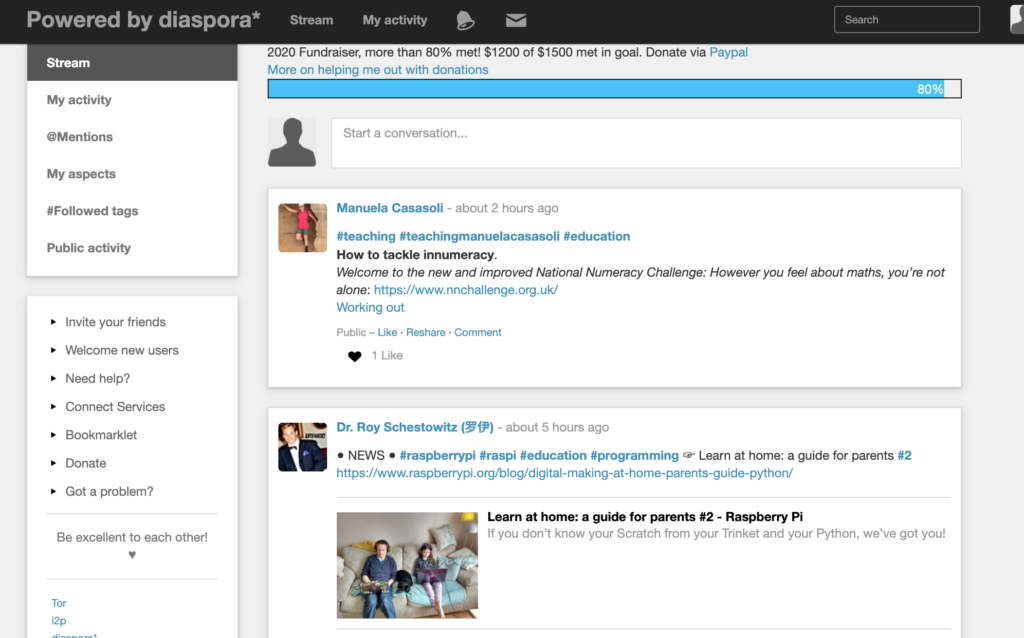
My second interest has been diaspora. This project is based on a federated model. So, there are multiple sites running the diaspora software. You join one or more that interest you, but you can also experience a public feed combining the content added to the multiple sites. This seems a great idea, but the public feed is too big and too random. I haven’t really found a site focused on educational issues which would be what would be of greatest personal interest. I thought about hosting a site, but the way the software is developed it would too difficult for me to implement on my server space.
Loading

Posted in Uncategorized | 2 Comments

Insight into online learning for all

The expectation that all K12 students would have to spend at least some time learning online caught everyone by surprise. Approaches had to be initiated quickly by those without previous experience. While still early in the process, initial reactions have been mixed and everyone is considering what has been learned to improve future efforts. Here is a resource from the Minneapolis Foundation drawing on experiences of local educators and input from the University of Minnesota.

The report offers background, philosophy, and recommendations. For educators wanting to go directly to the recommendations, scroll to the Appendices.

Loading

Posted in Uncategorized | Tagged | Comments Off on Insight into online learning for all

Make use of Brave support for creators

I have been an advocate for the Brave browser and ecosystem for some time. The developers of Brave have created a browser that prevents the collection of personal information AND supports content creators through ads that don’t leverage the personal information of users. It is easy enough to block ads, but this ignores the responsibility to compensate content creators who assume the ads the allow associated with their content will be viewed.

Brave does not automatically compensate content creators through the display of the ads it displays, but requires users to both opt in to view these ads and to share compensation with content creators. If you don’t want to view ads, you can agree to fund creators through micropayments when you view creators who have agreed to an arrangement with Brave. This is done through the use of BAT – a cryptocurrency you purchase. I invested $50 in BAT some months ago and I now have more money in BAT than I invested. I don’t understand or bother to investigate how the value of BAT is determined, but the value of what I invested has increased at a faster rate than I have designated for compensation.

If you agree to see ads, you can also earn BAT. So, you don’t have to actually put money into the Brave system, but you can earn BAT and then use these “funds” to compensate content creators.

However, this article notes that only 12% of Brave users have taken the steps necessary to compensate users. So, these users are blocking ads that appear on sites, but not bothering to take simple steps necessary to replace whatever the revenue to content creators was with the resources Brave makes available.

Here are the action necessary. Again, even if you don’t put money into Brave, you should at least make the effort to replace the revenue lost by blocking ads.

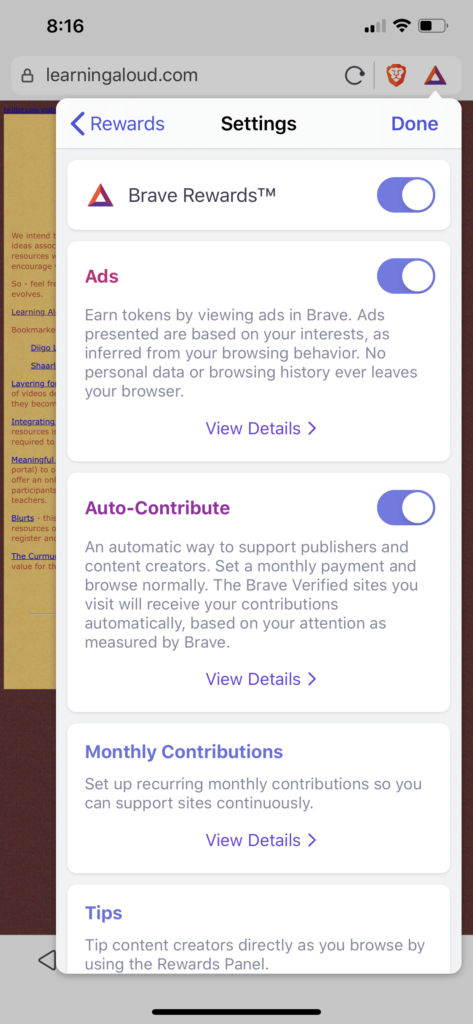
The red triangle that appears at the top of the Brave browser window provides access to the sliders allowing ads to be shown and allows revenue generated to be shared with content creators.

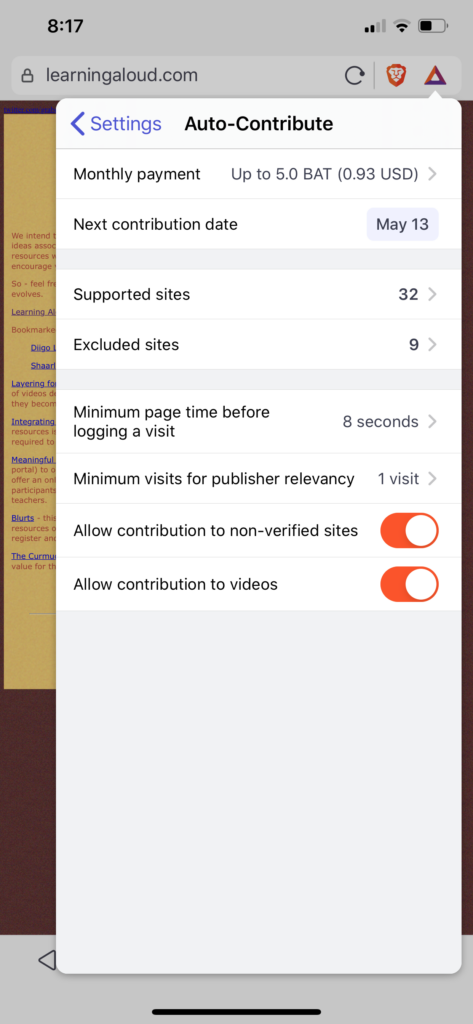
The settings accessed from the auto-contribute “view details” of the autocontribute section provide information about your ads viewed and allow you to set your monthly contribution to be divided among authorized sites in proportion to the time you have spent on those sites.

Loading

Posted in Uncategorized | Comments Off on Make use of Brave support for creators

Google tools for online instruction

Google has generated a useful summary of its tools for teachers now working with students online. The summary would be particularly useful to teachers working within the GSuite environment and looking for a few additional ideas to diversify students experiences in the time remaining this year.

A related video resource is Google Edu in 90 (90 seconds). These short videos explain specific capabilities of Google tools for education.

Loading

Posted in Uncategorized | Tagged , | Comments Off on Google tools for online instruction

What if ….

This article from the Wall Street Journal describes the decision of some states and districts to just end the school year instead of trying to finish the year online. [As an aside, I know this article is behind a pay wall and you may not have a subscription. I would recommend the Apple News subscription as a remedy. You get access to multiple magazines and several papers including WSJ for $10 a month.] The states include Texas, Georgia, and D.C.. I understand that teachers had little time to prepare, many students lack the necessary equipment and bandwidth, parents struggle to assist, etc.. I also understand that stopping a few weeks early will not be catastrophic in the big scheme of things. Our family lived through an early closure 20 or so years ago when Grand Forks, ND, was completely flooded and the city was shut down for months. There are circumstances that warrant giving up for the year.

Still, I wouldn’t have shut down. I would have reduced demands and expectations and carried on. What if this is not the end and it is not practical to open as normal in the Fall? The same challenges will exist in the Fall and states, districts, educators, and parents will have had no experience to draw on. It is possible budgets in the Fall will be even worse than at present. It is possible there will not be new money to provide devices and hot spots for families presently in need. It is possible that state budgets will require cutbacks in school personnel and funds for the purchase of curriculum materials designed for technology-based delivery. It is possible there will not be funds to bring educators back a month early to prepare for online instruction. Why not use the present as a time to explore and develop resources?

I think it very possible the time we are living through will generate permanent changes in many industries and the new normal will not be the same as the previous normal. Exploration, research and development, or whatever you want to call the invest in exploring options is desirable even in fields that are resistant to change (education). I think many states are passing up an opportunity.

Loading

Posted in Uncategorized | Comments Off on What if ….

Google Meet for all

As the competition between many to many video services has ramped up, Google is making Google Meet available to all users (not just those participating in a GSuite program). The present capacity is 100 participants for unlimited interaction, but Google suggests it may cut the time limit back to one hour at the end of September.

If you have tried Google Meet don’t expect it to just start working, the service will be rolled out and you should enroll to be notified using this link

Loading

Posted in Uncategorized | Comments Off on Google Meet for all