YouTube for Kids

YouTube offers age-grouped collections of videos for children and adolescents through a version of YouTube labeled YouTube Kids. Before I go further I acknowledge that some have issues with this program. There are two issues; a) videos may contain ads and b) videos may be inappropriate. People have various views on how serious these issues are. Google claims it selects videos carefully for the different age groups served by YouTube kids. Google also claims the same for the ads. It is possible to use the service without ads and to designate what channels children can see, but the best of these controls requires participation in a paid plan. What I describe below is the fee (ad supported) plan.

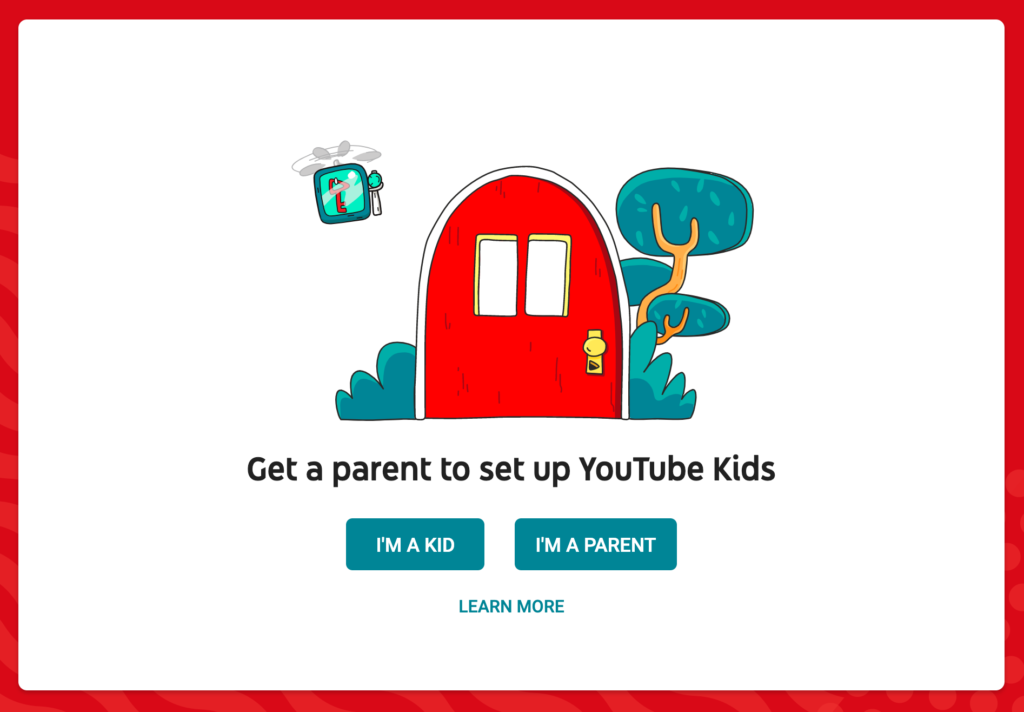
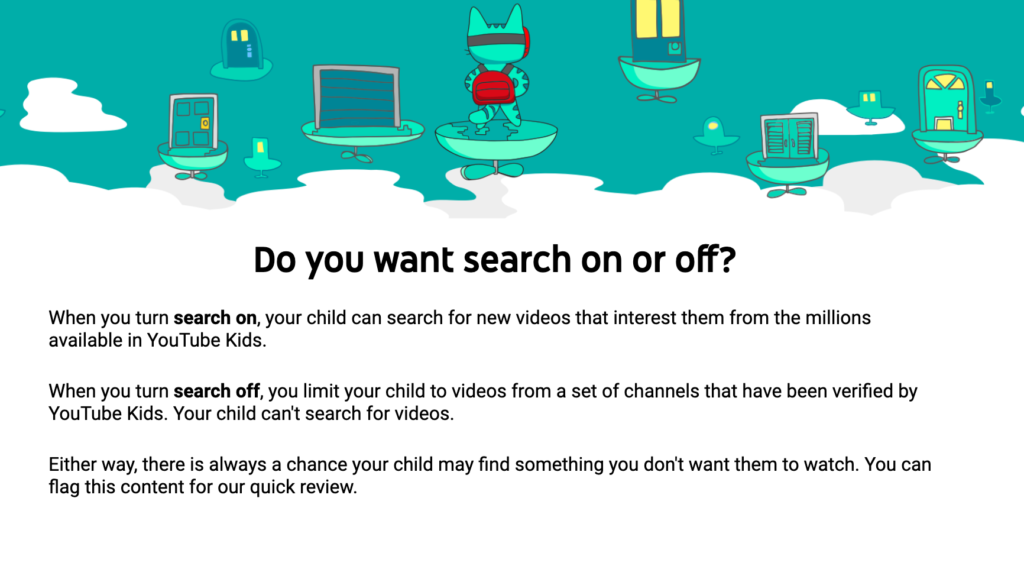
A parent or guardian sets up a YouTube Kids account. There are a couple of settings to consider at this point – a) the age group of the child and b) whether you want to allow searches.

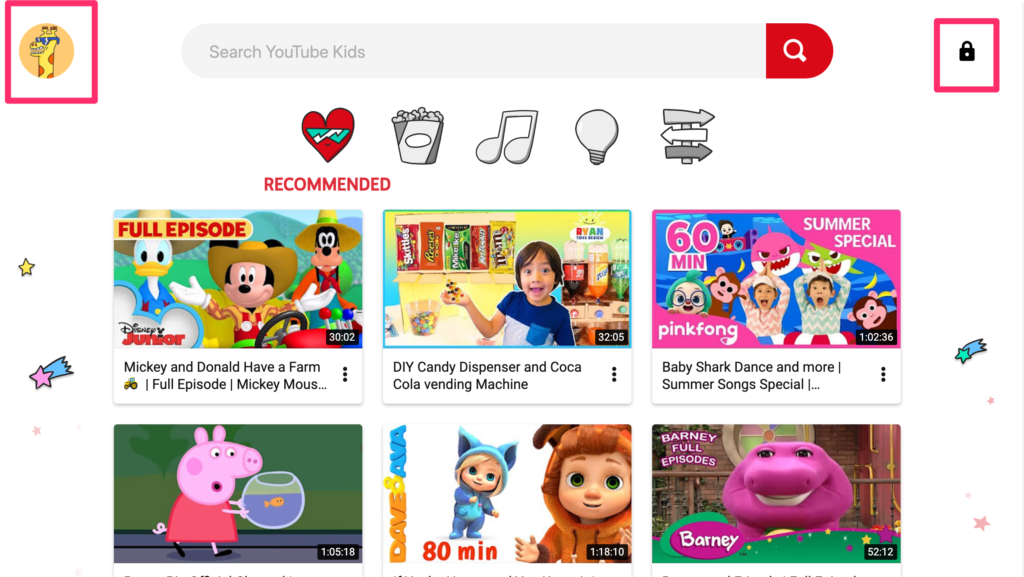
The video access screen looks like this. Across the top are icons for movies, music, and educational content. The content associated with a selected category appears below. This account has been set up to allow searches. The two red boxes offer a parent/guardian options. The lock icon allows adjustments to the settings for a particular child. The icon in the left shows the history of videos viewed. If for some reason content that has been viewed does not meet parental approval, there is a way to block content from that channel.

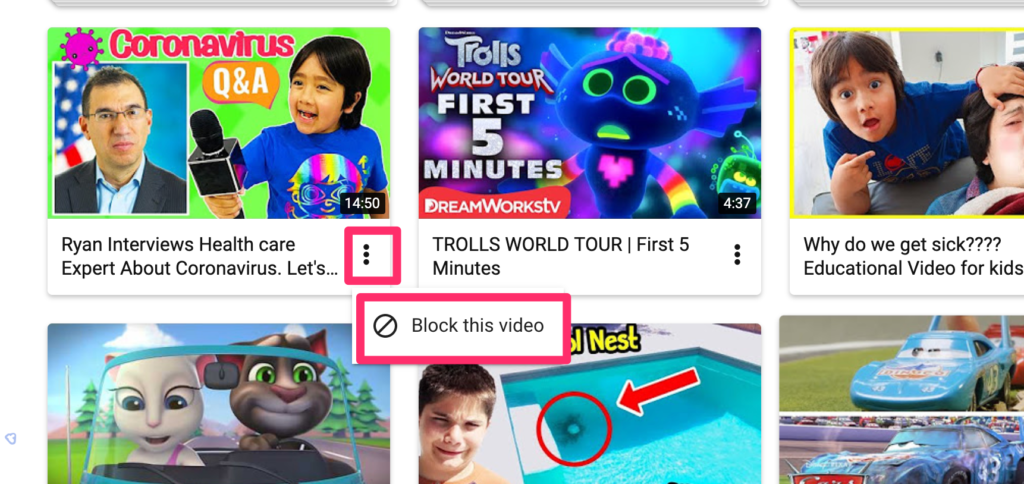
In the lower right-hand corner of the image for most video channels, you should see three dots. Selecting this icon allows the channel to be blocked.

Adults may have a different reaction toward children viewing ads than toward their own exposure to ads. Perhaps adults might try to block all ads. Note that Google does offer the opportunity to subscribe to a service that blocks YouTube ads. I have this service as a secondary benefit of paying for Google Play Music. When blocking ads it is important to consider that ads provide revenue for Google and for some content creators. The subscription option provides an alternate way to support these services.

Loading

Posted in Uncategorized | Comments Off on YouTube for Kids

Zoom security upgrade

Zoom is making some security adjustments in response to widespread criticism. For business customers, Zoom now allows the selection of a server location avoiding the concern that content would be routed through China. Education users will now have passwords by default (the individual initiating a session could require this previously) and provides a “waiting room” allowing the initiator to control entrance to a meeting. These enhancements should limit that intrusions of unexpected visitors in a meeting.

Zoom was quickly challenged by Google Meets in the education space in response to the security risks in Zoom. Now, I see Facebook is offering a group video opportunity for up to 50 users.

Loading

Posted in Uncategorized | Tagged , | Comments Off on Zoom security upgrade

Paul Kirschner – Distance Education

Kirschner is an academic I follow and he has made an effort to identify principles for online education. I like what he has to say because he describes some basic ideas for secondary students. Kirschner is a fan of Loom as a way to demonstrate key ideas. [My own Loom YouTube tutorial]

A short outline of key ideas. Among the topics Kirschner emphasizes is the metacognitive demands students must exercise when working independently.

Loading

Posted in Uncategorized | Comments Off on Paul Kirschner – Distance Education

News – a version for kids

I heard that NBC and Lester Holt are starting a nightly news program for kids. In attempting to find more information I found this story from Variety that highlights the new NBC program, but also provides information about other efforts based on roughly the same idea.

I found the first NBC program available from YouTube.

Loading

Posted in Uncategorized | Comments Off on News – a version for kids

One Nation Many Stories – Ken Burns

PBS and Ken Burns are making much of the historical content from Ken Burns available through a new site – One Nation Many Stories. Together with Ken Burns in the Classroom the content and lesson ideas make a great resource for teachers. I was astounded to find that one can watch the entirety of some of the collections (e.g., Jazz) which I purchased when first released.

Loading

Posted in Uncategorized | Tagged , | Comments Off on One Nation Many Stories – Ken Burns

How is online ed going?

There is danger in evaluating anything from online comments, but for many issues those who find something acceptable seldom comment. Hence, I see many negative comments about their personal online experiences or the experiences of children reported by parents. Some college students want their tuition dollars refunded. I don’t know if they expect to then receive course credit in addition to their money back or just a refund and they will try again in a future semester. Districts report that despite their efforts to offer instruction many students simply don’t show at designated times or assigned work does not get submitted (NPR report, Twin City Schools).

Parents report their kids receive too much or too little work and they must attempt to teach what they don’t understand in terms of the content itself or the assigned activities. The comments that I admit irk me are those from educators and even educational tech folks who make such comments. “My kid loves school, but now cries when he/she has to do an assignment.”

It is difficult to evaluate these complaints. Clearly, students didn’t sign up to take courses from their kitchen tables using a laptop or an iPad. The homework issue has been in dispute lately, but this new online situation has increased the complaints. As far as expecting kids to work after school goes, teachers are in a tough spot. More is expected of them and the performance of the students they teach is used to evaluate the educators and their school, but somehow high standards are expected to be met with less time for students to learn. Now, some of the issues are the same – why this much time after school hours? Many complaints are different and more related to requirements placed on parents.

I don’t know what to make of the present situation. I have considerable experience teaching online, but my experience has been with adult graduate students who signed up for the experience purposefully because they could not attend a face to face class on campus. Our online class is face to face with the exception of those who have time conflicts and must use recordings to obtain the information covered. I wouldn’t want to have to watch the other students discuss the content for the week with the instructor either, but again this is the practical reality of our situation. For the most part, I think everyone accepts the approach and the adaptations to their situations.

I would have suggestions based on these experiences for others teaching adults. Aside from how to use Zoom, Blackboard, or tools available for writing and discussion, I consider my knowledge and experiences based in my direct role as an online educator of little value to K-12 educators. Tools and tactics I can teach you. I don’t know what to tell you regarding the students who don’t or can’t participate or how to structure a task should the assistance of a parent be required to deal with the technology or the learning assignment. I think we all are trying things based on practical sense in such situations.

When we work with preservice teachers and the type of practicing teacher I have just described, we focus strongly on the use of technology in face to face situations. I recently came across a study indicating that 3.5% of preservice teachers had any chance explore to online learning experiences as part of their field experiences. I don’t mean using online resources, I mean teaching/learning online. Even though the percentage of K12 students (mostly secondary students) is edging upward, educators aren’t prepared to teach in this way. This is a specialization few teachers expected to undertake so why take time to create the circumstances for teachers to acquire this type of experience?

I think my advice in the present situation is to be tolerant and try to appreciate the situation others find themselves in. This suggestion applies to those complaining and also to educators expecting collaboration from parents. Some are concerned that online instruction will become our new normal and education especially higher education will never be the same again. I hope this is not the case, but if for whatever reason this is true try to look at our present circumstances as the first real opportunity to explore ideas about distance learning on a grand scale.

Loading

Posted in Uncategorized | Comments Off on How is online ed going?