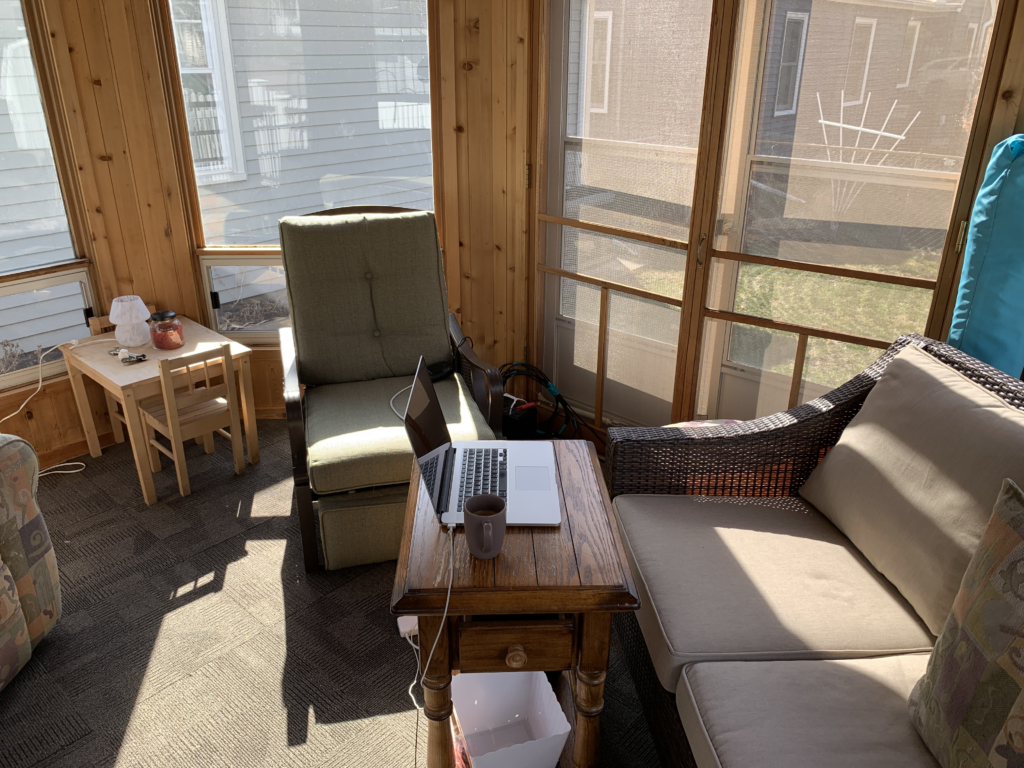
I love working in coffee shops. Retired or not, I still call reading and writing my work. I am not sure why I think or at least imagine I work better in a coffee shop. Perhaps the distraction of those around me offers a break or maybe some spark to my imagination that keeps me going.
I have been trying to recreate the coffee shop feel in our gazebo. It seems a reasonable substitute while we are social distancing. I have music. I have wifi. I am all solar powered while the sun is out to keep the place heated and they power on thanks to my solar panel. I don’t have the chatter in the background. I miss those old ladies playing mahjong.
Posted inUncategorized|Comments Off on That coffee shop ambiance
In this period of the U.S. government considering how it might subsidize various components of the economy in response to the shutdown caused by the Coronavirus, the Wall Street Journal offers an article asking whether Internet access should be included among other subsidized services. I apologize for the link to a resource that is behind a paywall. I have this habit of citing sources and I can read the WSJ because it comes with the Apple News+ service we pay to use. Some news sources have not protected their pandemic related stories, but this does not appear to be the case with this article.
Working from home is the new normal for many and this includes some in health care, education, and others providing services needed by many. The present Senate bill has a small amount of funding for mobile hot spots.
My own experience involves distance education. I have taught a nunber of online courses to graduate students interested in the application of technology in education. This is not the ideal situation for gaining more general insight as expectations for my activity were supported by a university and my area of expertise itself assures I have the background and equipment to function in this capacity and the same would be the case for the advanced students I work with.
This is not the case for others in higher education, for some K12 educators, and for the students who find themselves at least temporarily relying on an online approach to teaching and learning. It is not always a matter of motivation. Low-income families are more likely to face barriers involving internet access and equipment. Many schools with 1:1 plans can send computers or tablets home with students, but this does not alone assure connectivity. Some schools also have the resources to provide mobile hotspots to needy students. The issues are often more complex than might be assumed. If schools do not provide equipment, what about those families that rely on one device. What happens when three kids need to connect with their class in real-time to receive instruction.
There are also so many issues related to the quality of the learning experience. How much training do educators require to take advantage of the unique requirements of one to many online instruction? I am not a fan of assumptions often made regarding class size. It just takes more time to accomplish the same thing when interacting via the Internet. Thirty student high school classes or the hundreds we often teach at a time just don’t work the same online.
More equipment, more bandwidth, fewer students, etc. all are financial issues. What about laboratory experiences? The list of questions about how it can work and how it can be paid for go on and on. The present situation will offer a great opportunity to explore and the government and some commercial Internet service companies are easing the burden, but there are real costs here that need to be covered.
Posted inUncategorized|Comments Off on Subsidizing Internet Services
Our son Todd and his creative family came up with this activity as a way to have a daily fun event that involves others. Each day they take a walk and each family member takes a photo of the same scene. They post these photos as a collection to Facebook and ask their followers to pick a favorite. The winner is calculated and that person gets to pick the location for the next shoot. There must be variations on this idea that others may find a way to implement.
Posted inUncategorized|Comments Off on Family Photo Contest
I am going to update some of my existing content that seems appropriate for educators working from home.
VideoAnt is a system for annotating existing videos developed at the University of Minnesota. It would be an example of what I call a “layering” service in this case focused on video. A layering service allows the repurposing of existing content (video, web pages) generated by others to better serve an educational purpose by adding elements (comments, questions) to what already exists.
The present situation may leave many of us trying to find productive ways to spend our time. There are no sports to watch. We are nervous and need a distraction that offers some redeeming value. My recommendation for educational technology advocates is to explore a different online service that may have value in a classroom or for professional development. This type of project is flexible enough to fit personal circumstances.
My recommendation would be wt.social. This service is still under development by Jimmy Wales and crew. You may recognize Wales as the developer of Wikipedia. I have explored multiple services on what others have described as the indie web and I think this service has a reasonable chance of gaining traction. One way to understand wt.social is as an alternative to Facebook. I see it a little differently. I would describe the service as a way to identify and subscribe to topics maintained by different groups that collectively result in a feed. In the following image, you should be able to see what I mean. I have subscribed to several topics (subwikis in the red box) that generate a feed (green box).
I endorse the diversification of our collective use of social media for multiple reasons. Among my personal reasons is the need to oppose monopolies as a way to encourage continued development and as an opposition to the collection of personal information as a way to support most existing services (this is different from the issue of displaying ads).
If you decide to give wt.social a try, you will encounter a request to subscribe to the paid version. This may speed up your membership, but I did not pay and I was granted membership within 4 days. My concern which I have shared with the founders was that I would be willing to commit funds ($20 – I have been donating this amount to the startups asking for contributions), but the subscription options available seemed more than the service justified at this point. As a startup, this is the dilemma – the business needs funds to ramp up and the product has yet to get to a level warranting substantial payments. I think as a practical matter this is now, even more, the case than it was a few months ago. People are going to be resistant to adding another expense in uncertain times.
If you decide to give wt.social a try, take a look at the k12-edtech subwiki I have established. This may look like a personal blog at present. This is not the intention. The subwiki offers a place for all members to submit content. I just established the topic. To assure others that some content would be available, I uploaded posts from my blogs. There are too many existing subwikis that have nothing in them when you visit. This is a startup problem and seeding this wiki with content I had available was my solution. This is intended to be a shared space.
Posted inUncategorized|Comments Off on Explore a new tool
We use cookies to ensure that we give you the best experience on our website. If you continue to use this site we will assume that you are happy with it.
You can revoke your consent any time using the Revoke consent button.
You must be logged in to post a comment.