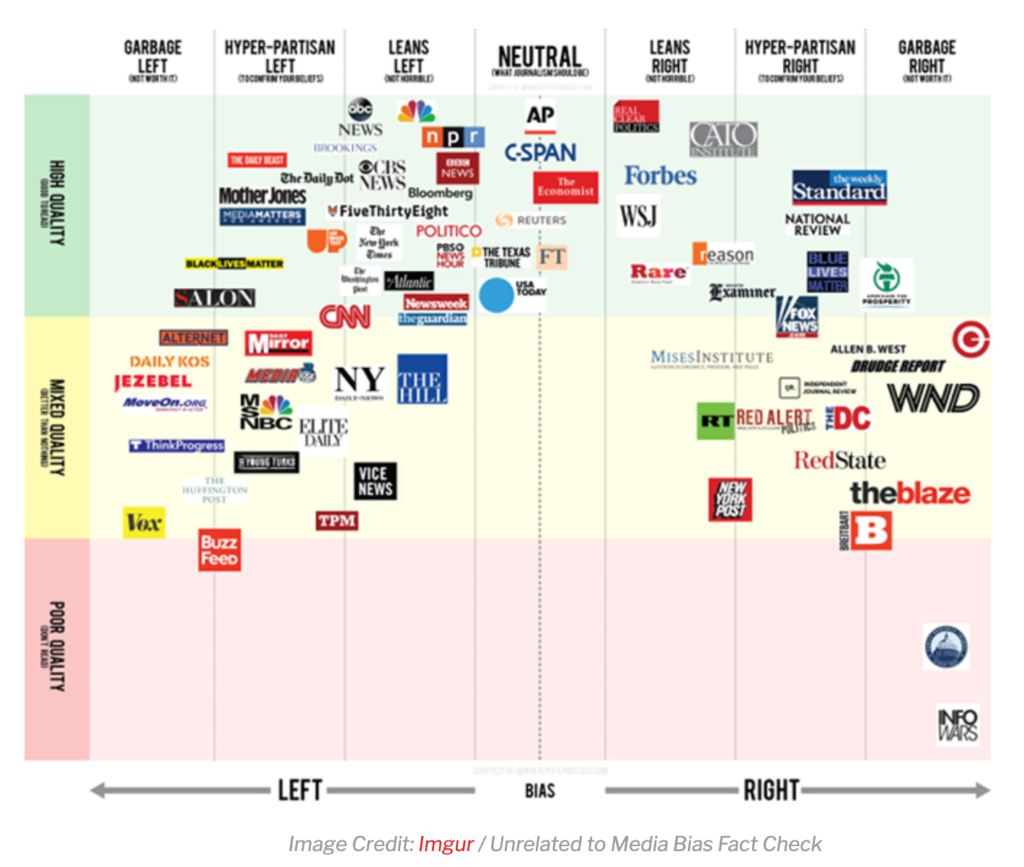
I found this article from Make Use Of to be helpful. It argues that the Spin and Accuracy of different news outlets to reflect different issues. In other words, the factual accuracy of claims made (facts) can be differentiated from the opinion/interpretation placed on these facts (spin). The article contains a useful chart if you would like to search for their take on your favorite sources.
Obviously, avoid content sources of greater bias and fabricated content.
My workflow involves exploring lots of online content, finding a few things I think are interesting, saving these things for possible later use, and when I am looking for something to write about exploring this stored content for possibilities. I have my way of doing and I have an approach that is consistent across whatever device I happen to be using. Typically, I explore with Chrome or Brave (based on chromium) and use an Evernote extension to store content in Evernote.
My standard approach aside, I do try to keep up on how others do the same thing. Personal preference and budget constraints can influence decisions and I want to be aware enough to be able to offer suggestions for others looking for options.
I encountered an article describing how recent version of iOS allowed users to screen capture a complete copy of a web page and save it as a pdf. It was unclear to me how this worked and I tried the strategy I was familiar with for iOS screen capture and it not seem to work as advertised. I could capture what I saw on the screen as a photo, but I could not figure out how to capture the parts of a web page I did not see on the screen. I had the most recent iOS version and there were no setting options so I was befuddled. Try as I might, I could not find the two buttons allowing me to select screen or page.
Eventually I figured it out. If you want to save a pdf of a web page in iOS here is the technique you need. My problem was it was not obvious to me from the article that this only works with Safari. I have built my work techniques around Chrome and chrome extensions. The option of screen or page only works with Safari. Execute the screen capture double button press in Safari and when you open the thumbnail of the screen for editing you will see the options of what to save. You save a screen as a pdf or photo. You save a page as a pdf. PDFs can be saved to files or to an online storage option such as Google Drive. I won’t change how I presently do things, but I can imagine a way to make the pure Apple thing work.
Posted inUncategorized|Comments Off on Safari Screen Capture
This is a followup to my last post in which I encouraged the viewing of the Frontline documentary on Artificial Intelligence. In that post I promised to recommend a few books related to the topics covered in this documentary. My recommendations follow. For each recommendation, I will provide a brief description. For each recommendation, I include a link to Amazon for the book and a separate link to a video or document presenting similar information
Thomas Piketty – Capital in the 21st century – Piketty explains how wealth is being concentrated in a smaller and smaller proportion of the population. TED talk.
I encourage everyone to view and seriously consider the recent two-hour Frontline special on artificial intelligence. The program does a great job of exploring the wide impact AI will have. The positive and negative changes that are coming will seriously challenge our assumptions about how things work. The program covers international competition for developing these new technologies (U.S. and China), the likely impact of AI and related technologies (robotics) on job opportunities, and how AI will impact wealth disparity as new developments further advantage the advantaged because capital will have an ever increasing impact relative to personal skills and accomplishments.
When I read about and buy in to the reality of disruptive change, I immediately wonder what role education must play. I see education as providing a mechanism not only capable of developing skills and dispositions suited to new circumstances, but also to necessary changes in values. My existing liberal perspective already encourages a sensitivity to justice and equity issues. This documentary argues that the disruptions we are now facing (AI, climate change) only increase the damage to legitimate equal opportunity. Our assumptions about government will also need to adjust. Unfettered capitalism may be great for encouraging innovation, but the level of innovation that is coming will require oversight to protect large segments of the present population.
I am not arguing that AI applications should be avoided. This makes little sense. I do think we have learned that powerful technology innovations have unforeseen and even foreseen but ignored negative consequences we have not taken seriously. The issue is whether we have the collective will to address negative consequences and how this collective support will be directed.
The Nightline special involved several authors I have read and influenced my thinking in the last year or two. There is some reassurance in seeing others rely on the ideas of perspectives I have already found to be persuasive. I intend to create another post recommending a small number of books that develop some of the ideas explored in this special. Start with this Nightline special and you may find that some of these books are worth your time.
Posted inUncategorized|Comments Off on Implications of AI
A recent post from The Commons proposed that universities might drastically reduce the student cost of textbooks if the institutions funded faculty members to write textbooks. I wrote a couple of textbooks for Houghton Mifflin that eventually ended up with Cengage and had at least one being sold for 15 years. I have an interest in alternate models for textbooks that eventually led me to complete a deal with Cengage allowing me to take back my copyright and explore the alternative model that interested me through Amazon. This post is not about my and my wife’s personal story as textbook authors, but I did want to argue that I have both relevant experiences and an interest in alternate approaches to educational content.
I do believe that expertise and effort deserve compensation. Where this compensation should come from is the issue. I also believe that some folks are better at this than others. This is true of teaching and research and I see a quality textbook as kind of a combination with the added requirement being the capacity to write effectively. With authors writing for textbook companies, the company takes the risk on quality. I am not so naive as to believe that companies always make the best decisions and other factors do come into play, but it is in the financial interest of companies to put their support and reputation behind good products. Since, this requires that the companies expect a profit on their decisions, the issue is whether this capitalist advantage is worth this extra cost to the consumer. It is important to understand that a personally authored textbook does not come with the editorial expertise, design, and multimedia professionals that come with a commercial contract. You also get sales reps, but it really is the first set of resources that are most important to the quality of a project. Because I believe in the contribution made by quality textbooks, I am willing to say that whether OER options are close enough is an interesting, but unresolved question. The OER research is pretty messy by research standards so whatever others read into some of the simplistic conclusions I see are likely motivated by personal perspectives that scholars would not apply to other areas of research. Some type of federally or grant organization effort would be required to really evaluate the quality issue. Unfortunately, most of the funded efforts are more focused on distribution than content creation.
The Commons article proposes a couple of interconnected ideas. The first is that universities should fund textbook development and the second that such textbooks could be remixed by others as a kind of Creative Commons resource.
So here is how I see the experience for an author. Because of the assumption of a remix opportunity for any instructor, this would have to be considered a one shot product for the original author as anyone could revise with no continuing benefit to the initial author. The question becomes how much would it take to entice an author to write a textbook from scratch with no real opportunity for the revision market. To be fair, a commercial author is taking a significant chance even when receiving a small guarantee (say $5000) from a publishing company. The effort could easily be a one and done. Spending the time to author a “one and done” probably means your take would be less than $10,000 for the generation of a 1000+ page manuscript. This is a process that requires considerable research so the writing and revision is only part of the process. The notion that you simply sit down and write based on what you teach was not my experience.
I can’t really remember the time required for our initial product, but it was spare time during the academic year and at least one summer. I could generate a revision in a summer or in about one month per chapter using downtime during the year. Just to be clear spending time in this way comes at the expense of other commitments. Merit pay for me was primarily based on grant submissions and research publications. Summer teaching money would also be an option to spending the summer doing the research and writing for a textbook. With a published book, you have some sense of what you make or lose in this trade off. Working on a first effort for a commercial publisher, you have no idea if you are making a financial mistake. This would be a little different if your were paid a fixed amount to generate a product.
Here is the final issue. I cannot imagine that the institution I worked at for most of my academic career (University of North Dakota) would invest in my time to write a textbook. Even as proven commercial author, I don’t think it would ever happen. This would mean to author an open source textbook and do so with some compenation I would probably have to search for grant funding. I would assume that a Foundation would be the most likely source (e.g., Bush Foundation). This means I would have to invest time in searching for resources and this type of grant brings little in indirect benefits to the institution so there is little local recognition if successful. What you would receive would be the money you could generate for a salary. This would be what I would try if I was motivated to invest time in such a venture. How about $20,000 for a summer commitment and a one shot product?
Or, your students can purchase my Kindle book for $9 (I keep about $6) and use my related online resources at no cost. This is my hobby project and as a retiree this is my professional hobby.
Posted inUncategorized|Taggedbook|Comments Off on What if Universities funded textbooks
I am pretty late in generating this post, but I thought some educators who focus on writing would be interested. Marginal Syllabus is multi-month activity for secondary and higher ed writing instructors to explore collaborative reading and annotation. The group will explore one challenging article a month and annotate to discuss this article with each other, with the author, and with other scholars. The collaborative activity makes use of Hypothes.is – a layering (highlighting and annotation tool for online content I discuss elsewhere) – and exposes educators to strategies for collaborative reading and annotation they may find useful in their own classrooms.
Whether you actively participate or not, this site is interesting to explore as it offers some interesting ideas about using annotation as an active component of a group reading project.
We use cookies to ensure that we give you the best experience on our website. If you continue to use this site we will assume that you are happy with it.
You can revoke your consent any time using the Revoke consent button.



You must be logged in to post a comment.