Why grades still matter

I often find myself disagreeing with some of the newer arguments for K12 education. Specific examples that occur to me at this moment would include the “no homework” and the “no grades” movements.

Grade report

This Chronicle post from Jeff Gentry considers the need for grades. Among the arguments Gentry identifies are what I would describe as the “student is not the only consumer of summative evaluations” and “everyone does not really achieve at the same level” positions. These are both arguments that make sense to me. At some point in education, all performances are simply not equal. Assuming you are ready for the next level when you are not is not a position to be supported. Assuming anyone who is interested will “get into med school” is not warranted. When I discussed the issue of dealing with feedback, I liked to describe the negative consequences that grades sometimes provide as possibly indicate one should consider a different area of emphasis. It is important to understand that this perspective was my position as a college prof understanding certain realities such as the competitive element involved in entrance to programs that must be selective (med school, grad school) and careers. Employers want to know who are the best prepared employees. They may not always think that academics are actually identifying these individuals, but this is a different issue from whether they want to see some form of differentiation.

In taking these positions, I have long been a supporter of mastery systems. These instructional approaches evaluate individuals based on level of accomplishment. This seems logical, but it does involve the actual reality that many students are not willing to put in the effort that is actually required to achieve mastery. When required, mastery tends to result in courses with a much higher proportion of students who do not complete. The issue then comes down to whether it is better to have courses with 50% completion or with 50% of students with C or lower grades (my way of explaining).


Loading

Posted in Uncategorized | Comments Off on Why grades still matter

Copyright law could change

Technology has always made copyright law a topic more should attempt to understand. It became easy to copy and paste all kinds of creative works whether music, text, or imagery. Certainly, educators take advantage of copy and paste opportunities hopefully striving to stay within the limits outlined as fair use.

One of the issues with copyright and fair use is that what is allowed is unclear and this challenge for educators becomes evident in what I would describe as the difference between classroom use and publication. When I try to teach this topic I make use of the TEACH act as evidence for my perspective which essentially is that the use of copied material on the open web (not limited to those in a class and protected to prevent general exposure) is publication and is thus more limiting for most use of content created by others.

The House just approved new legislation related to copyright. If this proposal reaches the Senate floor which has been an issue for proposals coming from the House lately and is approved, the legislation makes it easier for copyright holders to go after copyright violators for compensation. The bill proposes the development of what is described as a small claims court for copyright and proposes that this approach would offer legal remedies to photographers and other individuals who create content on a relatively small scale. If passed into law, I do think educators will have to be more careful.

Loading

Posted in Uncategorized | Tagged , | Comments Off on Copyright law could change

Are teachers willing to have students analyze political ads

When I am working with a class, my posts here often reflect the topic of the week. This week we are considering literacy skills needed to processing online content. An important subtopic involves interpreting the motives of those offering content.

In searching for new resources relevant to this topic, I came across this interesting collection of proposed classroom experiences from MiddleWeb focused on the analysis of political ads. This might be considered a subtopic of an examination of advertising, but I could not help thinking how educators must be careful when addressing anything with a political angle.

The general collection of ideas can be found at this location. One of resources I found to be most useful was this worksheet for recording various characteristics of individual ads.

Loading

Posted in Uncategorized | Tagged | Comments Off on Are teachers willing to have students analyze political ads

Layering with EdPuzzle

I haven’t written about layering tools for some time. I have spent time generating tutorials for multiple layering tools and explaining multiple ways in which layering tools can be used to design educational experiences by building on existing online content. What I have not done is to offer examples from K12 classrooms. In retirement, I no longer work directly with many educators.

I came across this classroom example provided by Wesley Fryer. He describes lessons he has developed using EdPuzzle to improve elementary students’ use of Gmail. His lessons take advantage of EdPuzzle to add quiz items to instructional videos.

Loading

Posted in Uncategorized | Tagged | Comments Off on Layering with EdPuzzle

Code that changed everything

Slate offers a different way to consider the history of programming. They have sought the opinions of programmers on the programs that have changed everything. The post includes snippets of code and the backstory so there should be something of interest to everyone.

Loading

Posted in Uncategorized | Tagged | Comments Off on Code that changed everything

Fair and balanced

Educators are designating this week to a focus on digital citizenship. This term means different things to different people and concerns multiple recommendations. Among the skills typically prioritized is the capacity to seek and process online information in a way to understand issues accurately. This goal is not easy as biased information is difficult to identify and information located can be processed in a biased manner. A digital citizen recognizes both challenges and seeks to avoid both biases.

One simple strategy is to seek information on a given topic from multiple and varied sources. This can require giving up on some personal selection as our own biases can influence what we select.

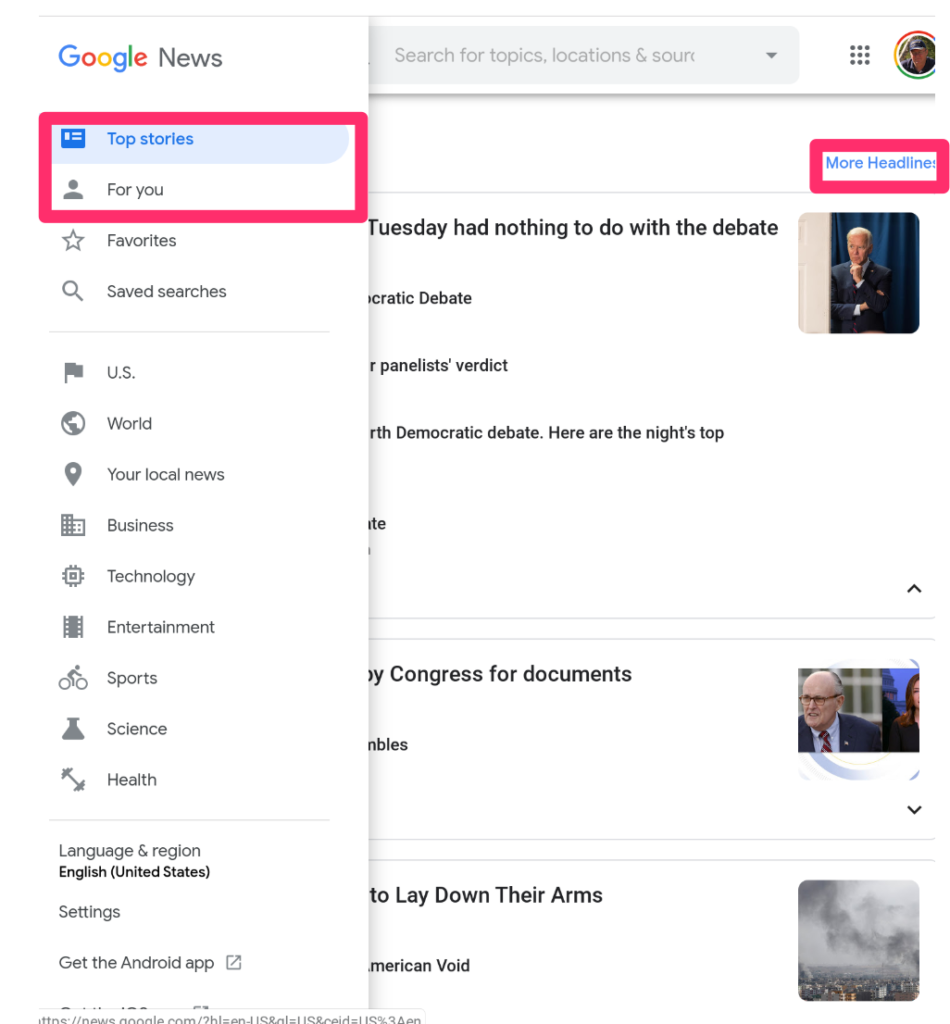
The Google News Aggregator offers one approach. First, it identifies important topics of the day and offers multiple sources of information related to these general topics. Second, it differentiates content suited to your personal history from a more general collection of sources. See the following image.

The two opportunities are identified in this image by the red boxes. The box surrounding “More headlines” provides a way to find multiple sources and multiple formats (news stories, images, tweets) related to a given topic and the box in the upper left shows the effort to differentiate top stories from the more personal selection “for you”. These two options are revealed when opening the drop down menu under the Google News heading.

Yes, the title of “fair and balanced” was used in a sarcastic way.

Loading

Posted in Uncategorized | Tagged | Comments Off on Fair and balanced