Are teachers willing to have students analyze political ads

When I am working with a class, my posts here often reflect the topic of the week. This week we are considering literacy skills needed to processing online content. An important subtopic involves interpreting the motives of those offering content.

In searching for new resources relevant to this topic, I came across this interesting collection of proposed classroom experiences from MiddleWeb focused on the analysis of political ads. This might be considered a subtopic of an examination of advertising, but I could not help thinking how educators must be careful when addressing anything with a political angle.

The general collection of ideas can be found at this location. One of resources I found to be most useful was this worksheet for recording various characteristics of individual ads.

Loading

Posted in Uncategorized | Tagged | Comments Off on Are teachers willing to have students analyze political ads

Layering with EdPuzzle

I haven’t written about layering tools for some time. I have spent time generating tutorials for multiple layering tools and explaining multiple ways in which layering tools can be used to design educational experiences by building on existing online content. What I have not done is to offer examples from K12 classrooms. In retirement, I no longer work directly with many educators.

I came across this classroom example provided by Wesley Fryer. He describes lessons he has developed using EdPuzzle to improve elementary students’ use of Gmail. His lessons take advantage of EdPuzzle to add quiz items to instructional videos.

Loading

Posted in Uncategorized | Tagged | Comments Off on Layering with EdPuzzle

Code that changed everything

Slate offers a different way to consider the history of programming. They have sought the opinions of programmers on the programs that have changed everything. The post includes snippets of code and the backstory so there should be something of interest to everyone.

Loading

Posted in Uncategorized | Tagged | Comments Off on Code that changed everything

Fair and balanced

Educators are designating this week to a focus on digital citizenship. This term means different things to different people and concerns multiple recommendations. Among the skills typically prioritized is the capacity to seek and process online information in a way to understand issues accurately. This goal is not easy as biased information is difficult to identify and information located can be processed in a biased manner. A digital citizen recognizes both challenges and seeks to avoid both biases.

One simple strategy is to seek information on a given topic from multiple and varied sources. This can require giving up on some personal selection as our own biases can influence what we select.

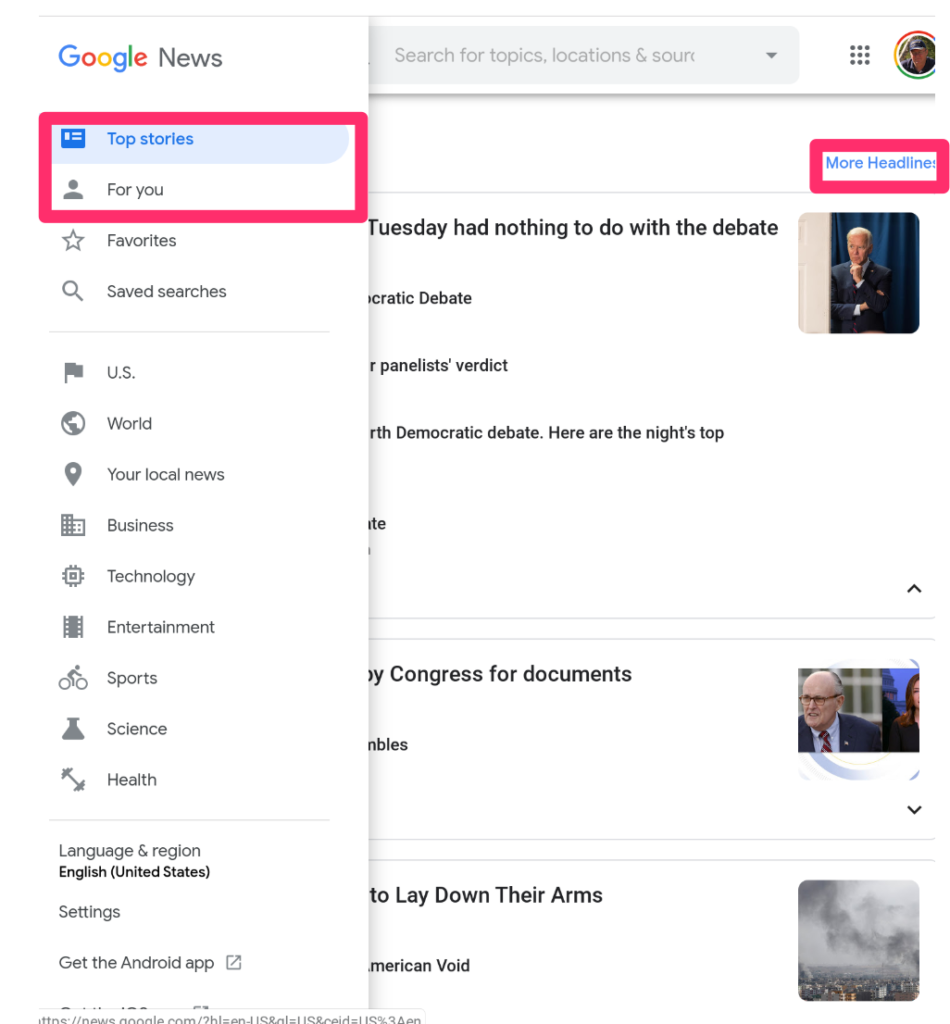
The Google News Aggregator offers one approach. First, it identifies important topics of the day and offers multiple sources of information related to these general topics. Second, it differentiates content suited to your personal history from a more general collection of sources. See the following image.

The two opportunities are identified in this image by the red boxes. The box surrounding “More headlines” provides a way to find multiple sources and multiple formats (news stories, images, tweets) related to a given topic and the box in the upper left shows the effort to differentiate top stories from the more personal selection “for you”. These two options are revealed when opening the drop down menu under the Google News heading.

Yes, the title of “fair and balanced” was used in a sarcastic way.

Loading

Posted in Uncategorized | Tagged | Comments Off on Fair and balanced

Should authority matter on Twitter

This brief comment is in response to a lengthy blog post by Daniel Willingham regarding the believability of educational experts based on Twitter tweets. I will leave it to you to identify just what you think is the core argument in this post, but my take would be that Willingham argues educators should not take too seriously the arguments of experts on Twitter.

The two supporting arguments seem to be that expertise in the field of education is more difficult to assess than in other fields that require certification (e.g., a license) and the area addressed by educational research is messier than other fields.

It is not my intent here to get into a detailed analysis. I agree that educational research is challenging, but so are certain fields of medicine. I am not certain I buy the certification argument as it seemingly suyggests that the skills of a physician are more uniform than those of educational researches with a Ph.D.

I do agree with the general concern that Twitter is not a good source for recommended practice. At best, it is a starting point. The brief comments probably shift the interpretation of expertise to variables such as past exposure to the author or the inclusion of degree level as part of the name associated with tweet. Blog posts offer more evidence of logic and place a heavier burden on the writer to communicate. In both cases, it is important to recognize that the posted work has not been vetted through editorial review as would be the case with journal publications.

However, here is the reality. The students I work with at the graduate level are mostly not focused on careers as researchers. They would not likely read the vetted journal articles I assign even though they are generally motivated learners. What happens when they are no longer in situations requiring they spend time on formal and reviewed research? I hope that they at least read longer-form content and have the background to be sensitive to logic, a link to evidence, and cross-referencing of suggestions with external sources. I also hope that educational researchers make the effort to provide resources with these qualities in addition to the work they publish in the research journals.

Loading

Posted in Uncategorized | Comments Off on Should authority matter on Twitter

Digital citizenship week

Next week is digital citizenship week. While there are weeks for so many different things, certainly it is a useful way to bring attention to important topics. Donut week is probably an exception, but it certainly has its own following.

Common Sense Media is a nonprofit with a mission to prepare and educate citizens for the productive use of online media. The organization has made an effort to organize some of its resources by grade level that are suited to the general goals of this week. There are lots of useful resources here.

Loading

Posted in Uncategorized | 1 Comment