States highlight problem of fake news

Your state may or may not have a commitment to prepare students to learn in a world where fake news is published without apology and politicians even at the highest level endorse false narratives. As preparation for responsible citizenship, preparing graduates to identify and rely on accurate information would seem among the most important goals educators must address. Exactly how this can be done in a climate where educators can be expected to keep politics out of their classroom even when politicians take positions on some issues (e.g., climate change) that are not in keeping with the best information available from experts and considered beyond dispute is clearly a challenge. What is the point of studying the facts of science and history, if some adults purposefully ignore such findings as inconvenient and then dispute challenges to their motives when called out on purposeful falsehoods (lies)?

Some states (e.g., California) have recognized this issue and passed legislation to make this an educational priority. However, upon closer scrutiny, what states have actually committed to do are pretty weak commitments in contrast to the level of the problem. See following paragraph describing the California law.

Last week California Governor Jerry Brown signed into state law a bill that mandates the California Department of Education provide media literacy resources on its website, to help teachers and students navigate the maze of information on the internet.

On the national level, Democratic Senators have also outlined legislation issues related to online content they would like to see considered. In this political climate, I am not holding my breath as party affiliation seems to determine what issues will be considered in the Senate.

Issues must compete for classroom time in K12. Coding for all seems to have achieved a level of acceptance based on the perception that technology plays an important role in the economy. Elementary educators are urged to find ways to embed coding activities in the curriculum and secondary administrators are encouraged to offer coding courses and find the means to hire staff with the appropriate background to teach such courses.

Among the issues with digital information literacy is where does it fit and how can it be taught while avoiding the overlap with political perspectives. Consider that coding when positioned as an occupational opportunity has few dissenting voices, but climate change while clearly an issue of science is frequently considered politicized. The scientists don’t think so, but the parents of students might. Legislation at the national and state levels would go a long way to giving educators political cover for taking on important topics.

Education Week offers this perspective on the preparation of students for a world in which fake news is a growing part of the confusion that citizens must navigate.

Loading

Posted in Uncategorized | Comments Off on States highlight problem of fake news

PixelFed

If you are an Instagram user and have a desire to move some of your online activity away from the Facebook company, I recommend PixelFed. You will find this service similar to Instagram (images and comments) and it does not display ads or collect your personal information. If you want to exchange images with a small group the members of which you might convince to move their activity or just want to follow others who post interesting images, give PixelFed a try. Your images can be shared publicly or can be designated as private.

Loading

Posted in Uncategorized | Comments Off on PixelFed

My Brave Ad Income

I have been following and participating in the Brave Internet program (ad blocking browser and ad-related services). My idealistic way of explaining the Brave program is that it provides the opportunity to protect user privacy while providing resources to content and service providers. There are a lot of assumptions in the model so label it as idealistic at present.

Brave just added the final component of the model – users can allow ads provided through Brave to be displayed and be compensated for viewing (in theory) these ads. Brave takes a cut of the funds provided by those who purchase the ads and Brave does not collect user data when displaying the ads. The content/service consumers is compensated by using the Brave ad model instead of existing ad models.

Last month I earned 6.1 BAT (presently valued at $2.04) for viewing ads through Brave. I used the lowest ad rate (2 per hour) and I could have set this higher. I also spent far more time online, but my Brave account is attached to my desktop computer and I do not accumulate BAT when using my laptop, tablet, or phone even though I might use the Brave browser on these other devices. Brave has yet found at a way to integrate accounts and the compensation plan also does not apply with tablets or phones. At this point.

I should also say that I cannot collect my $2.04 at this point, but this is supposedly coming. At present, I am just adding my income to the amount I have designated to support content creators.

Here is the biggest problem I see with the Brave model. I fear that most users will simply use the model to block ads and collect BAT for viewing Brave ads. One of the first “opportunities” Brave provided was for users to put in real model that was converted into BAT (a cryptocurrency) and the amount of this stash that was allocated per month would be distributed among the content/service providers that registered with Brave. I put in $50 as my investment in the experiment. I did register my domain (https://learningaloud.com) as part of this experiment. Brave provides no data on how many Brave users are also contributors. I am guessing not many so far.

Brave is great at protecting the privacy of users, BUT to this point it has protected producers only through voluntary contributions. Brave is in a position to do more. It would be as easy as splitting the ad revenue generated by the ads provided through Brave among itself, content creators, and consumers. Consumers could still make personal contributions. I just see this company advancing beyond privacy protection until it does a better job of including all of the parties involved in use of Internet resources.

Loading

Posted in Uncategorized | Tagged , , | Comments Off on My Brave Ad Income

Student prep for dealing with misinformation is no longer effective

Fact Check

This article from the Chronicle of Higher Education concludes that the approach taken to prepare students to identify misinformation online is no longer effective. The authors suggest that popular strategies typically involve providing students a list of things that can look for within the content they are reading and they suggest that these red flags are too easy to eliminate should a content creator be serious about misinformation. They conclude that it is necessary to go beyond the content under consideration.

The necessary approach is to think like a “fact checker”. Open a couple of extra tabs and read laterally. Test facts offered by searching for other sources. Fact checking has become a part of the political scene as news sources identify a claim and then offer evidence from other sources that either verify or refute the claim.

What should be fact checked? I would think any claim that is crucial to the position being taken. I can imagine a situation in which a white board is used to display a web page. Students might then read and highlight core claims made in the article that is displayed. Students might then use their own devices to fact check these claims, save the sources, and paraphrase the critical material from these sources.

Loading

Posted in Uncategorized | Tagged , | Comments Off on Student prep for dealing with misinformation is no longer effective

Creative Commons Image Seach

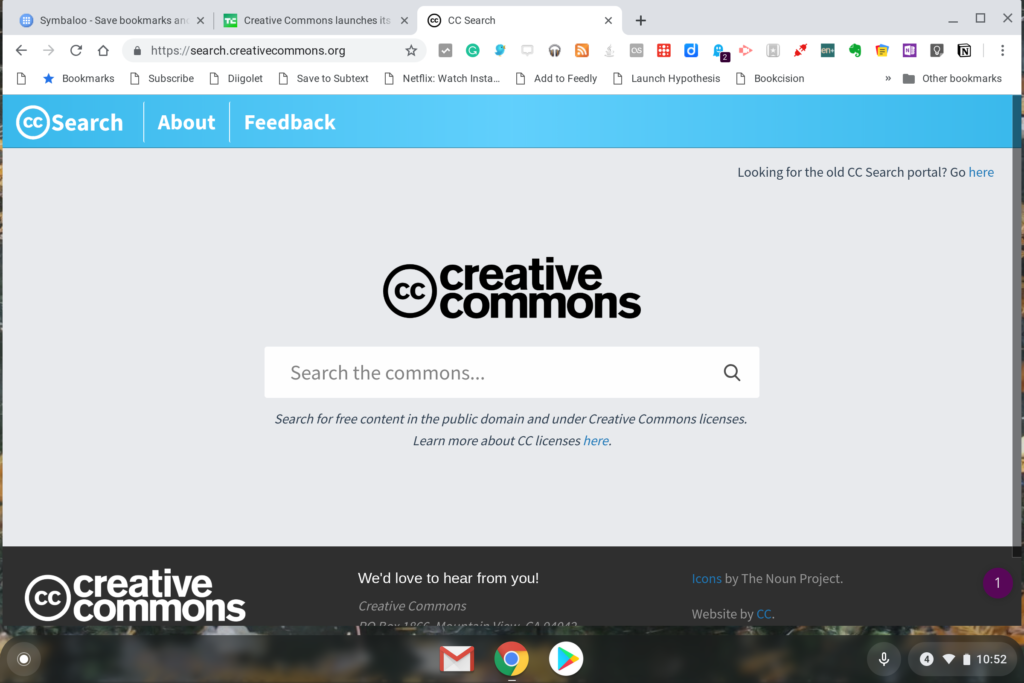
I recently explained how you can assign creative commons licenses within Flickr and search for Flickr images offered under a CC arrangement. Now I learn that the Creative Commons web site has developed its own search engine for finding CC images within Flickr and several other image collection and sharing sites (TechCrunch).

To use this search site, visit the Creative Commons page and find the icon for image search which appears at the top of the page (first image). This icon opens a page providing access to the search engine (second image).

Loading

Posted in Uncategorized | Tagged , | Comments Off on Creative Commons Image Seach

The ENIAC girls vanish

Female coder

I don’t think I have ever recommended a chapter in a book and I understand that it is not very practical to do so, but I found Clive Thompson’s chapter “The ENIAC girls vanish” the best explanation of gender imbalance in tech that I have encountered. This chapter is from Thompson’s book – Coders: The making of a new tribe and the remaking of the world.

The title is a reference to the early dominance of female coders and the chapter traces the history of the proportion of women working as coders and the factors responsible for changes. I cannot do justice to the complexity of this issue, but I will attempt to identify a couple of issues I found to be interesting.

In the beginning, men did hardware and women did software. Software despite the actual challenges of programming primitive machines was considered pretty much a secretarial task. As more and more programmers were needed and as wages increased more and more males were drawn into the field.

Thompson spends considerable time explaining changes in the makeup of college computer science students. Enrollment in CS programs was primarily male – white and Asian. Computer science faculty members were not oblivious to the lack of diversity of their students and made efforts to understand why. Thompson explains that makes had an advantage in early courses because of previous coding experiences. These were not kids who had taken CS in high school and this was at a time when having a computer at home was expensive. Early computers – TRS80s, Apple IIs – had limited software of interest to adolescents, but those who had access and were interested learned to program them to explore. Males thus came to college with experience and often dominated the initial courses discouraging the women who took the courses from scratch. The women who stuck it out ended up doing just as well in later courses. To address this issue, the CS programs decreased the size of intro classes and tried to offer greater individual attention in introductory courses.

Thompson then argues that CS became a victim of its own success. The visibility of the financial opportunities in developing software especially for online functions resulted in students swamping CS programs. The opportunities not only increased the number of interested students, but also made it far more difficult for higher ed to recruit and retain faculty members. Classes again ballooned in size and programs to shepherd beginning students were dropped. Getting through the early classes again was heavily biased by experience before these classes and those willing to compete to advance within these programs. This situation led to a decline in females entering and completing CS programs. The stereotype of successful programmers/entrepreneurs perpetuated in media also put off competent women. There have been some recent improvements, but the trend has yet to revert to what it was even 20 years ago.

Solutions? Thompson makes a compelling case that the talent for coding is widely distributed if individuals have the opportunities to develop this talent. It would seem that the issue is at what level should the money be spent to develop talent and what level of proficiency should be expected at the next level. Would wide availability of a CS course in high school be enough? Should higher education be funded at a level necessary to start students from scratch?

I have been trying to locate something else Thompson has written on this topic I could offer. I found this interview with Thompson that you may find of some use.

Loading

Posted in Uncategorized | Tagged , | Comments Off on The ENIAC girls vanish