I just read one of those year-end wrapup posts in this case focused on blogging trends in 2018. If you are interested, I provide the link. It was my impression that this survey focused on mostly paid bloggers and the “trends” and data were not broken down by the likely audience. I would guess this makes a big difference.
I did learn a couple of things. Bloggers who are still active seem to be moving to longer posts and they assume that readers want long form content. I guess services such as Twitter and Facebook take care of the need for comments.
One of questions included in the survey was whether or not a blogger updated and reposted posts. Many did and the survey seemed to indicate that these bloggers associated this practice with higher readership. I must admit I had not every considered doing this. I probably should.
Between my two blogs, Learning Aloud and Blurts, I have generated 3370 posts since 2002. That is a great deal of content and I assume some posts offer useful information over time. Since blogs quickly push posts off the front page, causal visitors and probably most visitors have no idea that relevant information may be available. Maybe I should offer a repost of the week or something similar.
One technique for finding old content of interest makes use of tags. I suppose I should use more tags, but I do use some. When a post contains a tag at the bottom of a post, selecting that tag will bring up older posts that have the same tag. Follow up with tags if a topic interests you.
Traditional search within a browser is not particularly useful because it searches only the content that appears on the active page. My blogs reveal 5 posts per page.
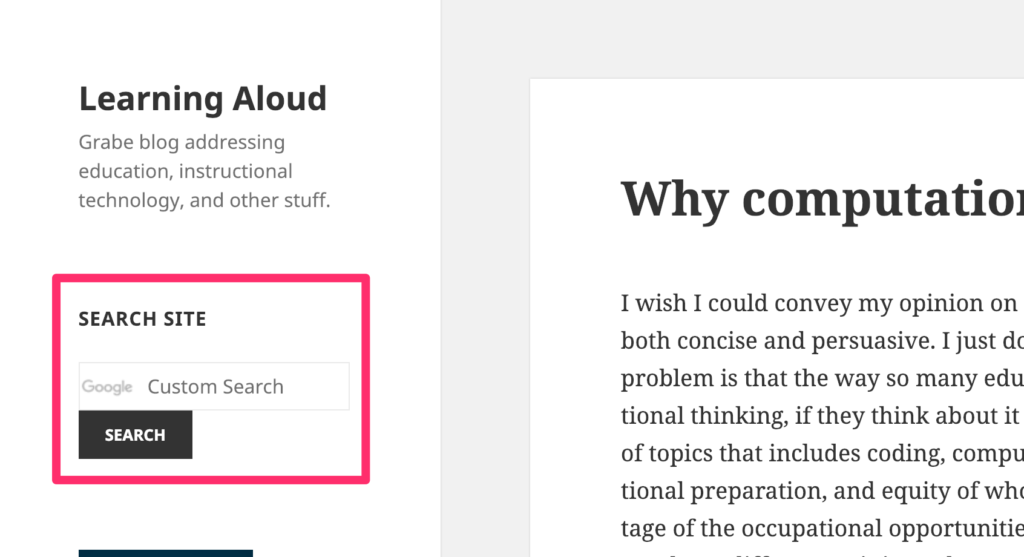
You can use Google custom search to make all of your content available to readers. If you look in the margins of my blogs, you will see a box for custom search. If you think I might have offered a comment on a specific educational topic, give custom search a try.
Studies have found that roughly 40 percent of students planning engineering and science majors end up switching to other subjects or failing to get any degree. That increases to as much as 60 percent when pre-medical students, who typically have the strongest SAT scores and high school science preparation
The preceding quote is from a NYTimes article “Why science majors change their minds“. Despite all of the emphasis on STEM the attrition rate for college STEM programs is very high.
With the importance of STEM careers and all of the effort in K12 to create settings that interest and encourage students to pursue these careers, why do so many students move on to something else. This is the question the NYTimes article examines. Are STEM careers simply too difficult? Is there something wrong with the approach that throws all interested students into large lecture introductory courses that are both difficult and graded in a rigorous and objective manner? Are students not dedicated to the amount of work that is required?
Looking back, I may be an example. I enrolled in university with an initial major in biochemistry and biophysics. My goal was to become a high school biology teacher so the initial advice I received regarding a major was definitely misguided. One hypothesis proposed by some is that students are pulled away by early success in other introductory courses. When I read this, I wondered about own life story. The only A I received in the first quarter of college was in the Introduction to Psychology and I eventually did earn a doctorate in Psychology. I did finally also get some help on how to major in biology and acquired a second major in this discipline. Grading was different, but for me anyway, I agree that Psychology courses were easier. My two brothers who ended up with engineering degrees struggled in the lower level psychology courses they took to meet general education requirements.
Looking back and based on my own experience as a college professor, introductory courses in the social sciences are also surprisingly difficult for students who you might think would have little difficulty. Such courses are primarily heavy on reading and some “science types” may not necessarily be great in processing large amounts of text. The courses also tend to rely on “objective testing” (multiple choice testing). Like STEM courses there are assumed correct answers and the scores on such exams are easy to compare. When scores are objective and distributed, profs award different grades. It is not surprising and for multiple reasons that no matter the eventual major that grades in introductory courses are often lower than in more advanced courses.
To be clear, my remarks are based on experiences in institutions that must rely on large introductory courses and experiences in smaller courses may lead to different outcomes. As the Times article also notes, some institutions are attempting to go to smaller introductory classes and to include “design projects” for majors. This might be described as abandoning the “sink or swim” and let’s get the “theory courses out of the way approach. Taking this approach when introductory courses have tended to serve multiple functions (general education, introduction to the major) introduces financial and values challenges. What happens when the Intro to Physics course must be large enough to accommodate physics majors, all engineering students, pre-meds, and the future secondary science teachers who need the course? An argument could be made that the introductory course in any discipline would be improved if taught to fewer students and differentiated depending on the goals of those enrolled. If funds are available, should STEM areas be prioritized for special treatment over social sciences or other disciplines which also rely on large, undifferentiated introductory courses?
What are states, parents, and students willing to pay for?
I have a personal perspective that I will share for what it is worth. I think we all carry personal theories of aptitude and also of the difficulty of specific disciplines. A mismatch between our theories and what we experience leads to problems. For example, I think many assume the capacity for math and science are primarily aptitude-based. I think many assume that aptitude equates to quick learning in general. What happens when you don’t understand calculus if you assume you get it or you don’t? What happens when you must read 50 pages a week in Introductory Psychology and this takes a long time when you assume smart is equivalent to quick?
I admit that I believe in aptitude differences and I believe that STEM majors are more difficult. However, I also believe that the degree is just the beginning and career success or just being employed in a desired field can be a very different manner. Any bets on the employment rate of psychology majors as psychologists versus the employment rate of civil engineering majors as civil engineers?
If this topic interests you, take the time to read the Times article. The piece reviews some of the ideas different institutions are exploring.
Posted inUncategorized|Comments Off on Why do STEM initiatives fail?
Curiosity Stream, a documentary streaming service, is offering a great deal for the next few days. You can create a gift card to offer the HD version of the service for a year for $12. You can also gift the 4K service for $42. We purchased the HD version for our kids and ourselves.
Be careful in how you do this. My inclination when receiving the notice of the gift was to first download the app and create an account assuming that I would be offered the opportunity to enter the gift code. WRONG. Do not create an account if you want to take advantage of this deal. When you receive the notice of a gift account, use the links from within this email to create your account. This will offer you the opportunity to use the gift code.
Posted inUncategorized|Comments Off on Curiosity Stream Deal
Cindy forwarded this post from the Heinemann blog site. The post outlines Heinemann’s effort to clearly state their position regarding copyright as some educators have obviously taken content from Heinemann sources and repurposed what has been copied as part of content then sold through Teachers Paying Teachers.
The language added to the existing policy includes this material:
Heinemann’s authors have devoted their entire careers to developing the unique content in their works, and their written expression is protected by copyright law. We respectfully ask that you do not adapt, reuse, or copy anything on third-party (whether for-profit or not-for-profit) lesson sharing websites.
We have felt publishers need to move beyond self-contained textbooks to take the opportunity offer readers book-related content and we have made an effort to take this multi-component approach in our own writing. Clearly offering sample lessons and tutorials online makes you vulnerable to easy copy and paste use of your materials by others. Selling this “borrowed” content is particularly egregious.
Part of the problem here is likely the blind eye of the sites serving as intermediaries between content creators and publishers. This lack of oversight seems familiar to the argument made by social media sites (e.g., Facebook) contending they have no responsibility for the content others make available through their service.
I suppose it also important to help educators understand the limits of “fair use”.
Posted inUncategorized|Taggedcopyright|Comments Off on Heinemann concerned with educator resale of copyrighted content
For educators wanting an alternative to textbook-focused instruction or quality compliments to textbook-focused instruction using historical documents and quality news stories, Newsela may provide just what you are looking for. In addition to the carefully curated content, the education service offers assessment tools and perhaps of greatest interest to many educators, the same content offered at multiple reading levels.
This recent Fordham Institute educational web site offers this description of Newsela. If you have heard of Newsela and perhaps even created a free account, you may wonder about the cost of the features provided with paid access. Newsela does not post these costs, but the Fordham article provides the following information.
“Newsela’s fee-based version, Newsela PRO, offers enhanced tools and experiences. Newsela does not publish prices on its website but shared in a recent tweet that the Pro version costsabout $6,000 per school, $2,000 per grade level, and $18 per student per year. (Newsela has worked with DonorsChoose in the past, so that may be an option for teachers who wish to subscribe to Newsela PRO on their own. They can also request a free thirty-day trial to see whether Newsela PRO works well for their purposes). (quoted content from Fordham article).”
Among the capabilities of Newsela that I find most intriguing are the “layering” capabilities provided. Layering is my way of describing annotation features (highlighting, annotation, and the embedding of prompts and questions) that I believe allow students to apply study strategies and perhaps more uniquely allow educators to demonstrate and teach study strategies.
Educators can explore the basic features of Newsela by establishing a free account. This should allow enough experience to determine whether a paid account is worthwhile.
The Gutenberg plugin for WordPress has a characteristic I find very annoying. This “defect” occurs when I select a phrase that signals the link to another page. The “word processing” options including the link button appears (white bar), but is immediately covered over by a bar (black) offering other style options for the selected text. There is no easy way to associate the URL with the selected text.
I can work around this glitch by moving into code editing mode, but this can’t be the way things are supposed work. I encounter this problem when blogging on my iPad so this issue may not be a problem elsewhere.
Posted inUncategorized|Taggedwordpress|Comments Off on WordPress ‘Gutenberg’ Design Flaw
We use cookies to ensure that we give you the best experience on our website. If you continue to use this site we will assume that you are happy with it.
You can revoke your consent any time using the Revoke consent button.



You must be logged in to post a comment.