Shoshana Zuboff is the author of a new book “The age of surveillance capitalism”. Dr. Zuboff explains how behavioral data collection starting with Google search became valuable as a way to predict our behavior. These data often collected without our conscious awareness has great financial value.
If this topic is of interest, she was interviewed by Leo Laporte for the Triangulation podcast and is an informative listen.
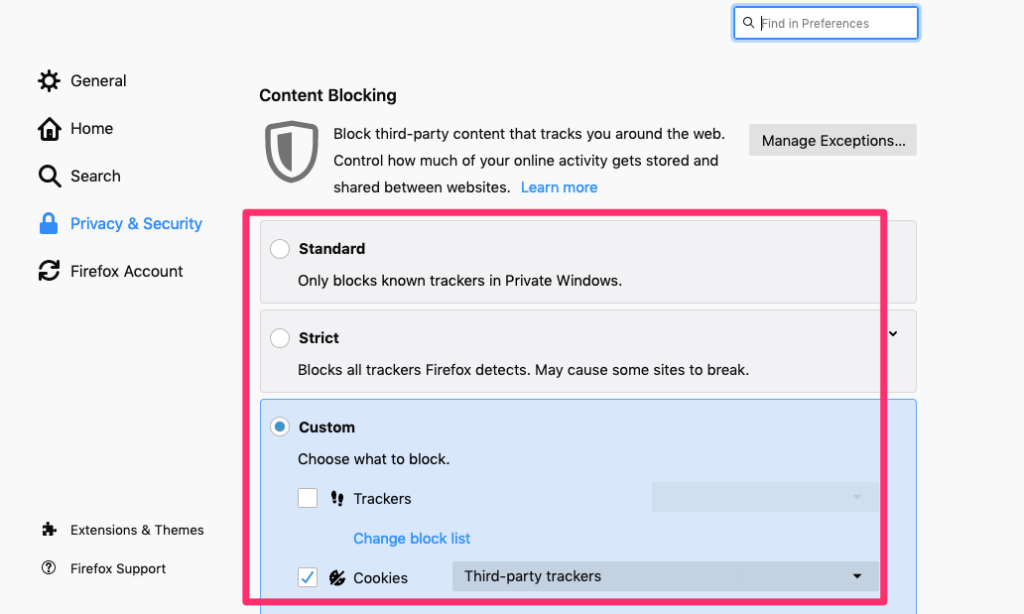
The Firefox browser has been upgraded. Browsers seem to be competing by offering different ways to protect user privacy. The newest browser to undergo this transformation is Firefox.
Firefox has a block everything mode (Strict) and on the desktop the opportunity to create a custom approach to security. I have concerns with the notion that users who value free content and services should block all cookies. Companies that do not rely on ad revenue (Apple, open source offerings such as FireFox) find it convenient to take an anti-cookie position. I have been positioning myself in a middle ground and block third party cookies. This limits the sharing of information across services sending user information to service not providing the content or service being utilized.
Posted inUncategorized|Comments Off on FireFox Upgrade
For those interesting in layering services, I just learned that Hypothes.is devotees have a YouTube Channel.
There are multiple layering services and you may find a different one more suited to your instructional needs. Hypothes.is is free and has been around for a while accumulating dedicated practitioners. I have a web site describing similar products.
The temperatures in the midwest have plummeted to well south of -20. One of tweets I read this morning offered a lesson from NASA for children explaining that the very cold temperatures were not a sign that the dangers of climate change had passed. The instruction went on to differentiate weather and climate. While the tweet was intended more as information for Trump supporters who might believe his comments disputing the reality of global warming., the lesson might be something teachers could share with students who are at home because of the dangers of the very cold temperatures.
Posted inUncategorized|Comments Off on Weather vs. Climate
I think educators need to broaden their approach to developing student critical thinking skills as applied to online content. I was reminded of what has become my new perspective when I read Alice Keelor’s recent post complaining about the tendency to share inaccurate Facebook posts. Her advice is to evaluate the credibility of the content before sharing and she offers multiple suggestions for how to do this. The resources she identifies would be quite useful to anyone willing to use them.
Educators have fallen into some variation of the “check before you share” approach offering techniques that range from simply considering the expertise of a source to more sophisticated techniques such as use of the cross checking resources Keelor identifies.
While applying these guidelines and procedures make sense, the “problem” is likely broader and will not be adequately addressed until individuals are able to accept their own role in accepting “fake news”. How is it we help students and ourselves recognize that we all are programmed to accept certain types of false information?
I use the descriptor “programmed” as it seems consistent with one of the arguments made in Lee McIntyre’s book “Post Truth”. Educators should understand what he means as it seems very similar to the notion of constructivism – each of us uses our existing knowledge to understand new inputs. Our existing knowledge, biased or not, plays a role in how we process an input and information that fits is easiest to understand and accept. You may be more likely to recognize this cognitive phenomenon by a more specific term – confirmation bias.
McIntyre’s book is one of the best sources I have reviewed that provides a broad description of the multiple factors that have come together to create such a risky setting for “learning in the real world”. The limitations of the learner is one factor I think educators overlook. There is also the problem of group conformity in situations when one is aware that a group one identifies with has a position on an issue. In Intro Psych, the classic study by Solomon Asch demonstrates just how susceptible people are to accepting a position advocated by a group when one would be very unlikely to take this position if acting independently. If you remember this study, it should be obvious how it applies to situations such as we now face when one political party takes one position and the other a very different position. You likely identify with one party or the other and just like the participants in the Asch research are easily influenced to accept faulty information supported by your group.
The careful processing of a source can in many cases function through the lens of “motivated cognition”. When these conditions apply, the challenge is more complicated than is likely to be solved by the recommendation that learners fact check. Such situations will require additional skills and likely outside intervention (perhaps participation in processing within a group with individuals who have different perspectives). Educational researchers might recognize the value of purposefully created conceptual conflict as a useful approach when the facts of science are inconsistent with the self-generated models of causation learners may develop based on personal experience.
I will offer a more complete description of McIntyre’s list of factors in another post.
Posted inUncategorized|Comments Off on Critical literacy must acknowledge the self
Prioritizing STEM within K12 may seem a significant departure from past priorities. Has this happened before? I must have been part of the post Sputnik push. There was certainly a great awareness of the Russian accomplishment and great concern, but I don’t think the actual courses offered changed at the elementary or secondary level. I am not sure. Being submerged in a system is sometimes not the best vantage point for viewing what is actually going on. I understand that there were major initiatives that involved the dedication of significant resources, but that seemed mostly an investment in research and perhaps greater support for higher education.
We seem to be in another Sputnik era. This time the K12 investment is in Computer Science, or perhaps because the focus is somewhat different, coding and computational thinking. The prioritization is not so much a threat from other nations, although China has made a great commitment to the speciality of AI, as it is the perception of nearly unlimited employment opportunities. While I do think the jobs, jobs, jobs coding focus has eased, why does this employment issue as a K12 focus seem to ebb and flow in public perception? Is it because of the cost of a college education and what does that have to do with K12 priorities anyway?
I am concerned that what remains of the vocational push has been augmented by promoters of the new mental capabilities of computational thinking. I have read many papers attempting to define computational thinking including Wing’s original argument. For me, most harken back to Seymour Papert’s writings in the early 1980s. Then, the promotion of a new and powerful way to develop thinking skills was heavily researched without the conclusion that this claim was valid. We seem engaged in a similar promotion of programming without the research of the Papert era.
I direct readers to a recent Forbes article echoing my position. I have written about the promotion of coding so many times it is probably best if I point readers to other sources offering a different or at least broader perspective. The Forbes article is very well done and examines the STEM issue from multiple points of view. The Forbes article makes some interesting arguments related to just how many jobs in computer science actually exist and questions whether this number will be increasing in the future.
Perhaps what is really needed at this point is a more general reconsideration of just what K12 and maybe even higher education are funded to accomplish. We seem to drift in and out of focusing on vocational preparation and even what employers want. How much of what is needed are skills unique to a given profession and how much is a focus on specific dispositions and thinking skills?
A careful consideration of the goals of education is important as we risk losing sight of important goals. We may even be creating a caste system within the ranks of K12 educators. I read an account of what I suppose was a well-meaning STEM promoter arguing that a differential salary system should be instituted at the K12 level to entice more STEM talent into teaching. I have heard of signing bonuses, but not a new variable added to the pay scale. I also question whether the greatest needs we face as a society will be solved by a greater emphasis on math and science. Problems that seem scientific in nature such as climate change are not problems that are problems because of science, but problems because of human values and the inability to understand abstract challenges that are inconvenient to address. The high school physics course and other physical science courses may offer an explanation, but not change what needs to be changed to affect a solution
We use cookies to ensure that we give you the best experience on our website. If you continue to use this site we will assume that you are happy with it.
You can revoke your consent any time using the Revoke consent button.



You must be logged in to post a comment.