One of the strategies I have been recommending for educators concerned about the way students are using ChatGPT is to ask students to include references in their reports. My daughter who is working on her dissertation and grant applications told me that ChatGPT will fabricate references.
I encountered an example of this problem. I write frequently about digital note-taking and try to couch what I discuss in the research I have read. Recently in evaluating ChatGPT I asked a question about this topic and I asked for references. One of the citations GPT added to the content it generated I did not recognize and I then attempted to download it from my university library. It does not exist and the page numbers included do not match the range covered by the issue designated in the citation.
It is not that uncommon to find a citation that is in error. We all can make mistakes when we enter citation information in a document we create. Usually, I can identify the problem by entering the title in Google Scholar. This is not the case with this example. Kiewra is well known for his research on this topic. Benton and Kiewra often publish together. So, the citation might seem real to those familiar with this topic. It is not.
I have been using several social bookmarking services. A social bookmarking service is the first step in my “read a web page” to “write a blog post” workflow. Social implies the potential for sharing web pages and annotations with others.
I have written about Memex Garden in at least one previous post. I invested in developing this service when it was first developed and the company responsible has now transitioned to a subscription model declaring the service is now ready for prime time. One of the final features added was AI.
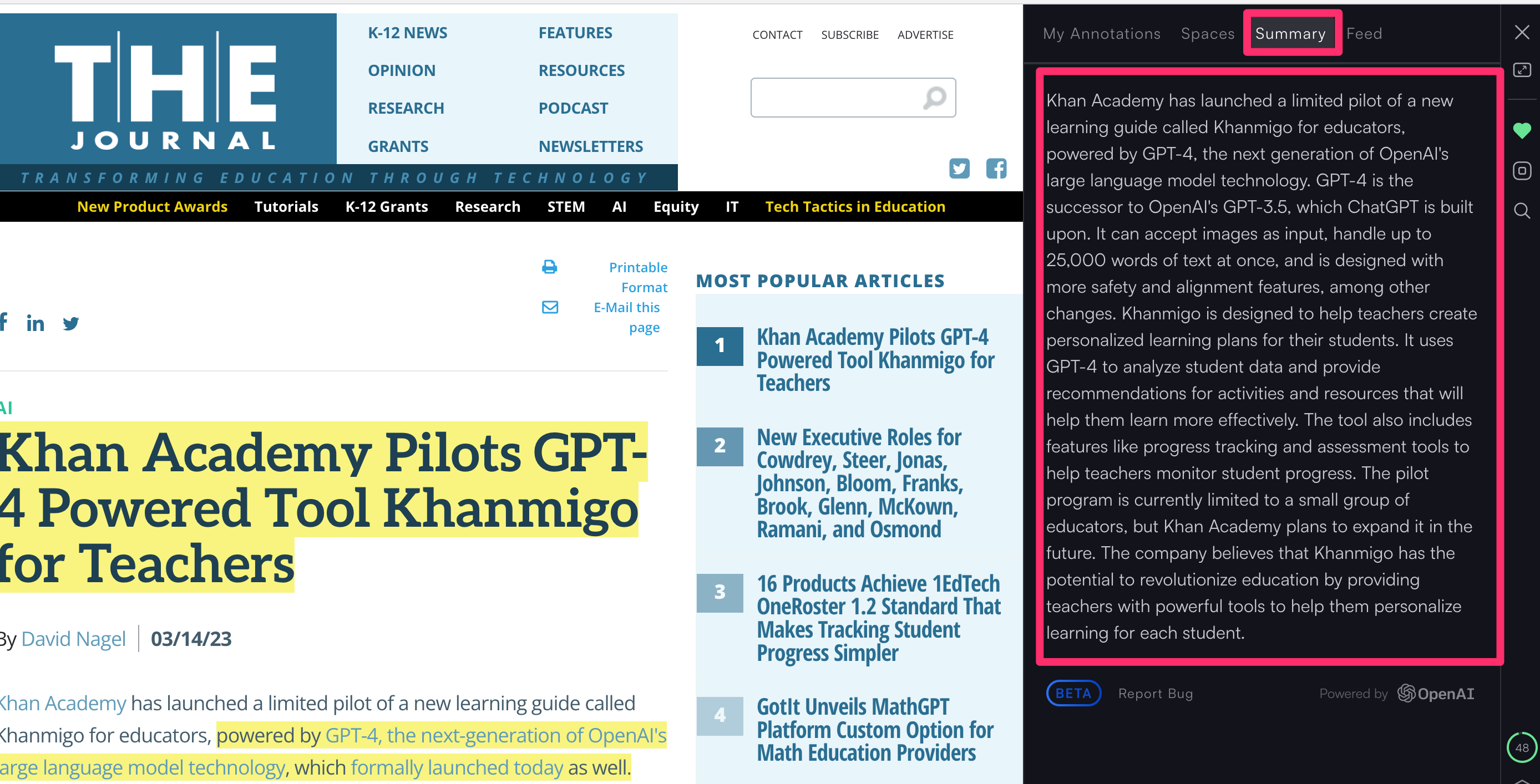
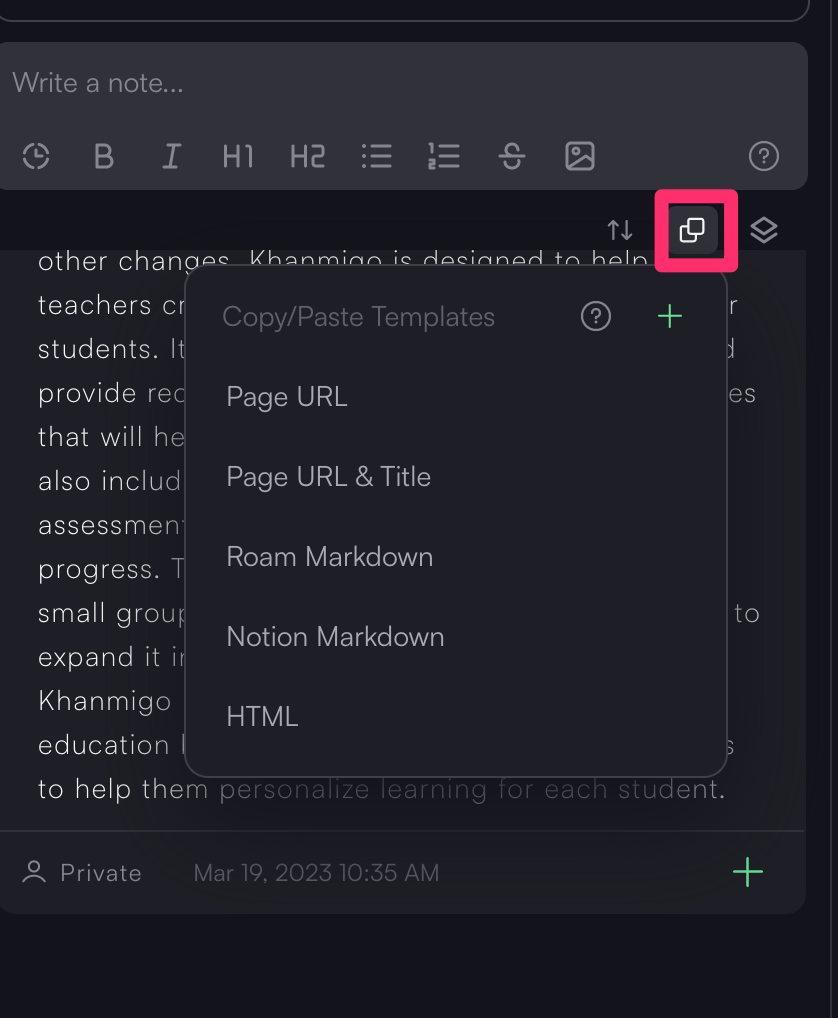
Memex uses AI to summarize web pages or parts of web pages. When activated as a browser extension, a side bar can be opened and one of the options is Summary (first image). Content generated as an AI summary, note, or highlight can be exported in several ways (second image).
The following is an example of a web page summary written by the Memex AI tool. The page summarized is about the new Kahn Academy AI tool.
Khan Academy has launched a limited pilot of a new learning guide called Khanmigo for educators, powered by GPT-4, the next generation of OpenAI’s large language model technology. GPT-4 is the successor to OpenAI’s GPT-3.5, which ChatGPT is built upon. It can accept images as input, handle up to 25,000 words of text at once, and is designed with more safety and alignment features, among other changes. Khanmigo is designed to help teachers create personalized learning plans for their students. It uses GPT-4 to analyze student data and provide recommendations for activities and resources that will help them learn more effectively. The tool also includes features like progress tracking and assessment tools to help teachers monitor student progress. The pilot program is currently limited to a small group of educators, but Khan Academy plans to expand it in the future. The company believes that Khanmigo has the potential to revolutionize education by providing teachers with powerful tools to help them personalize learning for each student.
As I explained at the beginning of this post, Memex Garden has now moved to a subscription pricing system. Details are provided in the following image.
This article from CBS News summarizes the results of an analysis attempting to predict the occupations most “exposed” to recent AI capabilities. Exposed was the word carefully chosen to indicate that AI could substitute for or complement competencies important in these occupations. In some cases, this analysis proposes the people doing this kind of work could be replaced and in others the people doing this kind of work will be able to use AI to improve their productivity and effectiveness.
The ordered list of the occupations most “exposed” follows:
Telemarketers
English language and literature teachers
Foreign language and literature teachers
History teachers
Law teachers
Philosophy and religion teachers
Sociology teachers
Political science teachers
Criminal justice and law enforcement teachers
Sociologists
Social work teachers
Psychology teachers
Communications teachers
Political scientists
Cultural studies teachers
Arbitrators, mediators and conciliators
Judges, magistrate judges and magistrates
Geography teachers
Library science teachers
Clinical, counseling and school psychologists
The methodology used in this analysis is explained in a paper explaining how existing estimates of the importance of 52 specific skills are involved in over 800 professions against the specific capabilities of multiple AI systems. The occupations with the greatest overlap are considered most exposed.
I would assume this list of exposed occupations would be used to identify the teachers who should pay the most attention to AI and how AI tools could be applied in their classrooms.
Posted inUncategorized|TaggedAI|Comments Off on Educators among professions most impacted by AI
The exodus of Twitter users seeking a friendlier and more productive alternative seems to have reversed. While Mastodon has far more active users than it had just a few months ago, it appears many of those who explored Mastodon instances have not stuck around or have become inactive. The reasons are many. The most obvious issue, the network effect, sets in when new users begin to miss the familiar group they left and who did not follow. Even though Mastodon is far more active and interactive than it was before the influx of new users, established connections are no longer there and new users have yet to make the type of connections they abandoned.
The other significant issue is that Mastodon does not work like Twitter. It is a federated service made up of many instances operated mostly by volunteers who set up a server just because it seemed like a thing to do. Perhaps they had a general focus in mind and perhaps they did not. So, in addition to new people, new users encounter a much more fractionated environment when they originally could satisfy a variety of interests using one service.
There are strategies that users can apply to deal with a federated environment. If you join several different instances which is probably what you will want to do, you can use a client that allows simultaneous access to your different instances. A client called Mastodeck displays multiple columns of content. If you used TweetDeck, this client works the same because it was developed by the same folks. A column can display content associated with a given tag or to the purpose I am addressing here with the content from different instances.
Maybe it is specific people rather than instances want to follow and these individuals are distributed across multiple instances. Any given Mastodon instance should provide options for home, local, and federated. The local option shows posts (toots) from all users on the instance (server) that you are presently using (BTW – it is not that difficult to switch between instances). Home shows you posts from all users you follow (the present instance and others). So if you want, you can follow me at @grabe@twit.social no matter what instance you use. Follow others from other servers and you have pretty much duplicated the chronological version of Twitter (not the “For you” option which is based on the Twitter algorithm). Federated follows those you follow and their followers which should generate the most content, but not necessarily the content you want to consume.
I am not necessarily arguing that you abandon Twitter. I do suggest you ignore “For you” and rely on “Following” which gives you a feed in chronological order of those you follow. Whatever you think of what Twitter has become under Musk’s “guidance” and ownership, I believe diversity in social media options is important and I first joined the original Mastodon instance “mastodon.social” in 2016. Social media services are likely to be responsive to users and to improve their services partly in response to competition from other services making the same commitments.
Posted inUncategorized|Comments Off on Mastodon Slump?
For those interested in AI and AI applied to language challenges such as what are demonstrated in ChatGPT, I recommend this explanation by Wolfram. I admit it is way over my head and I became completely lost when it moved beyond generating sentences to sentences that reflect the knowledge in its knowledge base. I was exposed to matrix mathematics back in graduate school, but I did not take the calculus-based version of statistics so the determination of weights and such things are beyond my understanding. The math is just one of the issues to contemplate in machine learning. I have been looking for something that took on the challenge of explaining the AI of language understanding and production. I think I have found such as effort, but to my frustration I just can’t understand it. Wolfram has a YouTube effort to explain many of the same concepts, but he seems to explain things well but my comprehension was the same – Wolfram YouTube and Wolfram YouTube
Posted inUncategorized|Comments Off on How ChatGPT works
The algorithms that prioritize what I encounter online fascinate me. How the exhaust from my online behavior can be used to determine what interests me or might be valuable to me and then is used to address these priorities seems potentially quite useful and I suppose under different circumstances quite frightening. Whether useful or damaging, how it all works is intriguing.
With Elon Musk’s purchase of Twitter, the algorithm that determines what appears at the top of my feed has obviously changed. This algorithm is the default provided Twitter users as “For You”. I cannot figure out what the “For you” algorithm was designed to do. It now could be a direct feed from TruthSocial and it certainly is not providing content I would seek out. I am completely mystified by what about my use of Twitter would encourage this collection of misinformation. As a means to prioritize what interests me, it is a complete failure. So what is the goal?
Posted inUncategorized|Comments Off on For You – says who?
We use cookies to ensure that we give you the best experience on our website. If you continue to use this site we will assume that you are happy with it.
You can revoke your consent any time using the Revoke consent button.






You must be logged in to post a comment.