It is Earth Day 2023. Imagine a humpback coming up to take a look. Not a pretty sight with the environment deteriorating under the impact of human indifference. Politicians are prioritizing short-term issues and the greed of large corporations over the opportunities to address the crisis.
The number of my recent posts focused on AI applications has probably started to blur together for many who follow this blog. I admit that at a basic level, the services described are similar. However, the services I describe have been optimized for different purposes and for individuals with specific needs. This service, Scispace, is focused on those of us who read academic research papers. The basic idea is to be able to generate from such articles quick summaries and insights that may be helpful in generating and storing a quick overview and help readers when components of such articles involve unfamiliar elements (e.g., statistical procedures).
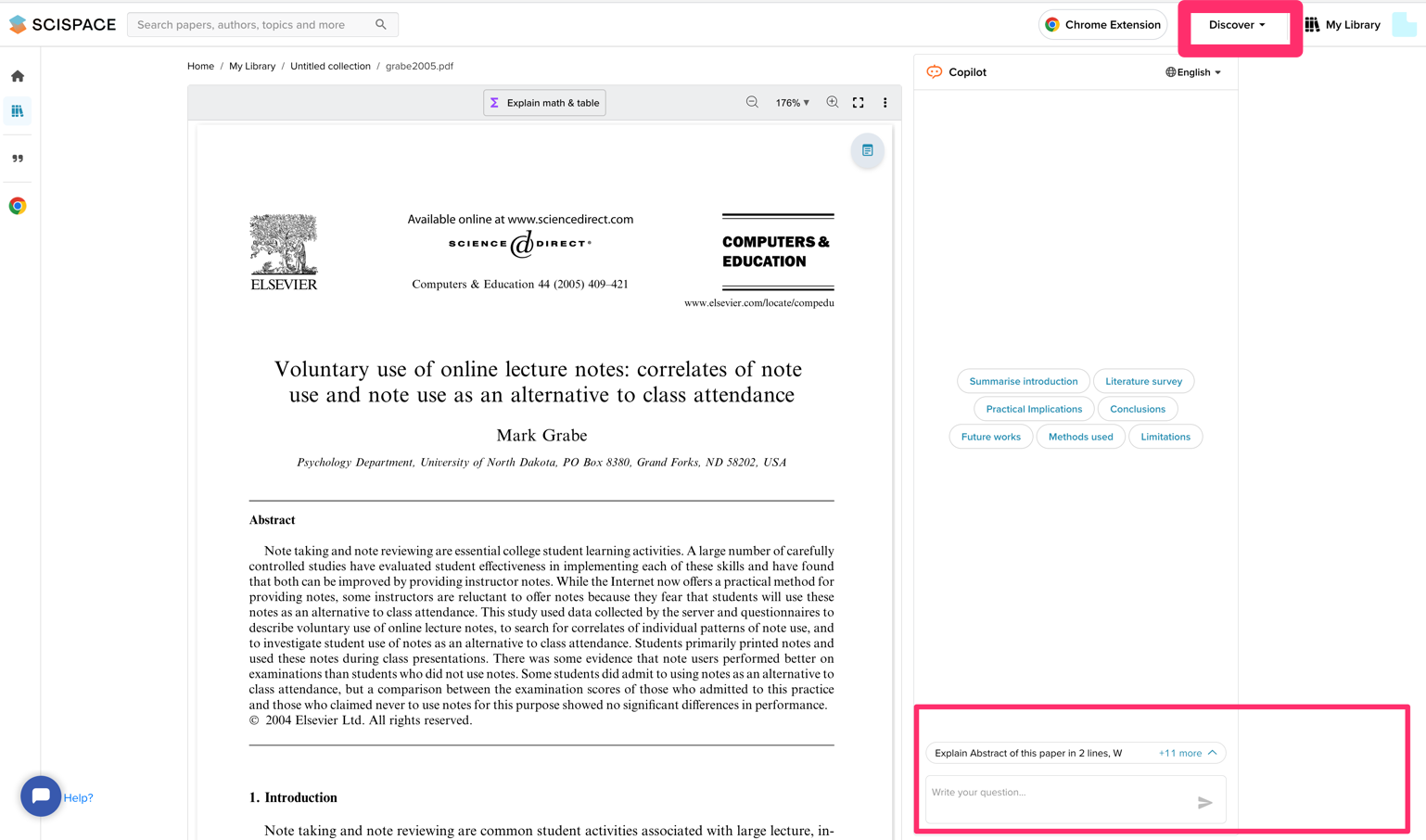
You either upload the pdf of an article you want to read or explore a pdf already added. The service is designed for users to create a library of articles they want to consult over time so this is not just for a one-time reading of articles. The basic design of the application is shown below. The article being read appears on the left and the AI inquiry panel appears on the right. I have added two red boxes to this panel to highlight two important capabilities. The box at the top opens a Discover dropdown menu which I will describe at a later point. The box at the bottom of the panel allows the entry of AI queries or the selection of a query from useful preselects.
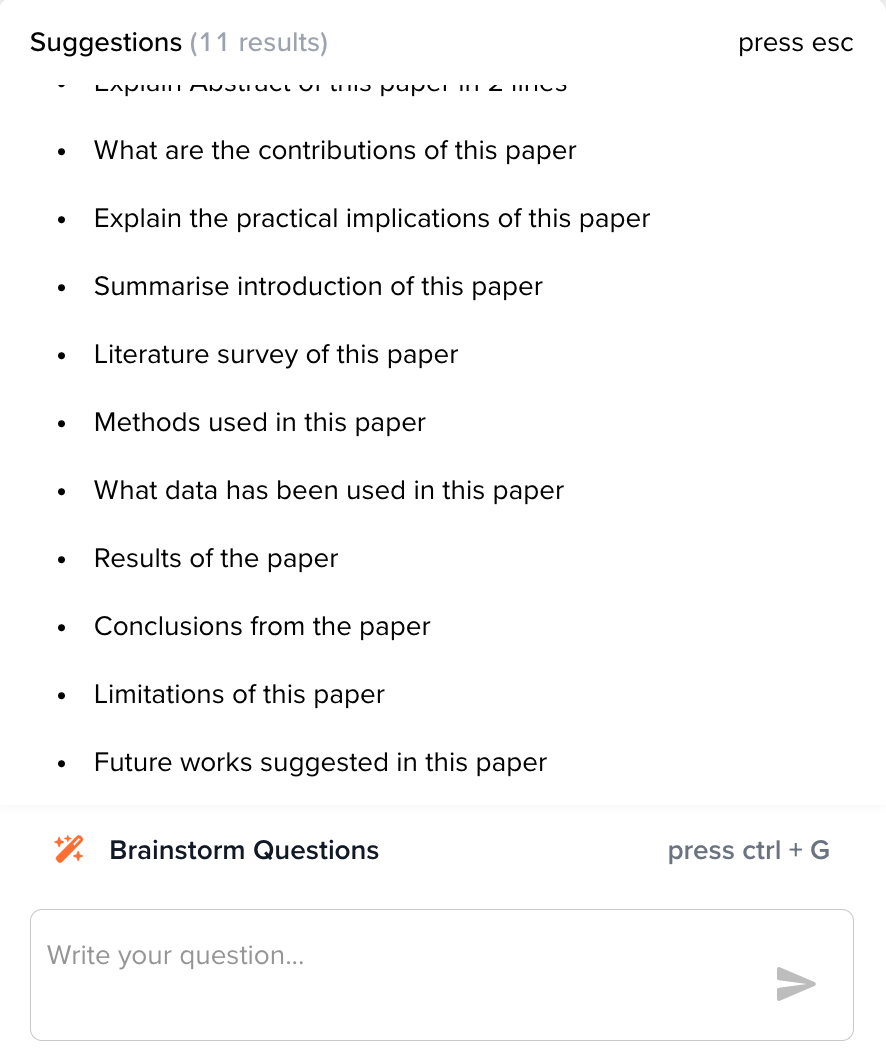
Some of the query presets are listed in the following image. These questions or questions you generate yourself can be applied to the article using AI.
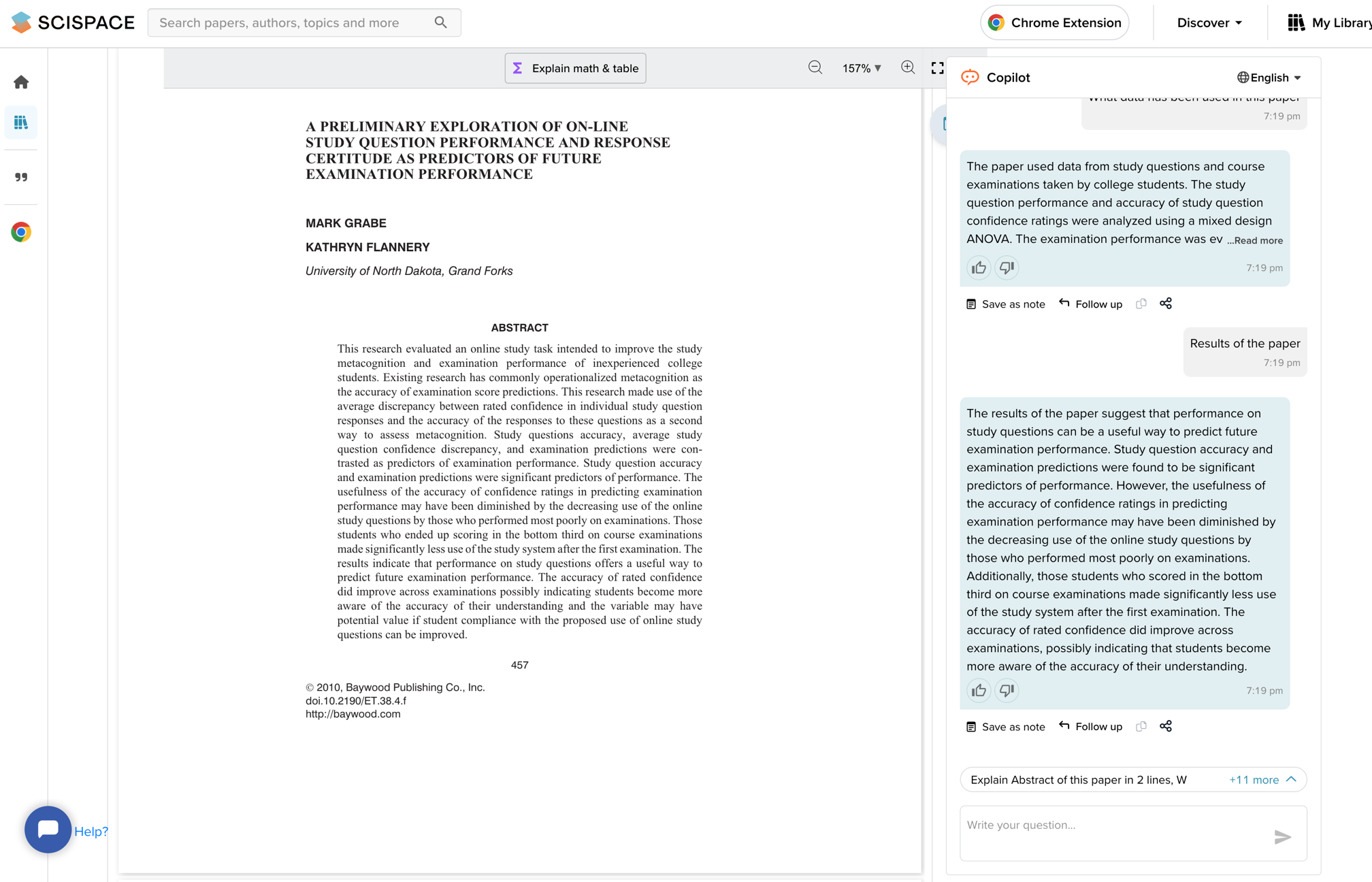
Answers to some of these questions for the article I uploaded are shown here,
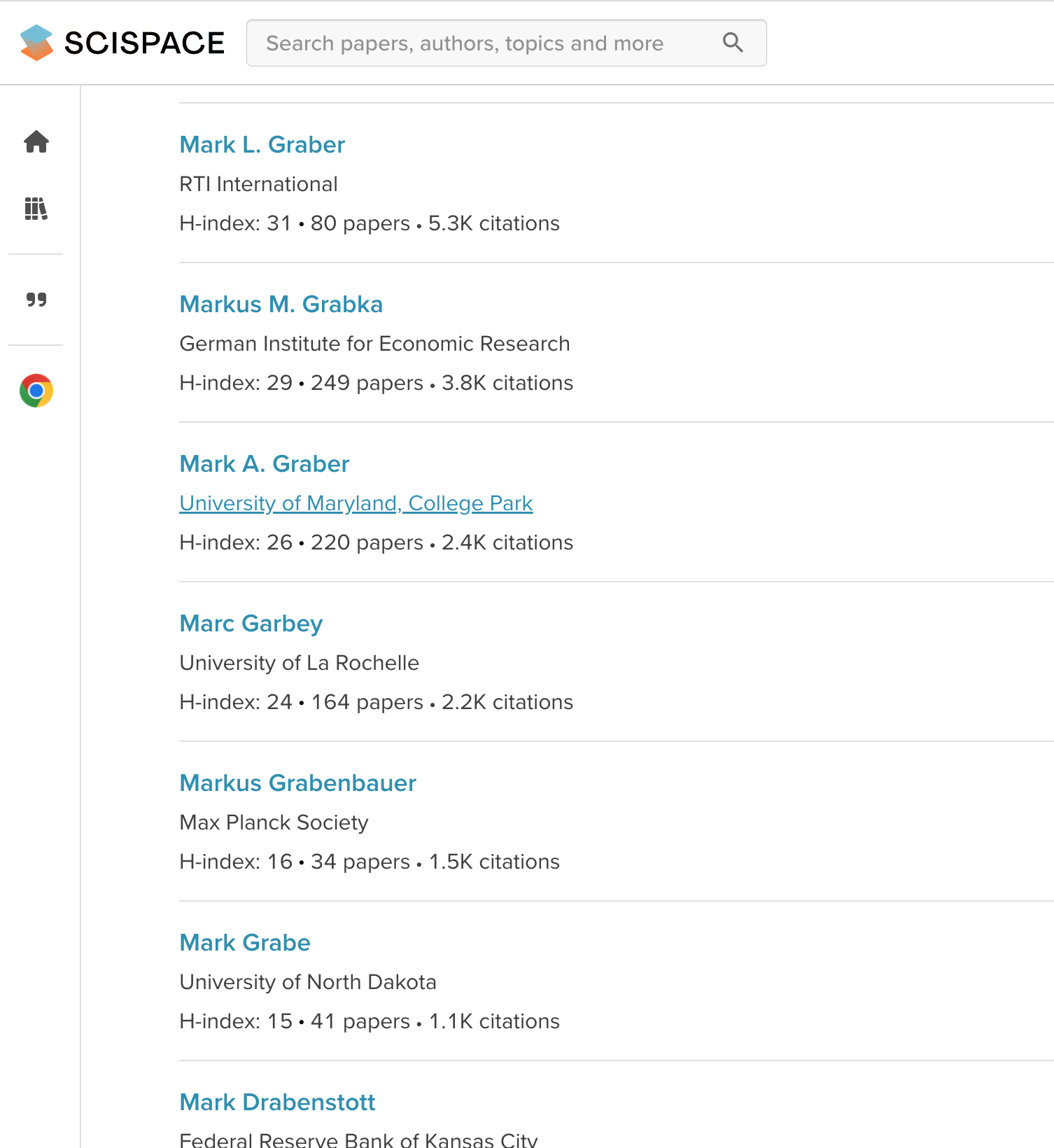
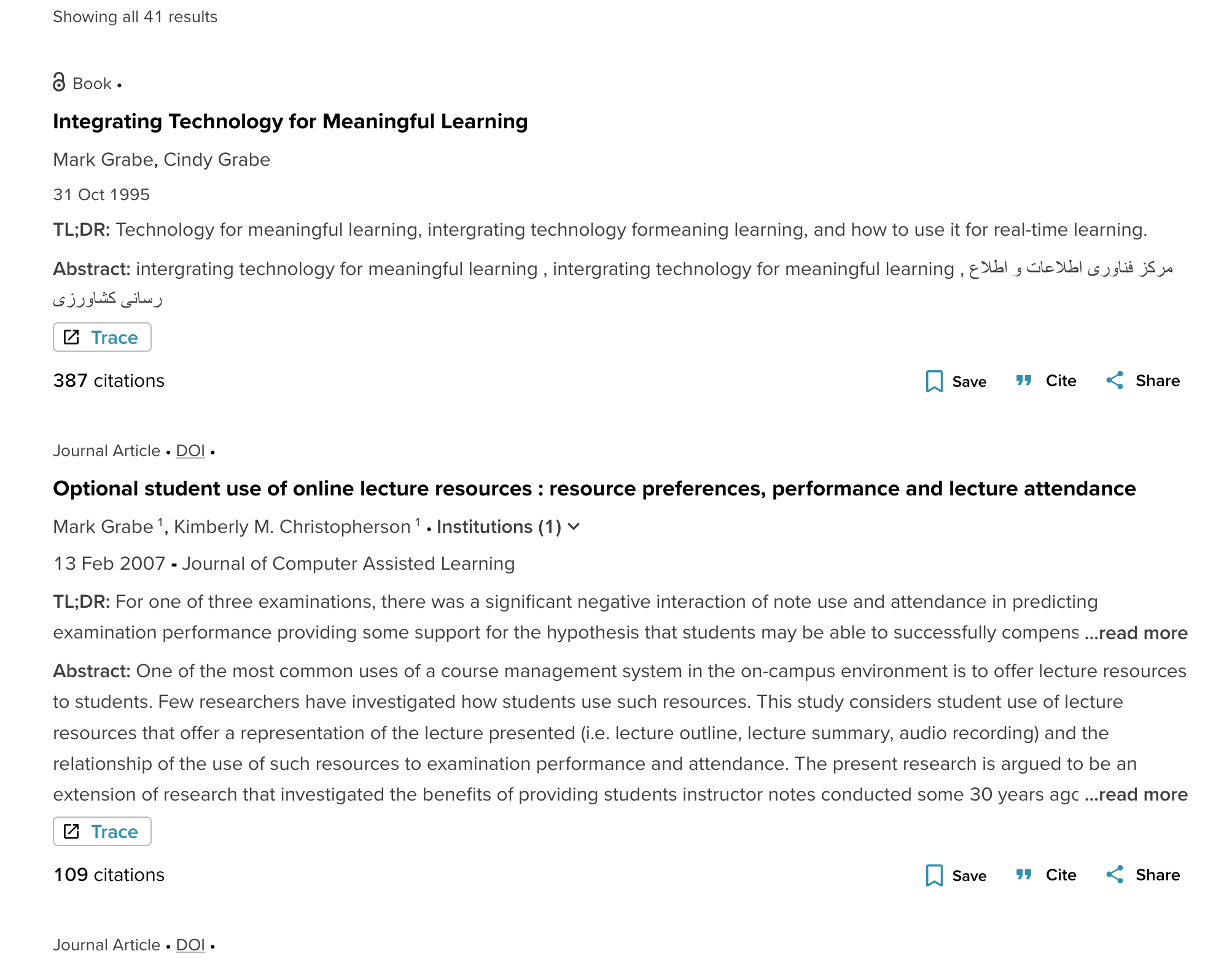
The Discover feature allows you to identify authors whose work interests you and then identify publications of an author you select. Yes, I did use myself in this example.
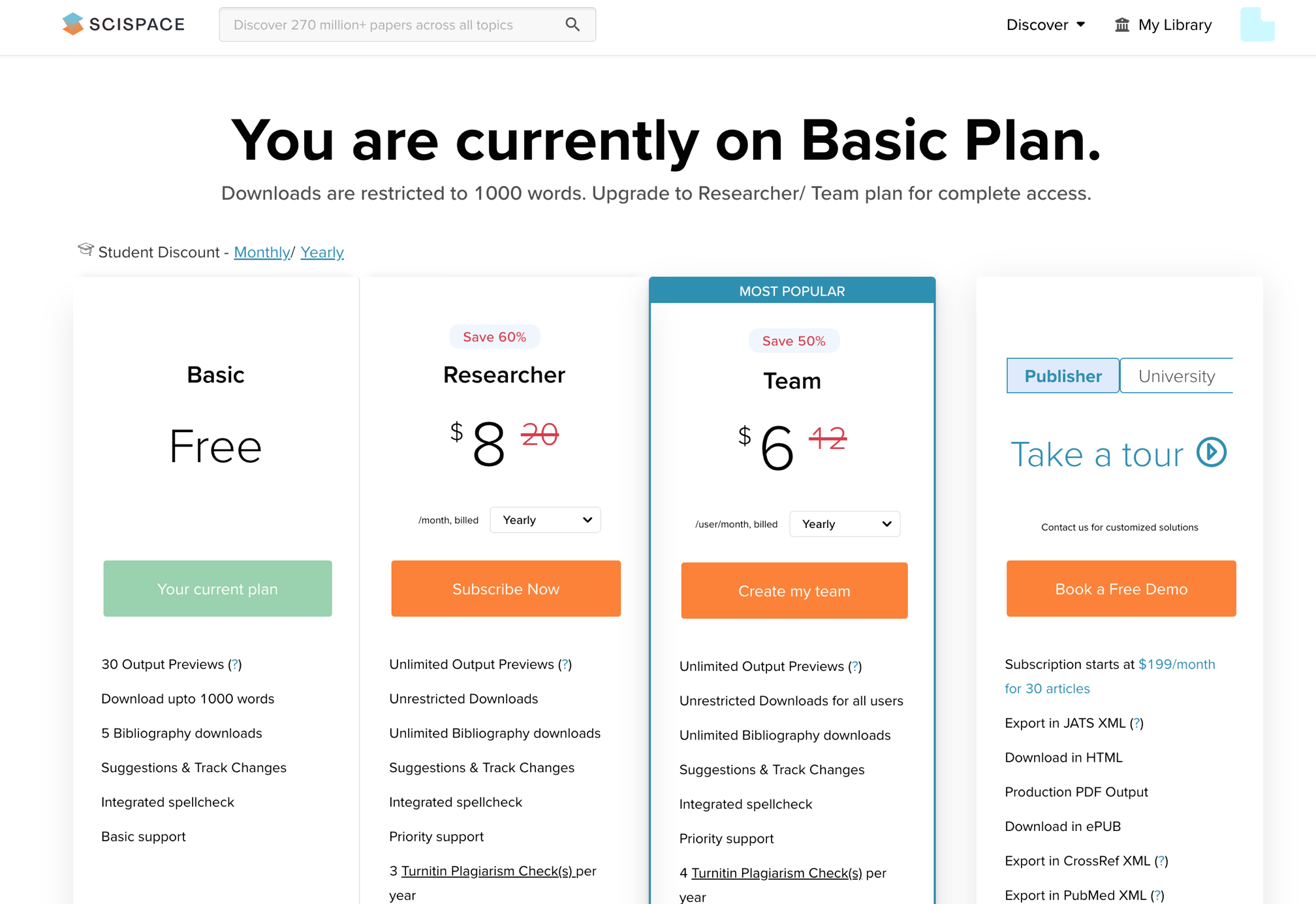
Unlike some of the other AI services I have explored, SciSpace does charge a fee for serious use. This makes sense as aside from just answering questions about pdfs you upload, it stores and allows the organization of these resources. Thus, there are infrastructure expenses associated with the service.
I see less personal value in the general question-answering potential of AI tools I have explored at this point, but I see how I can use AI tools targeting specific content I can designate.
Posted inUncategorized|TaggedAI|Comments Off on Scispace and CoPilot
You may be unfamiliar with the Internet Archives and the recent controversy of whether the Archives legally lends digital books in a way that honors copyright (for an example see this story). The Archives just lost a case in which they claimed they were functioning like other libraries. Lots of people don’t use libraries anymore and don’t understand that libraries loan audiobooks and “Kindle” books (digital books). You don’t even have to go to a library. Just have a membership in that library (have a library card) and you can download books.
Libraries can do this because they purchase a number of licenses for any digital book in their holdings. They can lend the number of books for which they have a license. The loans are for a file with DRM (digital rights management) that cannot be duplicated and kept or passed on. When the time for the loan is up, the file will no longer open.
The Internet Archives claimed this is what they were doing and the court that heard the case disagreed. Many feel that the Archives has been discriminated against in some way and that libraries and public access rules have been attacked. The concern is often expressed as an issue of greed and equity.
I was initially on the side of the Internet Archives mostly because I frequently borrow both Kindle and audiobooks from several libraries. I have tried in various ways to understand exactly what the issue was that made the Archives lending approach different. I thought maybe the Archives was loaning files without DRM that then allowed users to copy and share copies.
When I investigate issues that involve digital content I try to use material I am very familiar with. This is a way to rule out issues because I have a sense of what should be there. With this topic, I had the advantage of being able to access a book I wrote through the Internet Archives. Two editions of a textbook were available. The value of a textbook on classroom use of technology that is a dozen or so years old has modest value at best because things change so quickly, but there it was and copyright issues still apply even when you can no longer actually purchase that edition.
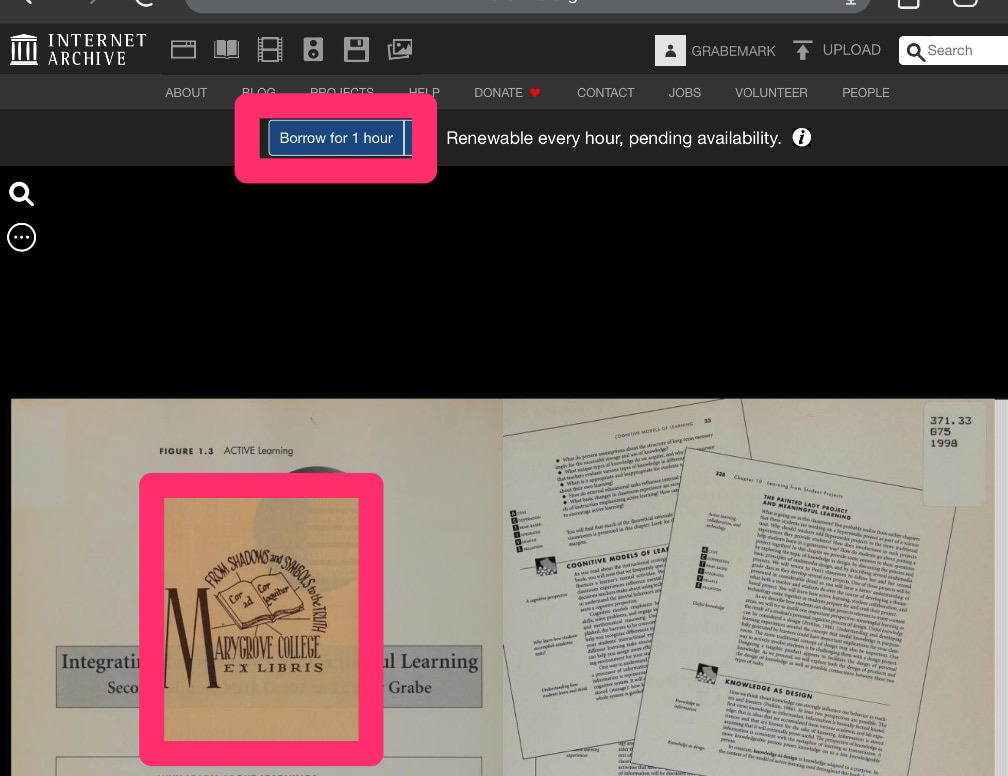
I found that I could easily access a book and “borrow” it online for an hour at a time. No waiting because a book has been committed to someone else, but with an old book this was not surprising. If you see the little box at the top of the page you see where I click to start the timer and reveal the full-text version.
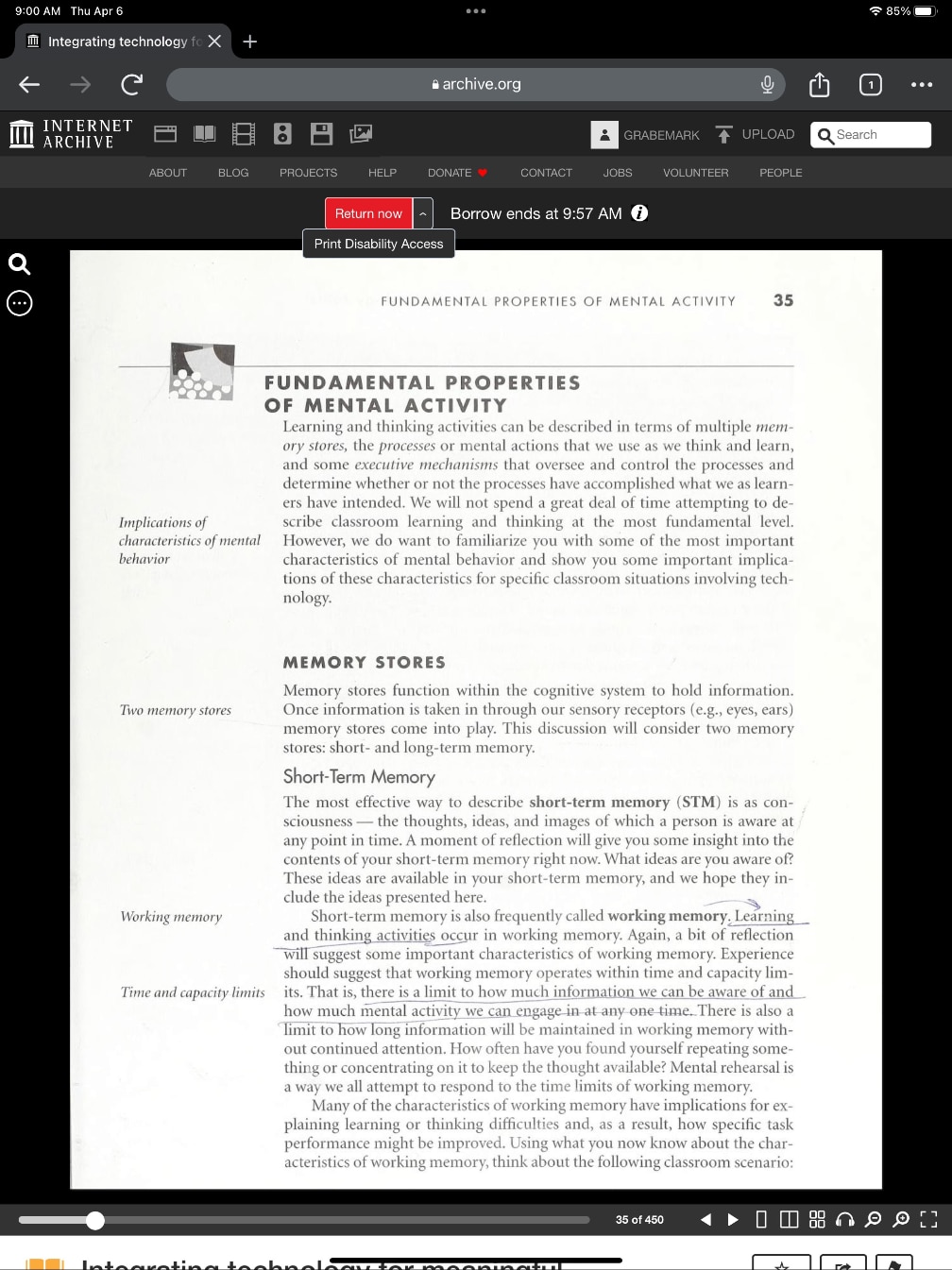
Several things to observe from my example. First, it appears that access is limited (you have the resource for an hour, but can end your access early). However, I was able to just request access again. Second, and maybe not obviously, the books are used. This was the case with both editions I looked at. One had a library seal and both had underlining and annotations. Here is the thing about books that are not “first sale”. Whether these books were purchased used or donated there is nothing from the acquisition of a used book that compensates either the company or the author. Finally, I was curious about the one access for one license requirement libraries must honor. I found I could open a copy of the same resource on both my laptop and my iPad. I seriously doubt the archive has retained multiple copies of the used books it had photographed (the camera used in recording the page images is listed in the metadata).
So, the Digital Archives approach to lending books is nothing like the approach of actual libraries. I have been unable to find the details of the court reasoning process at the level I have provided here, but it does surprise me that the court reached the decision that it did.
Posted inUncategorized|Comments Off on Digital library books from the Internet Archives
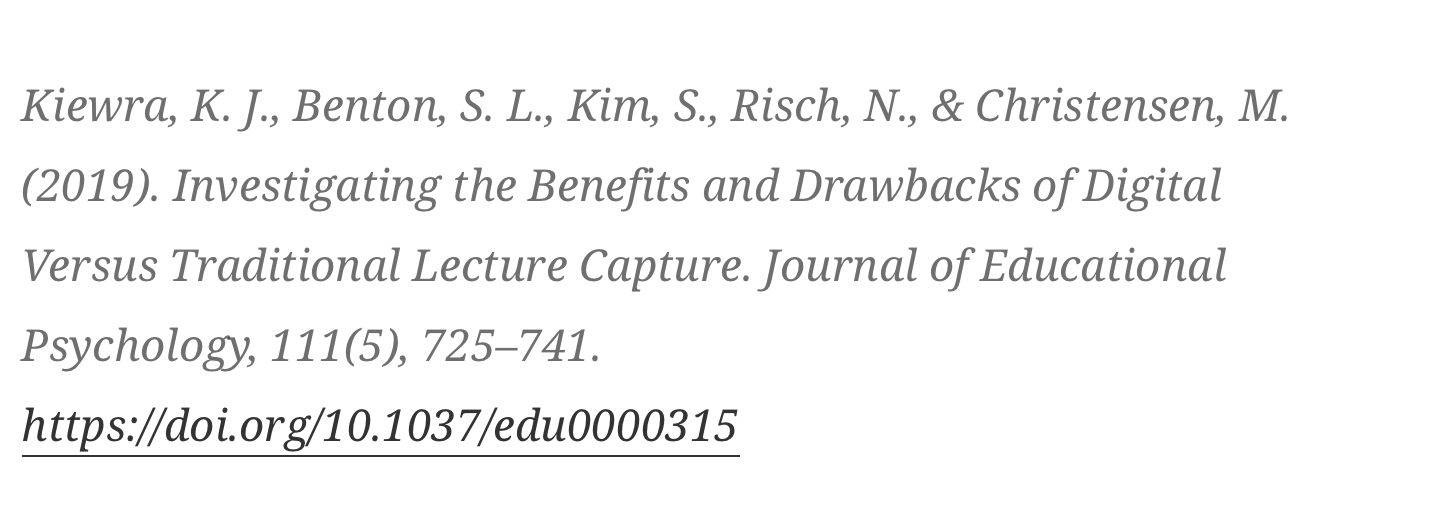
One of the strategies I have been recommending for educators concerned about the way students are using ChatGPT is to ask students to include references in their reports. My daughter who is working on her dissertation and grant applications told me that ChatGPT will fabricate references.
I encountered an example of this problem. I write frequently about digital note-taking and try to couch what I discuss in the research I have read. Recently in evaluating ChatGPT I asked a question about this topic and I asked for references. One of the citations GPT added to the content it generated I did not recognize and I then attempted to download it from my university library. It does not exist and the page numbers included do not match the range covered by the issue designated in the citation.
It is not that uncommon to find a citation that is in error. We all can make mistakes when we enter citation information in a document we create. Usually, I can identify the problem by entering the title in Google Scholar. This is not the case with this example. Kiewra is well known for his research on this topic. Benton and Kiewra often publish together. So, the citation might seem real to those familiar with this topic. It is not.
I have been using several social bookmarking services. A social bookmarking service is the first step in my “read a web page” to “write a blog post” workflow. Social implies the potential for sharing web pages and annotations with others.
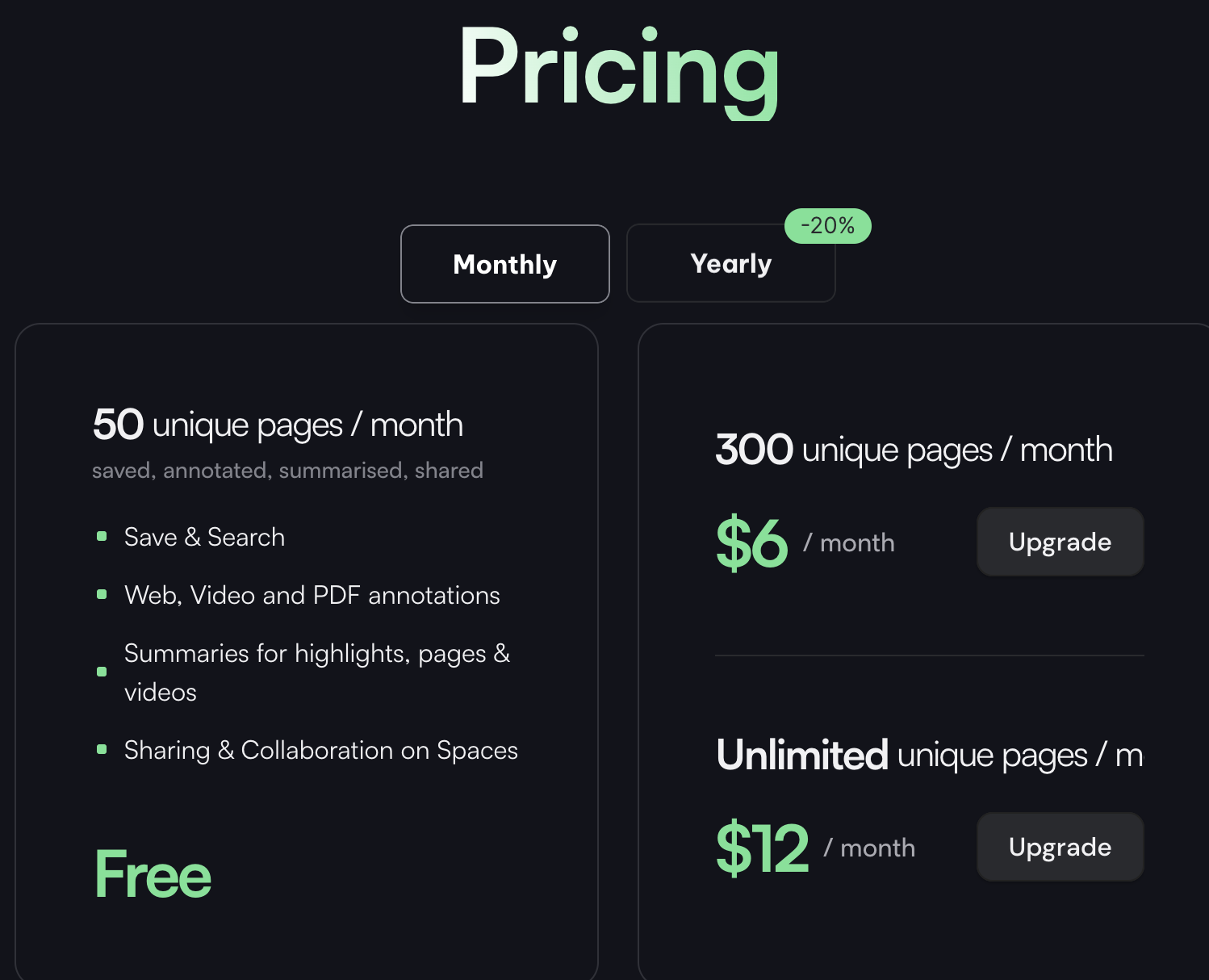
I have written about Memex Garden in at least one previous post. I invested in developing this service when it was first developed and the company responsible has now transitioned to a subscription model declaring the service is now ready for prime time. One of the final features added was AI.
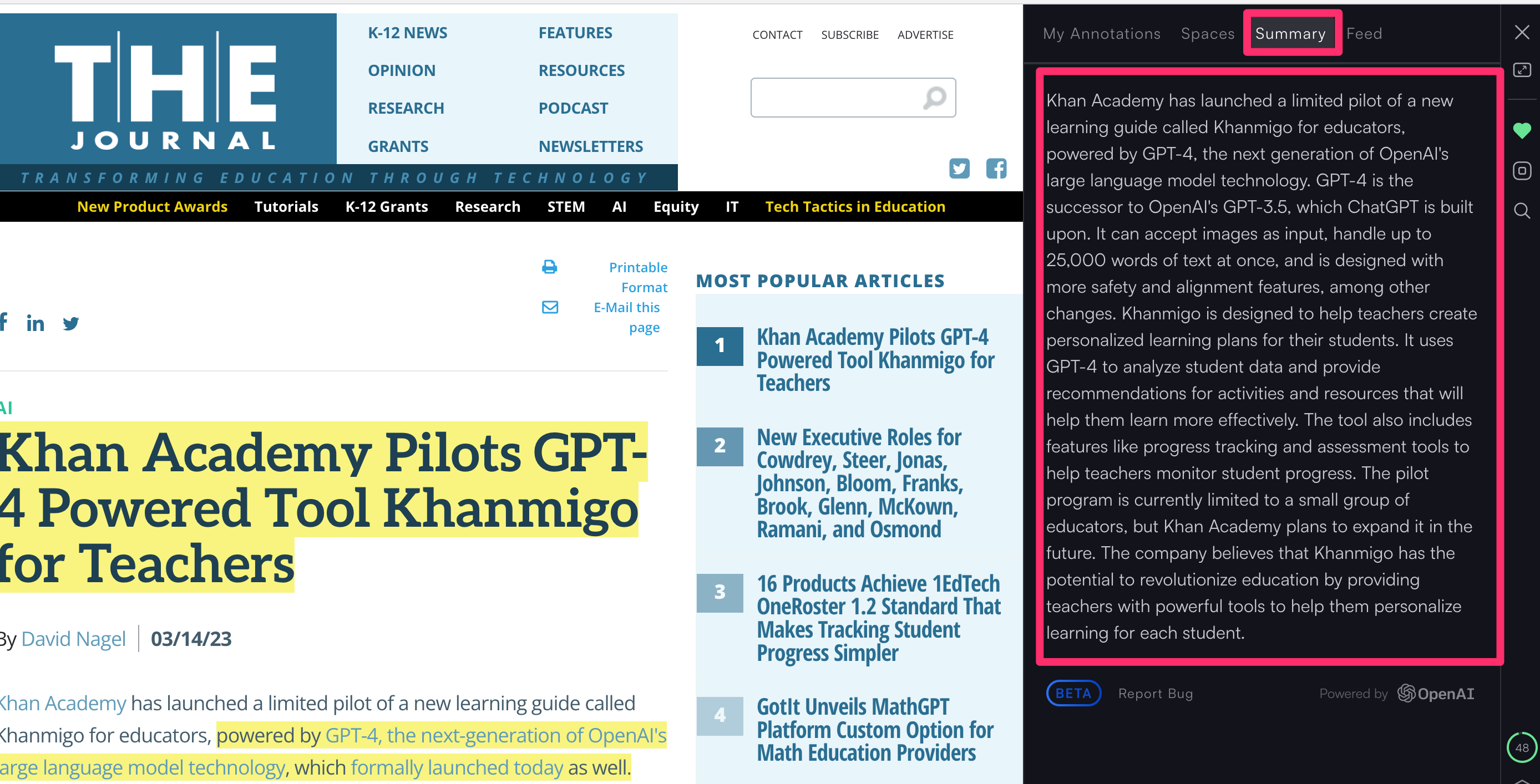
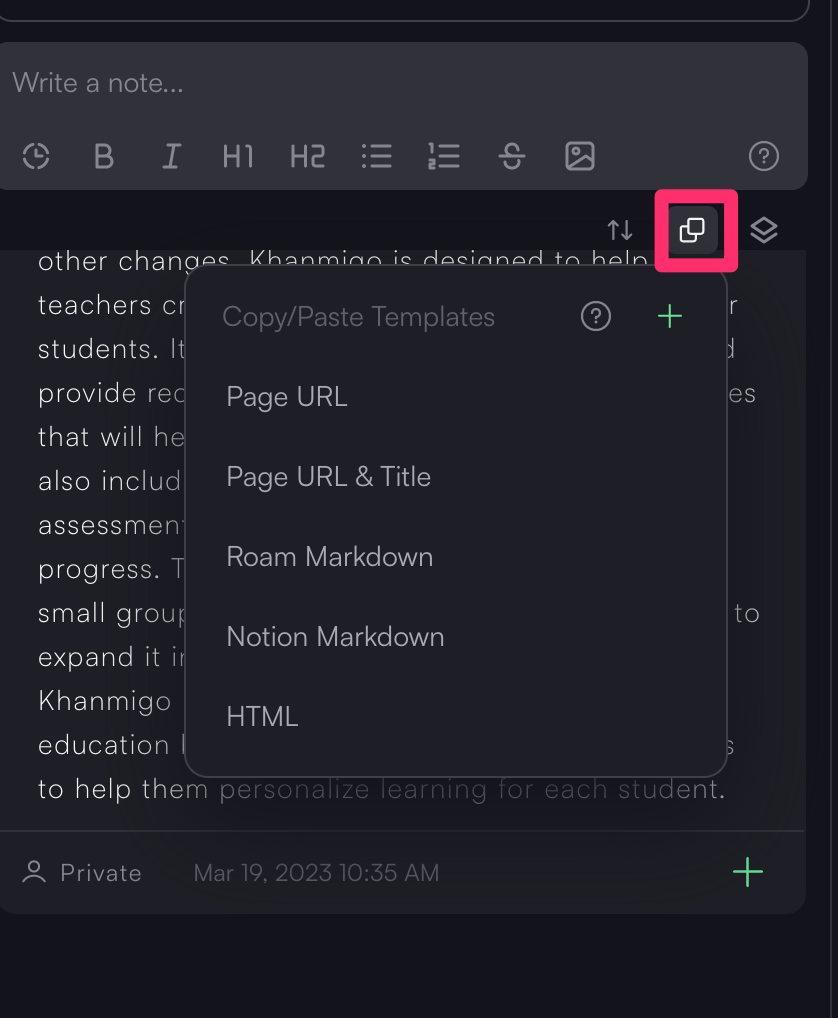
Memex uses AI to summarize web pages or parts of web pages. When activated as a browser extension, a side bar can be opened and one of the options is Summary (first image). Content generated as an AI summary, note, or highlight can be exported in several ways (second image).
The following is an example of a web page summary written by the Memex AI tool. The page summarized is about the new Kahn Academy AI tool.
Khan Academy has launched a limited pilot of a new learning guide called Khanmigo for educators, powered by GPT-4, the next generation of OpenAI’s large language model technology. GPT-4 is the successor to OpenAI’s GPT-3.5, which ChatGPT is built upon. It can accept images as input, handle up to 25,000 words of text at once, and is designed with more safety and alignment features, among other changes. Khanmigo is designed to help teachers create personalized learning plans for their students. It uses GPT-4 to analyze student data and provide recommendations for activities and resources that will help them learn more effectively. The tool also includes features like progress tracking and assessment tools to help teachers monitor student progress. The pilot program is currently limited to a small group of educators, but Khan Academy plans to expand it in the future. The company believes that Khanmigo has the potential to revolutionize education by providing teachers with powerful tools to help them personalize learning for each student.
As I explained at the beginning of this post, Memex Garden has now moved to a subscription pricing system. Details are provided in the following image.
This article from CBS News summarizes the results of an analysis attempting to predict the occupations most “exposed” to recent AI capabilities. Exposed was the word carefully chosen to indicate that AI could substitute for or complement competencies important in these occupations. In some cases, this analysis proposes the people doing this kind of work could be replaced and in others the people doing this kind of work will be able to use AI to improve their productivity and effectiveness.
The ordered list of the occupations most “exposed” follows:
Telemarketers
English language and literature teachers
Foreign language and literature teachers
History teachers
Law teachers
Philosophy and religion teachers
Sociology teachers
Political science teachers
Criminal justice and law enforcement teachers
Sociologists
Social work teachers
Psychology teachers
Communications teachers
Political scientists
Cultural studies teachers
Arbitrators, mediators and conciliators
Judges, magistrate judges and magistrates
Geography teachers
Library science teachers
Clinical, counseling and school psychologists
The methodology used in this analysis is explained in a paper explaining how existing estimates of the importance of 52 specific skills are involved in over 800 professions against the specific capabilities of multiple AI systems. The occupations with the greatest overlap are considered most exposed.
I would assume this list of exposed occupations would be used to identify the teachers who should pay the most attention to AI and how AI tools could be applied in their classrooms.
Posted inUncategorized|TaggedAI|Comments Off on Educators among professions most impacted by AI
We use cookies to ensure that we give you the best experience on our website. If you continue to use this site we will assume that you are happy with it.
You can revoke your consent any time using the Revoke consent button.





You must be logged in to post a comment.