RSS is a great tool for discovery. Much has been made of the termination of Google Reader, but much of the focus has been on tools that might replace Reader. Less attention has focused on how we might discover new feeds.
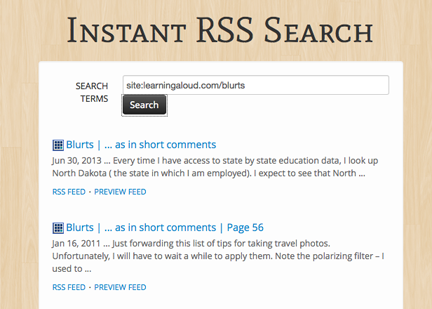
Instant RSS Search offers a tool you may want to explore. You can locate sites that offer rss feeds for a given topic (e.g., edtech) or find the RSS feed for a given site (Note: You do not actually need this with Feedly, but it may still come in handy).
Posted inUncategorized|Taggedrss|Comments Off on Now that Reader is gone – Instant RSS search for discovery
I happened to notice this news about Xtranormal because one of the students in my summer grad class presented on this online service. Xtranormal, a service allowing users to have characters in an animated movie speak the text entered by the user, has shut down (end current subscriptions). It was an interesting service, but I am guessing not enough users were willing to pay for the pro version.
Posted inUncategorized|Comments Off on Xtranormal is gone
Every time I have access to state by state education data, I look up North Dakota (the state in which I am employed). I expect to see that North Dakota has done well. My confidence is not based in an assumption of high quality, but because I assume North Dakota does not have to face some of the challenges that face educators in other states. This perspective actually prompted part of my reaction to the implications in comments I address here.
For example, this post regarding reading performance indicates North Dakota (and Iowa) scored toward the bottom. I started to think about this. My biases may be at work here, but I think first impressions may be misleading.
Careful reading indicates the chart shows gains in reading performanceamong students receiving free or reduced lunch (used as a measure of poverty). Two issues to consider:
This is not a chart showing levels of performance – gain scores are a difference score.
This is a chart based on a subset of all students and the size of this subset is not constant by state.
Researchers know that change scores are very difficult to interpret and I think this could be the case here. A key issue in this case is likely what the scores were before the intervention (NCLB). If the scores reflect a “ceiling effect” improvement would imply something very different from a situation in which the beginning scores were originally low (and little changed occurred). I think it likely there is some of each possibility at work here and it would be important to know which low improvement states within this group fall into the low or high start category.
The second possibility is that a state with lower population and a lower proportion of students from low income families may find more it challenging to address the needs of these students. I do not know that this is the case, but I believe it to be the case with other educational challenges – e.g., ESL students.
It is possible I am completely wrong and North Dakota is doing a poor job of instruction. However, critical thinking is important any time data are presented and causality is difficult to tie down in correlational rather than manipulative research.
Posted inUncategorized|Comments Off on All reading performance is local
The Chambers Daily identifies a comment in Apple’s description of Ios7 that offers educators a way to deal with the COPA age 13 requirement for many online services. Read the analysis here.
Posted inUncategorized|Comments Off on ios7 and COPA
I was surprised to learn a couple of months ago that after years of being associated with Apple Maine had decided to take a new course and align with the Windows platform. It seems this was primarily a financial decision made by the Governor and department of education. In part, the governor claimed the Windows platform was more popular in business settings.
What does all this mean? Hard to know, but the politicians in this case came off looking pretty clueless. It might be a good strategy to allow those who actually work with the students to choose the tools they find most appropriate to the job.
WordPress (the software running this blog) is expandable through third-party plugins. For example, I use a plugin to sent a tweet when I post something here. You likely see many others who do a similar thing.
Twitter recently changed its API invalidating the plugin I had been using. This is a problem when the products of different companies can be combined. It took me a while to find a provider who had made the adjustment and located WP to Twitter. If you viewed this part as a consequence of seeing a tweet, you know who to thank.
We use cookies to ensure that we give you the best experience on our website. If you continue to use this site we will assume that you are happy with it.
You can revoke your consent any time using the Revoke consent button.


You must be logged in to post a comment.