One of the points I always make in explaining the potential dangers of so many online social sites for young people is that most of these sites were designed for a broad market and for many purposes. Hence, being upset because such sites contain content or offer the potential of inappropriate experiences for young people cannot be blamed on the site. You should know what you might encounter.
This said, these sites are attractive to young people for the same reasons they are attractive to adults. The sites offer interesting social opportunities.
The idea of a photo walk is hardly new. I tend to understand such adventures as exercises for photographers in which they explore a location together and capture what they see.
Some photographers are now altering this social experience somewhat to explore a location for the benefit of those unable to explore (or no longer able to explore) that location for themselves. The idea of virtual photo walks using Google+ is to take images following the directions of someone else:
By rigging their smartphones to cameras, the photographers take directions during from virtual participants who tell them to snap photos of a particular tree or walk down that road to show them what’s beyond that ridge.
A smartphone I would think would be the easiest way to do this. The immediacy of the experience would be great. Photo quality would be acceptable. What a great base for a classroom project – the variations seem endless.
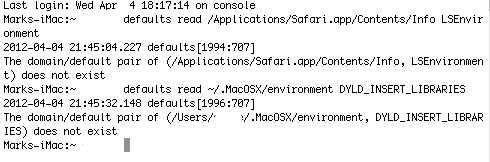
This Ars Technica post indicates that you Mac may have picked up a trojan. Evidently this may be one of the reasons you were notified of a java update a few days ago.
I ran the test on one machine to check it out. The responses the terminal commands generated came back to indicate no problems. If you are concerned about this issue or even running the check, you might do a little looking around to see what you think.
P.S. – Since my original post, another way to check for this problem has surfaced. My link here is to the recommendation from MacWorld. I have not downloaded and try this app.
Flickr, the online image and sharing service, has provided Picnik as an online image editor. When Google purchased Picnik, this probably became awkward. Those of us who use Flickr have known for some time that we would no longer be able to edit our images within Flickr beginning later this month.
This post from Bloomberg Business provides an interesting summary of the tech patent battles. It is difficult for consumers when companies become self centered and the focus is more on other companies as enemy than on whether actions taken are actual infringements. it is difficult to know how much of this is appropriate. Stealing ideas such as the mouse and GUI interface? (yes I know). The court battles can be more harassment than about actual lose.
Posted inUncategorized|Comments Off on Patent Battles
Educational Researcher, a major AERA research journal, had a recent article summarizing use of wikis in K-12 settings. The authors have already posted a summary so you do not have to be an AERA member to take a look. The one characteristic of the newer report I found to be unique was the attempt to different two categories of student wikis. The general results seem very similar to previous research. The new research suggests that student use of wikis is limited and that most student projects involve single student reports. The sources I have been citing suggest that about 9% of students author a blog or wiki and this new study reports a 20% level of student activity with the more highly valued long term, collaborative, multimedia projects involving only 1% of all wikis. The new study promotes the use of data from large scale data warehouses. The authors had access to data from PBWorks.
Access to large data sources can be great, but I wonder if results would vary as a function of the wiki tool. For example, if my school had access to Google docs for education, I think that I would approach shared “copy editing” and embedding multimedia (two of the activities pointing to the more desired use of wikis) quite differently than if I was using PBWorks. A Google docs document is essentially a wiki and assigning pairs or small teams to multiple wiki documents is relatively easy. PBWorks might make more sense if the goal was a public document created over an extended period of time by a larger team from different schools. My point is that while a large dataset offers some advantages, a dataset focused on one tool also has significant interpretative limitations.
Posted inUncategorized|Taggedwiki|Comments Off on Student use of wikis
We use cookies to ensure that we give you the best experience on our website. If you continue to use this site we will assume that you are happy with it.
You can revoke your consent any time using the Revoke consent button.


You must be logged in to post a comment.