I spend huge quantities of time writing stuff in Google docs and I must admit I learned something new and helpful about docs I should have known this evening (yes my wife did bring this to my attention). There must be a lesson here somewhere – experience does not always translate as understanding, listen to the woman (I think that is a line from a movie), etc.
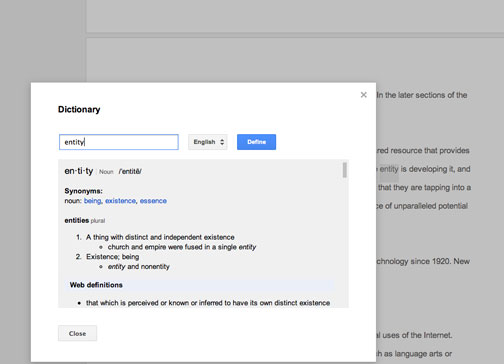
It seems that in docs you can get some of the same info you would get from a dictionary or thesaurus (a difficult word to spell) by selecting a word and using command, shift, Y (on the mac). Brings up a dialog box with word info.
THE Journal claims that Google is evaluating adding Google + to the Google apps for schools package. Seems like a good use of Circles to control sharing. Will the software then be modified in some ways so that the potential population of “friends” will be controlled?
Posted inUncategorized|Comments Off on Google Plus as part of Apps for Schools?
For a while now, the trend in generating content online has been away from software on a computer owned by an author and toward online content creation sites. For example, you do not need to own software to blog. You use a browser to connect to a site allowing you to write and integrate multimedia. Some blog sites allow the creation of pages (instead of posts) allowing the generation of something more akin to a web site. Google sites, etc. offers a browser-based approach to creating a web site.
Adobe appears to be interesting in revisiting the older model. They have just announced Muse which appears to be what might be described as a “drag and drop” authoring environment. With Apple pretty much abandoning iWeb, I am certainly glad to see that a company is still developing tools for the “hobbyist designer”. These tools used to exist (anyone remember PageMill) and I still like the idea. The related challenge is going to be “hosting” – I wonder if Adobe will also provide a hosting service of some type.
I do not like the funding model which basically requires you to rent access by the month.
Posted inUncategorized|Comments Off on Does “Muse” signal a course reversal
Blogger and photographer Thomas Hawk posted recently contended that Google + would soon provide the opportunity for Google to overtake Flickr as the digital photography destination of choice. Hawk provides two contrasting galleries of his own pictures in support of his claim.
I do like Google’s Picasa and I do understand that Google seems to be consolidating services (perhaps Picasa with the photo service in Google +, hangout and the videoconferencing feature of chat) and focusing its offerings elsewhere. I still prefer Flickr to the Google services. The “does not count against space allocation” feature of Google + photos gives me trouble. I don’t like a service that has a built in crop feature that messes with my images. I will still pay $25 a year to store my photos in the form factor I prefer.
Hawk does make some other points I consider more damaging. He claims Google is now “interested” in photo storage and sharing and is making constant upgrades. He claims Flickr has offered little new since 2004. I cannot evaluate these claims, but, if true, innovation is certainly a factor in maintaining user interest. I think Google + is focused (get it, a photography pun) on digital images because uploads from phones are so popular for Facebook users and Google wants to compete in the social networking space. Flickr may have little to do with the commitment to images.
I hope Flickr holds on – Yahoo! based or otherwise. Multiple players are important in the online innovation process. I would rather see this as Flickr and Google + Photo than as Google + photo and Facebook.
Old guys can become cynical. Like, when they encounter some great new idea and it seems pretty much the same thing they encountered thirty years ago. Proficiency based learning – sounds very much like mastery learning from the late 1960s-1970s. I think Fred Keller’s famous paper – Goodbye Teacher – was published in 1968 (No, Keller was not advocating getting rid of teachers) Keller was actually arguing that lecturing had some serious limitations. No it was not that lecturing is boring (which seems to be the present view). It was that lecturing is a one size fits all approach when students need to hear different messages suited to their individual needs. Most people of have heard of Benjamin Bloom from the taxonomy concept. He was also a big player in the original mastery learning area – the concepts of formative and summative were associated with Bloom’s view of mastery.
I am glad mastery learning is having a resurgence – the theoretical ideas (variations in time to learn as a way to understand differences in aptitude, importance of taking care of background knowledge deficiencies as a way to improve the efficiency of learning, etc.) have always been among the more useful to me and I think they should be re-examined.
BTW – my reaction to the lack of connection to previous versions of similar ideas does not imply that I think we cannot do things better now. Mastery learning was to me a great idea that was difficult to implement. I think technology may offer a way to take care of some of these challenges. There is another reality – mastery was tied into concepts such as objectives, hierarchy of skills, etc. that seem automatically to be rejected by some. Maybe the new language is partly a way to avoid tripping some of these knee-jerk reactions.
We use cookies to ensure that we give you the best experience on our website. If you continue to use this site we will assume that you are happy with it.
You can revoke your consent any time using the Revoke consent button.



You must be logged in to post a comment.