This research summary from Hechinger is likely to get a lot of attention and a lot of different interpretations. The review of multiple studies asked the question what was the value of educators reviewing data from standardized tests evaluating student academic performance. Did student performance improve as a consequence? The composite answer from the studies investigating this question was no. This same conclusion was even evident in controlled studies that compared the results from experimental studies with a treatment and control group (exposure to data on student performance was assigned).
Here is my prediction. Some will argue this outcome shows that standardized testing has no benefit and should be abandoned. The researchers offer a different interpretation concluding that while educators did learn more about the struggles of their students they made no changes in how these students were being taught. Why adjustments are not made was not investigated and would now seem to be the next target for researchers. Does the classroom environment lack flexibility? Are teachers lacking strategies that could be used as alternatives to existing approaches?
Posted inUncategorized|Comments Off on No benefit from test data
Following my most recent post, I was doing a little reading about Google Reader. Among other things, I learned that supporters have attempted to launch a very similar product and called it Old Reader. I have been giving it a try and as advertised it offers a very similar and satisfactory experience. The one downside is that this service appears not to have a phone option so those who want to use their phone for going through the results of their RSS feed are presently out of luck.
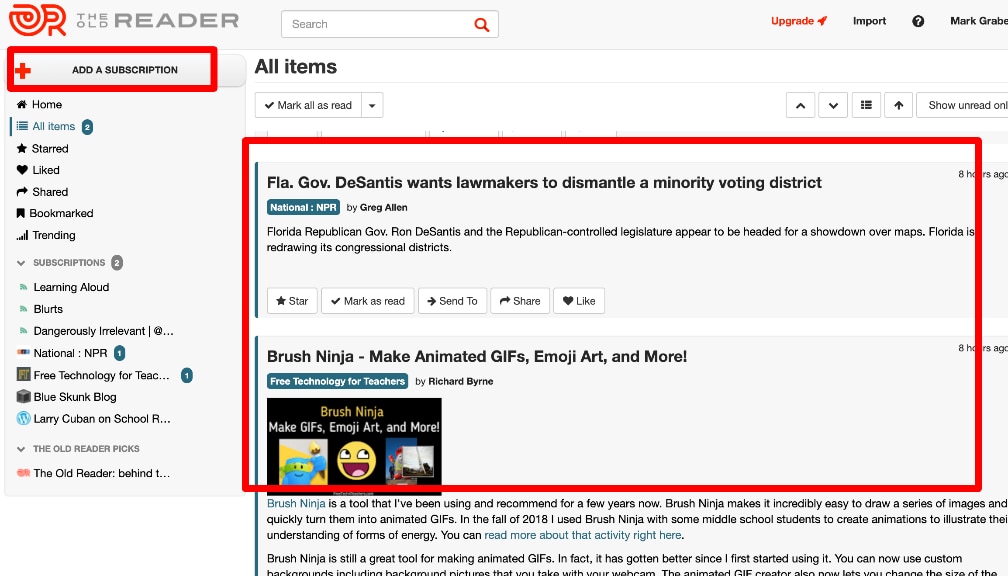
The cost for Old Reader is free up to the point you want to follow more than 100 sites. This seems very generous. It is easy to use. You enter the address for a blog or site you want to follow and it will do the work of finding the feed for that site (see red box in upper left hand corner of image shown below). Like Reader, you simply scroll through your feed and unless you mark a hit as something you want to retain the information it is removed from what appears in your feed.
If you want to use RSS from a laptop or desktop machine, Old Reader seems a great way to go.
I recommend your attention to the first 45 minutes or so of this This Week in Tech podcast. The episode begins with comments on several major “music” sites paying for exclusive rights to popular podcasts and then focuses on these same services purchasing RSS sites. RSS feeds allow the collection of new content from several media types, but an RSS feed is necessary for the distribution of podcasts. The core concern was that users would have to go through fewer and fewer services to access content.
The conversation then moved on to the entire consolidation process moving audiences toward accessing fewer and fewer points of access for information and entertainment. Obviously the popularity of Facebook as replaced how many offered their content and to a lesser extent the same is true of Twitter. Along with this consolidation come the algorithms that exercise poorly understood control over the content that is actually consumed.
If you are not an RSS user, I recommend Feedly. Google’s termination of the Google Reader did a lot of harm in limiting the use of RSS but there are still some good readers out there.
Posted inUncategorized|Comments Off on Creeping consolidation
I stumbled into a heated Twitter discussion last night. Thinking back, after some of the political interactions I have had over the past year or so, the interaction was kind of cute. I am trying to reconstruct the interactions this morning, but I am having to guess at some of the details because those participating have removed some of their tweets. I do know that some of the participants are aligned with different online services so this situation was similar to Democrats and Republicans arguing over a given issue.
My guess is that the interaction began with a reference to this article from The Georgetown Voice titled Welcome to Surveillance University. The focus of the article was on technology services allowing the behavior of students to be monitored. Examples included test monitoring services for distance students, questions regarding the use of the camera on a student’s computer to monitor their presence while in a remote learning class, and more to my personal interests software that allows the educator to determine whether or not a student has read the assigned material.
This final topic targeted a service, Perusall, I had reviewed as part of my interest in what I call layering services. Without getting into the details of what I mean by layering, such services allow a teacher or learner to add elements to existing digital content. Elements include questions, notes, highlights, discussion prompts, etc. Some systems include a way to evaluate learner responses to prompts (questions) or the use of some elements (highlighting). Perusall also tracks student reading of the assigned material. Other services I have reviewed may do so as well. This was just not a capability I paid much attention to.
Several of the Twitter participants labeled tracking whether a student had completed a reading assignment as surveillance which appeared to set off someone associated with Perusall. The phrase “surveillance capitalism” was thrown around. This is an inappropriate use of Sashona Zuboff’s concept which is focused on service providers harvesting user data to target ads and profit from the display and the sale of targeted ads to companies willing to pay. It is the reason you get many online services without paying money for them. You pay with your attention and your data. A teacher using the capability of a service to monitor student completion of assignments is not involved in surveillance capitalism.
W
hat about monitoring student completion of assignments? Obviously, educators require students to hand in assignments that have been given without necessarily grading them. Handing in the assignment obviously involves determining if the task had been done. Maybe this is simply what the teacher wants to know. Does this involve surveillance and show a lack of trust? Technology that is used to deliver content can easily enough be adapted to track whether or not someone who must sign in to view that content spends time on the material. My position in the Twitter interaction was that as an educator I might want to know this information. It would have an influence on my understanding of other student behaviors. If a student was struggling to grasp assigned material, knowing whether the student had attempted to study the material and struggled or not read the material would be an important distinction. This just seems obvious to me.
Luna Notes is an easy to use annotation tool for YouTube videos. The extension brings up a window to the right of the YouTube being played. Clicking in this window allows the generation of a note that is linked to the time in the video at which the user clicks in the window. Restarting the video after taking a note opens another note box. These notes are saved associated with the video allowing review and immediate access to locations in the video associated with a note (click on the time stamp in a note). Luna Notes is presently free.
This is a post I obviously first offered some time ago, but it seems even more relevant now given recent and ongoing events.
Donald Trump has added a new dimension to his complaints and proposals for his reelection. The President of the United States warned of a national education crisis on Thursday: the “ideological poison” of “radical” history education. He has proposed the development of the “1776 Commission” to address what he sees as flawed history instruction. I have seen this movie before.
I am not a great student of history and have often noted with some pride that I got through college without taking a history course. This was a significant challenge as my major professor in graduate school taught the grad course on the history of psychology and was a noted scholar focused on the history of the emergence of “life span developmental” psychology.
The limitations of my formal education aside, I have some insight into the exact issue that Trump raised and I have read a good amount on the topic and the role K12 history courses should serve.
My focus as is so often the way anyone becomes interested in a specific issue originated in a unique way. Much of my early interest in technology (say late 1980s) was focused on how technology tools could play unique roles in the hands of students. I was interested in David Jonasson’s concept of mindtools [https://frank.itlab.us/forgetting/learning_mindtools.pdf] and from this Cindy and I proposed “technology integration”. Our efforts extended Jonasson’s list of technology tools to include other tools such as digital probes and photography. A core concept in Jonasson and our argument was that students at all levels should have opportunities to engage in age-scaled tasks that explore content areas. We adopted “Do …” as a way to explain what we thought was both motivational and would enable authentic learning. For example – Doing biology, Doing writing, and to explain the background for my present focus, “Doing history”.
History seemed perfectly suited to personally authentic tasks as one’s community and family provide a history within which students are embedded and tasks can be created to enable investigations and authoring related to such histories.
Without any formal background in history, I found inspiration in my own personal experiences. I grew up on a farm and for some reason I was allowed to explore the contents for our attic. My father was a radar operator in WWII in the South Pacific and he had old equipment in the attic. Battery operated radios and a ham radio. He helped us string a wire from the house to a nearby tree as an antenna for the ham radio and when he had some time would sit with me and write down the content of Morse coded messages we could find. He also had a shoebox of 620 negatives he had made while stationed overseas. These negatives are large and you can contact print them (you don’t need an enlarger). He would create collections of photos in the field his comrades could send home to their families and make a little money. I became interested in photography.
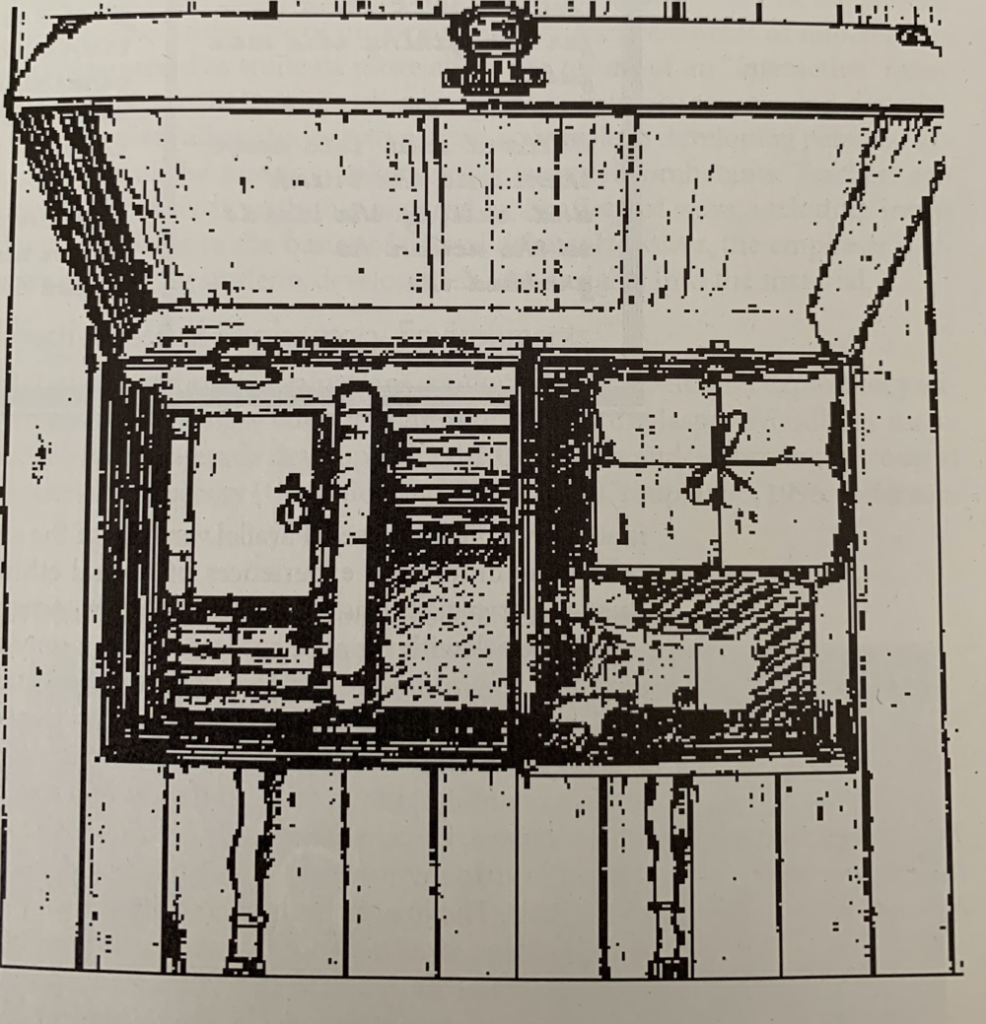
The connection? At some point, I began creating technology-enabled, exploratory environments and my first prototype created in HyperCard was “Grandma’s Attic”.
The idea was that learners could have access to a simulated attic providing access to artifacts associated with a family with certain characteristics (e.g., I was working in North Dakota and focused on groups settling the state – e.g., Norwegians, Germans from Russia). The resources of the attic – letters, diaries, photos in a photo album, newspapers, magazines, physical objects such as a spinning wheel – could be examined in an effort to put together impressions about the family. Historians are trained to apply what is often referred to as the historians’ craft (often a college course) which involves techniques for collecting information from the type of resources described here and making objective observations that could be used to make arguments about the lives of people associated with and creating such artifacts. So doing history offers a great opportunity to problem-solve, engage in critical thinking and argumentation, and other potentially generalizable cognitive skills in addition to acquiring the facts and stories of history.
The concepts of doing history and authentic learning tasks scaled to K12 student capabilities resulted in Cindy and my writing and receiving several significant grants – a Technology Innovation Challenge grant and Cindy’s Teaching American History grant.
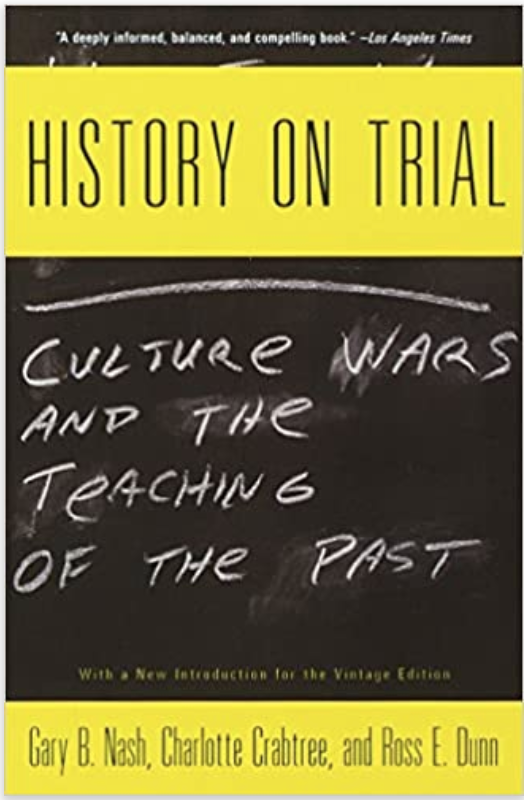
It is the preparation for writing these grants that I connect with Trump’s claims about the failed purpose for all K12 students taking history courses. Educators are expected to accomplish so many things and this list just seems to grow. The great controversy with learning history has been whether it is about teaching what might be called Patriotism and a shared perspective of the cultural background we all share OR whether it should be what I would describe as what historians study and write about – what actually happened in the past and what are the consequences of these past experiences as the American people have moved through time. This difference of opinions has been described in many ways. I remember reading this book as I helped contribute to the others working on these grants. If Trump’s complaints about how students are being influenced by their exposure to our history interests you, I would recommend the book to provide context.
I come down on the side of learning the facts of our history much in the same way I argue we need to understand and act on the facts of science. Certainly, history would be one of the courses in which issues such as slavery and enduring inequalities of all types should be considered. Denial of the facts of our past is not what education should be promoting.
We use cookies to ensure that we give you the best experience on our website. If you continue to use this site we will assume that you are happy with it.
You can revoke your consent any time using the Revoke consent button.




You must be logged in to post a comment.