Google has added options for sharing photos and photo albums stored in Google Photos. When sharing an album you can now share directly without creating a link. The default will be to enter Google addresses for those you want to share content with. You can still create and share a link to the photos.
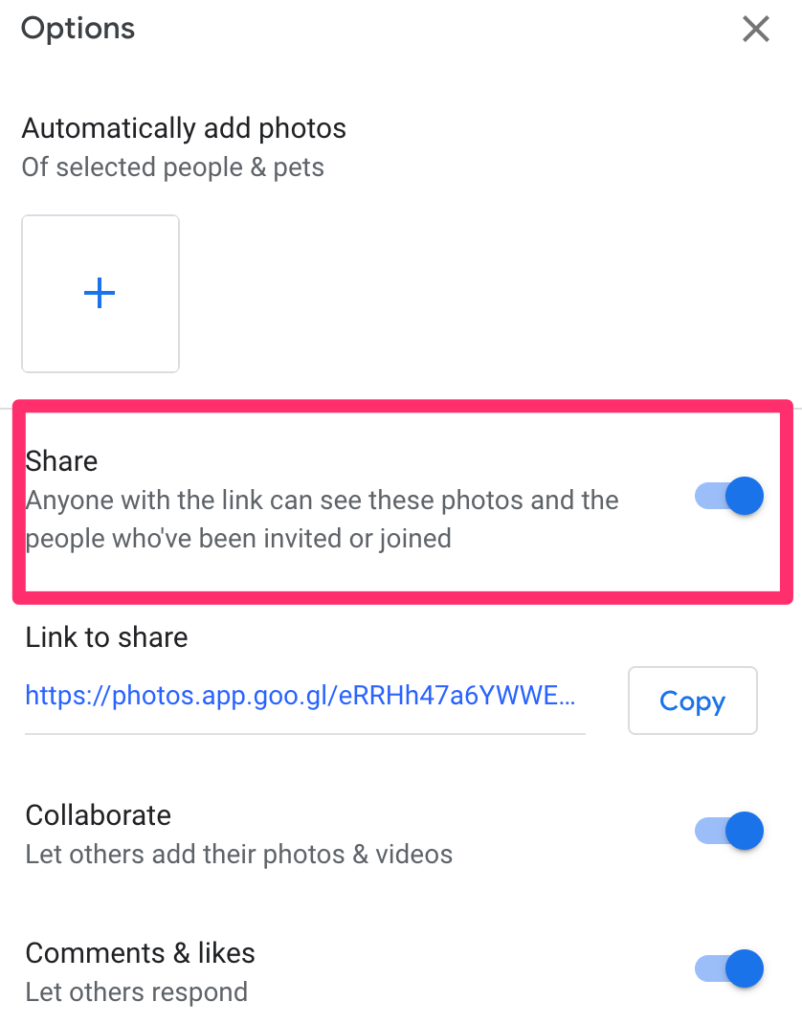
When exploring this option, I learned a bit more about the link-based approach. These new insights involved options for discontinuing a sharing link and setting other permissions on link-based options.
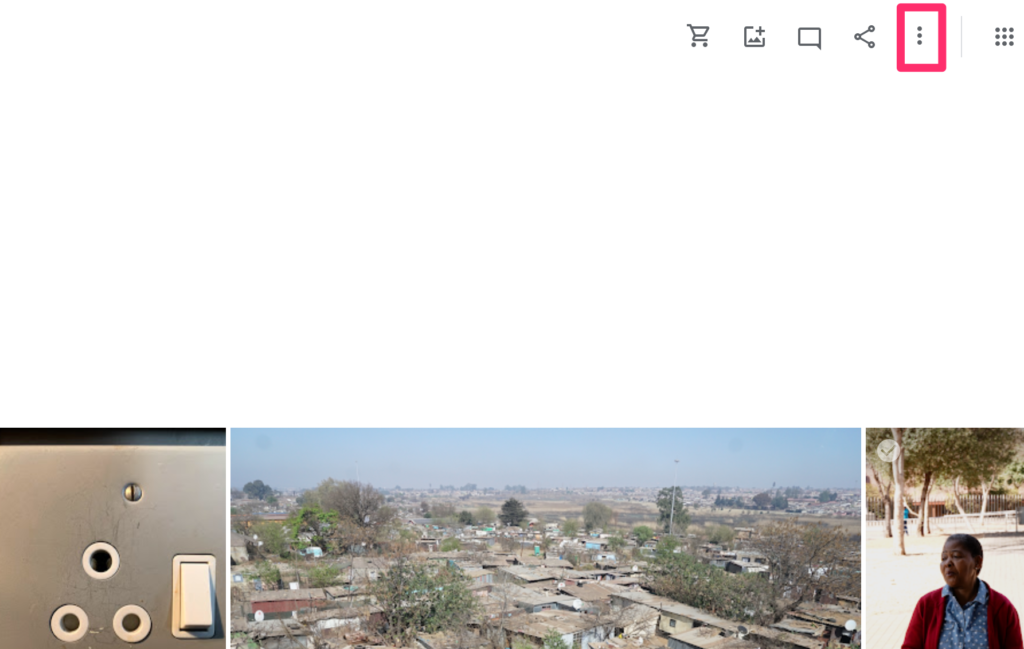
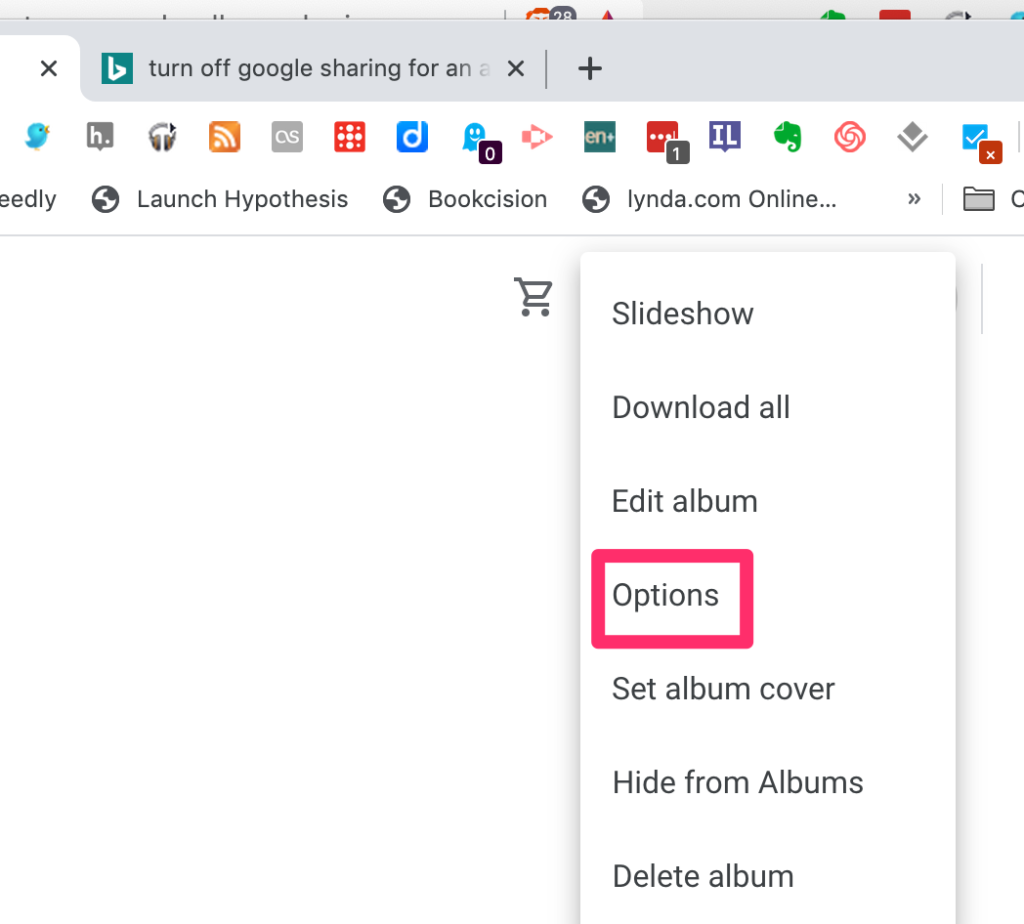
It is a three step process to get to the options. Open an album and use the three dot icon to get to options.
The theory of the flipped classroom makes sense. If you only have a fixed amount of time in a face to face classroom, this time would seem to be more effectively spent answering questions and helping individuals with specific issues than presenting. To provide the necessary information, those teaching using this tactic prepare a video for access before class. This tactic may have special benefit when teaching online because separating the presentation and interaction components of teaching allow learners flexibility. The presentation component can be reviewed when the students find most convenient and the interaction component can be either “as needed” at specified times and might be scheduled with smaller groups of students. Because there is more face to face time for questions in courses using the flipped model it is often predicted that students with greater needs will be most advantaged by this approach.
It is important to test the theoretical advantages of any educational tactic. The flipped classroom has received attention from researchers, but it is difficult to conduct applied research (students enrolled in actual courses) with proper controls. A study conducted at the U.S. military academy at West Point provides data from a study conducted according to relatively strong research standards. All studies leave interpretive questions unresolved and I will offer a couple of my concerns at the conclusion of this description.
The study is intended for publication in the journal Education Finance and Policy, but is available online as a preprint. The citation is included at the end of this post.
The study involved college students taking courses in Introductory Calculus and the Principles of Economics. These courses were selected in part because both involve problem-solving skills and not only the acquisition of information. The study involved the random assignment of sections to either the experimental or control conditions and involved three class periods (one unit in each course). Students at West Point are involved in classes of small size (<20) so there were many sections involved. Instructors taught courses both in the experimental and control conditions. The video components were approximately 20 minutes long and students in the control condition had the opportunity to view the videos as a review after their face to face class although very few did. Students in both the control and experimental classes worked the same problem sets.
Students completed a quiz at the end of the unit and were also compared on questions covering the key unit that were included on the comprehensive final. Immediate benefits for the flipped approach was found in the math course, but not the economics course. No difference were found on the final.
One of the more troubling findings with the positive math data was the determination of who benefited. The advantage appeared due to the performance of white males with higher ACT scores. This outcome contradicts the assumed benefit to those who might benefit from greater face to face attention. Math students watched some of 80% of the available videos and 73% of the econ students watched some of the video. The percent of video that was viewed correlated with quiz score .52. I may have missed in my reading of the article, but I did find that the viewing behavior varied with the characteristics (e.g., assumed aptitude/knowledge) was reported. A result I have found in my own research into who took advantage of the use of an online student environment I created and evaluated was that students with more positive capabilities/knowledge were more likely to use the study tool. Frustrating to those of us attempting to create voluntary opportunities that can compensate for individual differences.
Some personal observations related to issues:
A three lesson study (3 – 20 minute videos) is still a limited exposure to a treatment. It is hard to know if prolonged use as would be the case in a course based on the flipped model would increase or decrease use of the videos.
Students were not totally dependent on the videos as there was assigned reading material.
The use of the videos by student characteristic is an interesting issue and worth investigating in future studies.
These are advanced students with I would assume above average backgrounds because of the nature of admission to the academy. This would seem to limit how generalizable the results are.
Stern, E., Greenberg, K., Moore, O. & Yankovich, M. (in press). Effects of flipped classroom instruction: Evidence from a randomized trial. Education finance and policy.
Posted inUncategorized|Comments Off on Evaluating the flipped classroom
The pandemic has caused all of us to evaluate our daily routines and balance safety with work issues. There seems great pressure to open schools as many with other forms of work depend on teachers to care for and educate their kids. Exactly how this can be done within existing resources to both meet quality education expectations should a different approach be required for some time and to do so meeting requirements for the health of children and teachers has yet to become clear.
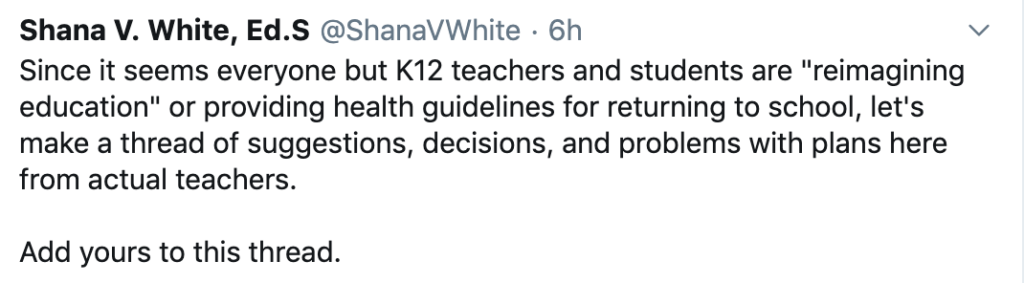
I understand that educators feel others seem to be providing suggestions that educators regard as impractical or unproductive so I liked this twitter request. The request generated a 150+ responses when I reviewed the replies. The opportunity clearly raised an opportunity many felt was useful.
In reviewing the replies, I must say I was disappointed, but maybe not surprised. This is a difficult situation. I would guess 75-80%+ of the responses addressed problems and challenges. There were so few actual suggestions or positive comments I began responding to each thanking the contributor for their recommendation or recommendations. Within only a few minutes, I received replies from multiple individuals in response to my comments on their posts. This surprised me and I take it as maybe a sign that others should recognize similar contributions.
We do need positivity. Merchants are concerned for their businesses and worried they won’t be able to continue to support employees. Parents are frustrated with their efforts to meet employment obligations and assist in the education of their kids. Everyone is concerned with the real threat to the health of families and relatives. At some point, we do accept that the challenges are quite real and need to encourage those with ideas for how we can move forward and do the best we can under the circumstances we face and may face for some time.
If you see this post soon after it is uploaded, you might use Twitter to locate the request for input and either add your suggestions or thank those who come up with useful ideas.
Posted inUncategorized|Comments Off on Educators speak
If you are looking for interesting, technology-related podcasts content, take a look at Rabbit Hole. This is a new effort from Kevin Roose and colleagues at the New York Times. The first few episodes address the recommendation system from YouTube and how the AI behind these recommendations has changed as a reaction to the bias and information bubble it seemed to create for compulsive users. The series of posts on this topic follow one such user through analysis of his YouTube history of activity and includes interviews with YouTube employees and exec Susan Wojcicki. The topic of the bias involves political extremism and it was cultivated in this user.
Indiana University data and media scientists are interested in the spread of misinformation and are making some of their tools available. The portal for these tools is called OsoMe (awesome). An additional source for some of this work is available from the WSJ (you should be able to watch the video even if you do not have a subscription).
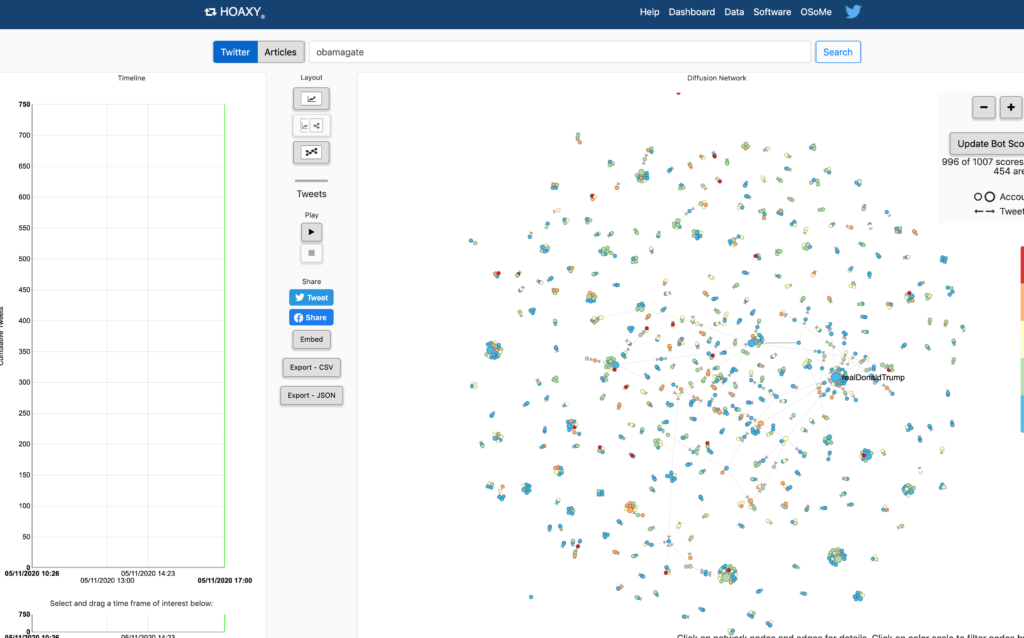
I have been exploring with a tool they have named HOAXY. You can take advantage of searches they have already completed on fact checks or claims from sketchy sources. These are based on the references to the titles of online articles. You can also search for terms (in twitter or articles). I have done several searches using the derogatory nicknames President Trump assigns to those he labels adversaries. The following is for the term “obamagate” which is a recent term. This term was used several days ago without retweeting, but has exploded today.
Posted inUncategorized|Comments Off on Exploring online spread
We use cookies to ensure that we give you the best experience on our website. If you continue to use this site we will assume that you are happy with it.OkNo
You can revoke your consent any time using the Revoke consent button.Revoke Cookies


You must be logged in to post a comment.