Using NotebookLM to Compare Party Platforms

I like to offer some uses for AI that are easy to create and that others may find interesting to explore. NotebookLM is a free product that allows users to identify sources and then chat with that source material. Present interest in the Presidential Conventions and contrasting views of the Democratic and Republican parties led me to this idea. What if I loaded the two parties’ platforms into NotebookLM and then asked the AI system to contrast the position statements on issues that I care about. I write mostly about technology and education so instead of the entire platforms, I uploaded the sections that dealt directly with education.

If you want to try this same activity yourself, it was easy enough to find both the Democratic and Republican platforms online and upload the sections within the platforms focused on K12 education. The Democratic platform is available such that the sections can be downloaded as individual PDFs. The Republican platform is one long file, but it was easy enough to copy and paste the section focused on K12 education.

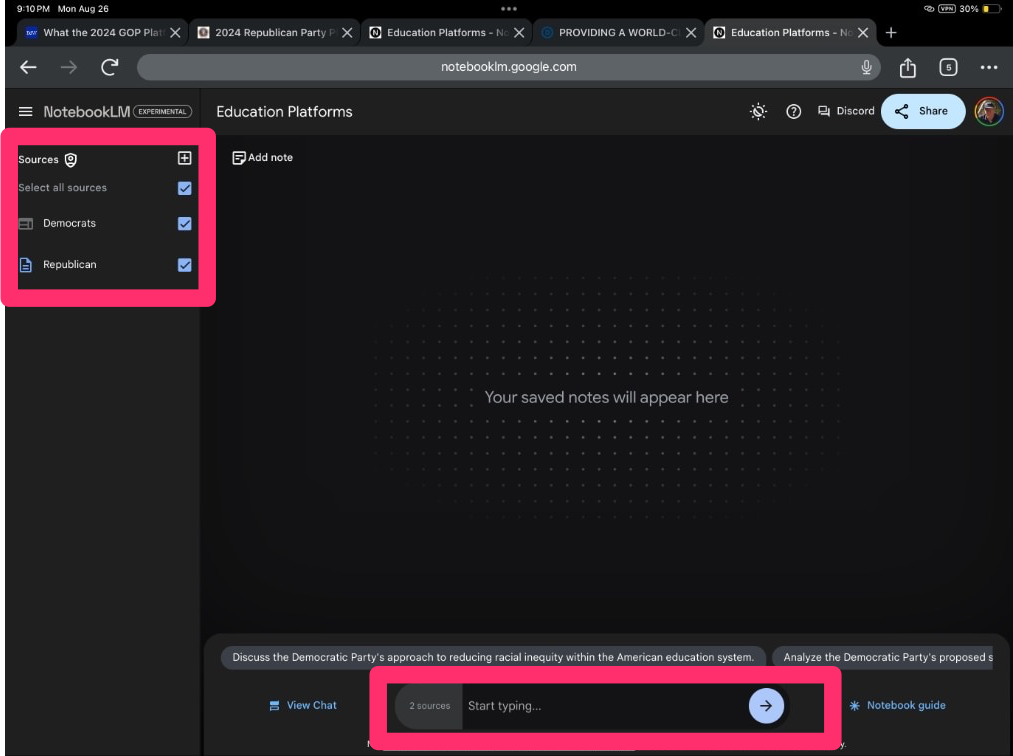
NotebookLM is available online. What you will see when connected is displayed in the following image. For this demonstration, you will want to first upload your source material. If you identify the large red rectangle on the left side of the image, you will see it that says sources. You can upload multiple sources. You should see a +. Selecting this icon will reveal a dialog box asking you to identify a source by type. I had a pdf which I uploaded as Democrat and a section of text which I uploaded after selecting the “text file option). Make sure both sources are selected and then you can begin by interacting with the AI tool (see the horizontal red rectangle near the bottom of the image). 
I entered the prompt – Ask what the Democratic and Republican platforms have to say about funding for K12 education and received the following response.

The AI tool also suggested several additional prompts should I be interested in suggestions related to this topic.

Contrasting Funding Priorities for K-12 Education: Democrats vs. Republicans

Both the Democratic and Republican platforms express commitments to improving K-12 education in the United States, but they differ significantly in their approaches to funding.

Democrats

  • Prioritize equitable funding: The Democratic platform emphasizes addressing funding disparities between schools in different socioeconomic areas. They highlight that using property taxes to fund schools disproportionately disadvantages low-income districts.
  • Increase federal funding: Democrats propose tripling Title I funding, which specifically targets schools with high concentrations of low-income students. They also advocate for “progressive funding formulas” at the state level to direct more resources to schools with greater needs.
  • Support specific programs and services: Democrats outline various programs and services requiring increased funding, including:
    • Universal free school meals
    • Wraparound services like healthcare, before- and after-school programs, and adult education classes
    • Expansion of community schools
    • Increased resources for guidance counselors, social workers, nurses, and school psychologists to support students’ mental health

Republicans

  • Critique federal spending and control: The Republican platform criticizes the current level of federal spending on education, stating that despite high per-pupil spending, the U.S. lags behind other countries in terms of educational outcomes.
  • Advocate for decentralization: Republicans propose closing the Department of Education and returning control and funding responsibilities to individual states. This suggests a shift in the balance of funding responsibility from the federal to the state level.
  • Focus on school choice and alternative models: The Republican platform emphasizes expanding school choice options like charter schools, homeschooling, and 529 Education Savings Accounts. This approach suggests a preference for directing funding towards a wider range of educational options chosen by parents, rather than focusing solely on traditional public schools.

Key Differences and Implications

  • Role of federal government: Democrats see a significant role for the federal government in funding and ensuring equity in K-12 education, while Republicans advocate for a reduced federal role and greater state autonomy.
  • Funding distribution: Democrats emphasize directing more resources towards schools and students with higher needs, while Republicans focus on providing funding mechanisms that empower parental choice, regardless of income level.
  • Specific program priorities: Democrats prioritize funding for a broader range of social and support services within schools, while Republicans do not explicitly address these programs in their funding proposals.

It’s important to note that neither platform provides detailed budgetary breakdowns or explains how these funding increases would be financed. 

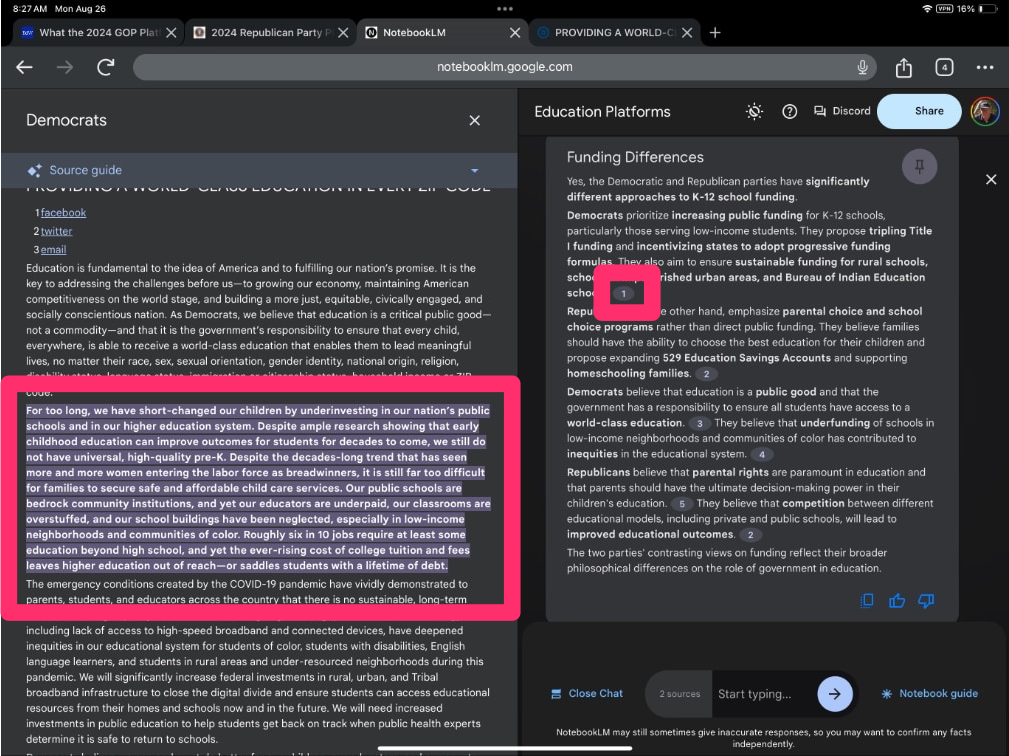
I copied the response so that I could provide it here. You will see first summaries of what the AI decided were important points associated with each platform followed by a summary of the contrasts I requested. If you look at the following image, it looks a little different. After the sections of the AI response, you should see multiple sections followed by a small symbol (sometimes more). If you click on one of these symbols, the lefthand panel will bring up the original document the AI system used in generating that specific part of the response to your prompt. 
Video

Summary

I thought this application represents a concrete application of NotebookLM. It builds from multiple source documents and responses to prompts asking for analysis of the contents of these documents. I don’t know if educators would feel concerned about using this idea in their classrooms because of the topic, but it is objective and relies on the material offered by the parties based on what they have to say about a specific issue. 

Loading

Posted in Uncategorized | Tagged | Comments Off on Using NotebookLM to Compare Party Platforms

Do we resist productive learning experiences?

I have been reading the book about learner cognition titled Making it Stick. The researchers review many of the activities that have been shown to enhance memory and offer proposals that learners of all ages and educators might apply based on these activities. These activities include retrieval practice (i.e., the testing effect), spaced repetition, interleaving, elaboration, and reflection. These tactics have all been covered in my posts over the years. In addition, the authors explain that self-perceptions often lead learners astray because other study tactics seem more productive when in fact these tactics (e.g., rereading) generate an illusion of knowing. The less-used but more productive tactics involve desirable difficulty which is sometimes related to the the illusion of knowing associated with the more demanding tasks. The more productive tactics are also simply more work. 

In the section on recommendations for educators, the authors translate the productive practices demonstrated through careful research into proposed classroom activities. For example, retrieval practice could involve a short writing assignment at the end of a class period or a quiz covering the reading material for the week. Spaced repetition could involve periodic tests that were cumulative rather than simply covering the most recent material that had been covered. 

After reading this material, I wondered about the actual use of these concepts which are fairly easy to translate into concrete classroom experiences. For example, those in the College of Education would certainly be aware of the research on the science of learning and would be more likely to be making use of such activities than say the faculty in the College of Engineering. Aside from short in-class writing tasks, it has been my observation that this is not the case. If you consider your own college experiences, test this observation against your own experiences. 

Aside from what I wonder about the relationship between an understanding of educational research and applications, are productive methods avoided because these applications result in push-back from students? Again, students may be unaware that recommended strategies actually result in better retention and understanding, but these same activities are also more demanding (desirable difficulty) and require constant attendance. Students do not like regular quizzes and complain about practices such as cumulative final examinations. Faculty members sensitive to their own popularity and instructor evaluations may avoid more demanding, but productive activities. How much students learn is seldom quantified, but instructor ratings are omnipresent.

The authors of Make it Stick comment on this issue without directly describing potential student resistance. They urge transparency when explaining why the tactics they advocate are used and when possible making the activities low stakes. This works fine for frequent quizzes but is not practical for a cumulative examination. 

Reference
Brown, P. C., Roediger III, H. L., & McDaniel, M. A. (2014). Make it stick: The science of successful learning. Harvard University Press.

Loading

Posted in Uncategorized | Tagged , | Comments Off on Do we resist productive learning experiences?

Political Values

There is so much noise in the political discussions that lead up to an election that it is easy to lose focus on what politicians are actually likely to accomplish. There is no perfect way to reach such a conclusion, but it is helpful when a party offers a clear statement of their values and related goals.

Here is the education plank just released by the RNC. I look at this information more so than the statement of other goals because of my background and expertise. I object to many components of this position statement. I could offer my perspective, but I have what I think is an approach more likely to be influential. If you have teachers in your family or circle of friends, ask them to scan this content and comment. Perhaps their reaction will be informative.

CHAPTER SEVEN: CULTIVATE GREAT K-12 SCHOOLS LEADING TO GREAT JOBS AND GREAT LIVES FOR YOUNG PEOPLE

Our Commitment:

Republicans offer a plan to cultivate great K-12 schools, ensure safe learning environments free from political meddling, and restore Parental Rights. We commit to an Education System that empowers students, supports families, and promotes American Values. Our Education System must prepare students for successful lives and well-paying jobs.

1. Great Principals and Great Teachers

Republicans will support schools that focus on Excellence and Parental Rights. We will support ending Teacher Tenure, adopting Merit pay, and allowing various publicly supported Educational models.

2. Universal School Choice

Republicans believe families should be empowered to choose the best Education for their children. We support Universal School Choice in every State in America. We will expand 529 Education Savings Accounts and support Homeschooling Families equally.

3. Prepare Students for Jobs and Careers

Republicans will emphasize Education to prepare students for great jobs and careers, supporting project-based learning and schools that offer meaningful work experience. We will expose politicized education models and fund proven career training programs.

4. Safe, Secure, and Drug-Free Schools

Republicans will support overhauling standards on school discipline, advocate for immediate suspension of violent students, and support hardening schools to help keep violence away from our places of learning.

5. Restore Parental Rights

Republicans will restore Parental Rights in Education, and enforce our Civil Rights Laws to stop schools from discriminating on the basis of Race. We trust Parents!

6. Knowledge and Skills, Not CRT and Gender Indoctrination

Republicans will ensure children are taught fundamentals like Reading, History, Science, and Math, not Leftwing propaganda. We will defund schools that engage in inappropriate political indoctrination of our children using Federal Taxpayer Dollars.

7. Promote Love of Country with Authentic Civics Education

Republicans will reinstate the 1776 Commission, promote Fair and Patriotic Civics Education, and veto efforts to nationalize Civics Education. We will support schools that teach America’s Founding Principles and Western Civilization.

8. Freedom to Pray

Republicans will champion the First Amendment Right to Pray and Read the Bible in school, and stand up to those who violate the Religious Freedoms of American students.

9. Return Education to the States

The United States spends more money per pupil on Education than any other Country in the World, and yet we are at the bottom of every educational list in terms of results. We are going to close the Department of Education in Washington, D.C. and send it back to the States, where it belongs, and let the States run our educational system as it should be run. Our Great Teachers, who are so important to the future wellbeing of our Country, will be cherished and protected by the Republican Party so that they can do the job of educating our students that they so dearly want to do. It is our goal to bring Education in the United States to the highest level, one that it has never attained before!

Loading

Posted in Uncategorized | Comments Off on Political Values

Lies and free speech

The lies are bad enough, but Republicans such as Jim Jordan are claiming that efforts to identify online misinformation and disinformation are attempts to limit free speech.  Those with funds can threaten and implement lawsuits that even though mostly unsuccessful place a serious burden on institutions without access to political money.  This was the case with the Stanford Internet Observatory one of the targets of this political harassment. Of course, each of us can fact check questionable claims, but a formal organization would simply have the reputation and credibility necessary to make a difference. Just to be clear responding to or labeling disinformation is free speech so complaints about an effort to limit such analyses and responses are hypocritical. 

The links I have provided are related to Stanford University’s Internet Observatory and the decision to scale back operations after online disinformation researcher Alex Stamos decided to leave the institution and program. Stanford had collaborated with Washington University in an effort to address the online falsehoods associated with the 2020 election and vaccination programs to combat the COVID epidemic and were the targets of multiple suits related to their efforts. (NYTimes, NPR, Platformer).

The rejection of expertise and data has become a serious problem online (see references) and efforts to reduce the identification of misinformation and disinformation as a free speech issue is in itself a misrepresentation. 

Disinformation

It may be ironic or serendipitous, but as I wrote this post a useful example appeared in my Twitter feed. This makes a good example. Consider the claim about giving the vote to illegal aliens. Aside from the term applied to those seeking asylum, it appears that Democratic politicians are working to change eligibility to vote. Those who are not citizens cannot vote in federal elections and there is no effort to change this requirement. In addition, there is no effort on the part specifically of Democratic politicians to make such a change. You should have learned this in high school, but some may be persuaded by the baseless claim if you are not thinking critically.

Is any part of this possible? Perhaps, but the specifics are not included and this is what makes the statement misleading. Folks like Jordan know this is the case and are taking advantage of the lack of exactness present in false claims that appear online (PolitiFact has a good explanation). To be more exact, there are a few locations in which all adults can vote on local issues. For example, voting on a school board election is quite different from voting for the President. The issue is also confused with the situation in the District of Columbia in which citizens of the country and the district cannot vote for federal officials and an effort was made by Democrats to change this denial of suffrage.

References

The Death of Expertise: The Campaign against Established Knowledge and Why it Matters (Tom Nichols)

Science denial: Why it happens and what can be done about it (Sinatra & Hofer) 

Loading

Posted in Uncategorized | Comments Off on Lies and free speech

Garden Tower and Vermiculture

This is our new project. We both garden. I grow the vegetables in raised beds and Cindy has many flowers mostly in pots on our deck. Some of of our projects such as my hydroponic indoor garden have an educational component and there is always something new to learn when you raise plants.

Our newest project involves a garden tower (see above). This is great for small areas and as you can see it is appropriate for many different kinds of plants (mostly herbs and shorter plants such as lettuce and basil, but some other plants can be grown on the top such as cucumbers and tomatoes).

The tower is intended to be largely a closed system. It is a column of dirt you plant and then water from the top. The water moves down and some collects in a tub at the bottom (you can see the drawer than can be removed to pour water that reaches the bottom back in the top).

In the middle of the garden is a hollow tube for creating compost that feeds the plants in the tower, but can also be removed (using the drawer) for other uses. The composting process makes use of vermiculture (worms) which break down the material added to the tube. You continually added alternating portions of brown material (e.g., leaves, cardboard) with green material (kitchen scraps, etc.) to this tube. Once the organics begin to break down you add worms (red wigglers). We just added 400 worms. The worms used in composting are smaller than the worms you might find in your own garden and prefer a different food source.

The worms speed up the process of composting.

Loading

Posted in Uncategorized | Comments Off on Garden Tower and Vermiculture

Arguing with an AI opponent

I became interested in argumentation as a way to develop critical thinking and engage more effectively when involved in a disagreement after reading the work of Deanna Kuhn (see citations). I encountered her when looking about for a way to deal with my bewilderment at the online political rhetoric I first recognized in association with the Presidential election of 2016. Spending time using social media at that time and continuing through today, I found myself perplexed by contentions I knew simply to be wrong or more honestly ridiculous and the vicious and flawed manner in which so many would defend such positions when challenged. Perhaps naive, I had assumed that engagement with these individuals involving logic and evidence would be helpful. This was not the case.

Argumentation has the sound of an emotional disagreement. This is not the intended reaction. An alternative term that conveys a similar meaning might be debate. Kuhn studied argumentation developmentally in educational settings and evaluated techniques to improve the quality of arguments (debates). Without proper training and practice, individuals resort to fallacious reasoning, ad hominem attacks, and other ineffective tactics that undermine their credibility and weaken their arguments. They tend to focus on what they have to say and fail to register the positions and evidence advanced by others. Ultimately, poor argumentation skills can hinder communication, hinder problem-solving, and hinder progress in various aspects of life. Processes we may not label as arguments, such as the process by which scientific research leads to advances or persuasive writing, but such processes are based on similar features – clear identification of positions with the suggestion of supporting evidence and the challenging of the value of evidence that has been advanced supporting opposing positions.

I have written multiple posts about argumentation and argumentation skill development and you may find some of these posts of interest. 

I am returning to this topic in reaction to a post on the potential of AI as a debate opponent by Eric Curts. Curt’s post includes a general-purpose AI prompt to engage a student in a debate with an AI “opponent” and suggests a list of topics for educators who may want to try offering their students this type of experience. I encourage your examination of his post.

I have made mention of debate as one way in which students might chat with AI, but Curt’s post encouraged greater exploration on my part. As I claimed in recent posts, educators simply need to explore AI just to see what they can get it to do as such exploration seems the best way to find relevant uses.

I have written at some length about the research comparing the value of student reading and notetaking by using paper or a laptop and was curious to debate this topic with an AI opponent. I advocate for the value of using digital resources, but I have read a great deal of this research and recognize there are many the claims and counterclaims. I was curious to see what the debate experience would be like. I was impressed with the experience.

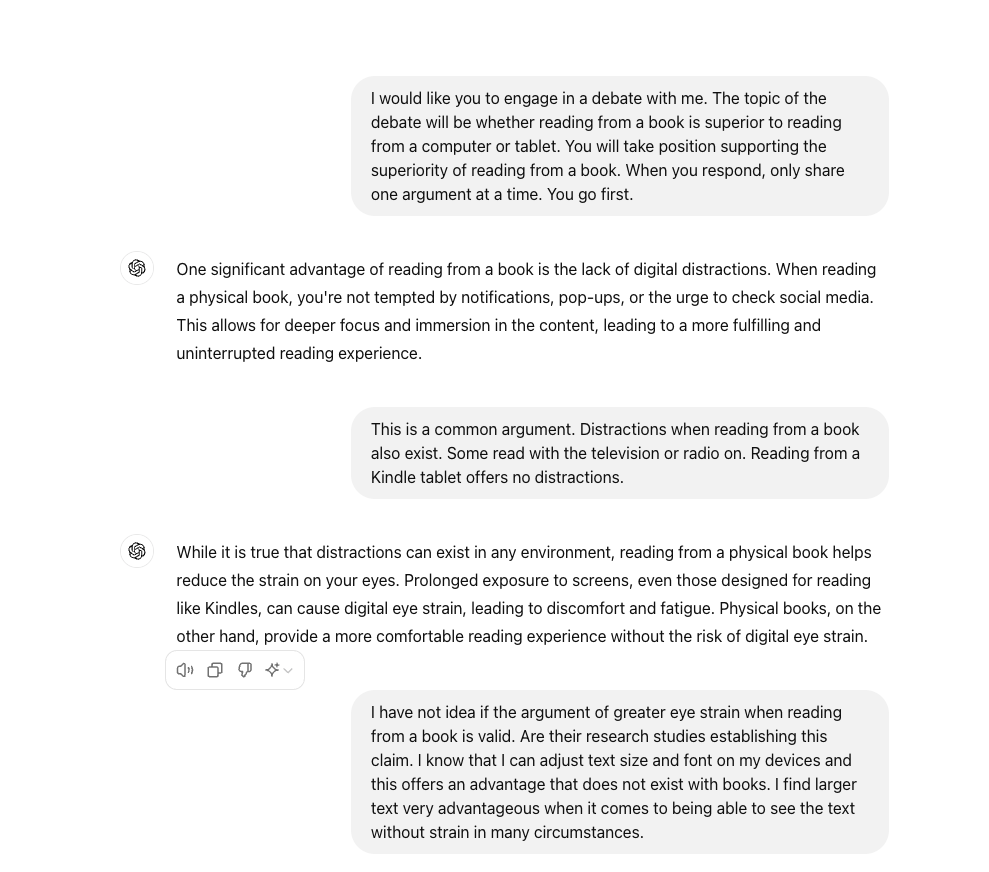
I used my own version of Curt’s general purpose prompt. The first couple of responses from the AI system and me follow.

I would like you to engage in a debate with me. The topic of the debate will be whether reading from a book is superior to reading from a computer or tablet. You will take the position supporting the superiority of reading from a book. When you respond, only share one argument at a time. You go first. 

ChatGPT has a great feature that allows the sharing of a chat. Here is the transcript of the entire exchange between me and the AI.

The ease with which a ChatGPT transcript can be shared generated several related ideas. It would be easy enough to have students debate using a prompt generated by the teacher and to submit their transcripts for review. Kuhn used a related approach in her research. She had students argue using chat. The value of the chat transcript was in the opportunity for review and critique. Kuhn used the transcripts for research purposes, but also as a way to analyze the interaction as an instructional approach. Where the claims made by an opponent acknowledged and addressed? Was evidence provided to support the claims you made? etc.

Take a look at the Curts post and try debating an opponent yourself.

Citation

Kuhn, D., Hemberger, L. & Khait, V. (2016). Argue with me: Argument as a path to developing students’ thinking and writing. Routledge.

Loading

Posted in Uncategorized | Tagged , , | Comments Off on Arguing with an AI opponent