I am going to update some of my existing content that seems appropriate for educators working from home.
VideoAnt is a system for annotating existing videos developed at the University of Minnesota. It would be an example of what I call a “layering” service in this case focused on video. A layering service allows the repurposing of existing content (video, web pages) generated by others to better serve an educational purpose by adding elements (comments, questions) to what already exists.
The present situation may leave many of us trying to find productive ways to spend our time. There are no sports to watch. We are nervous and need a distraction that offers some redeeming value. My recommendation for educational technology advocates is to explore a different online service that may have value in a classroom or for professional development. This type of project is flexible enough to fit personal circumstances.
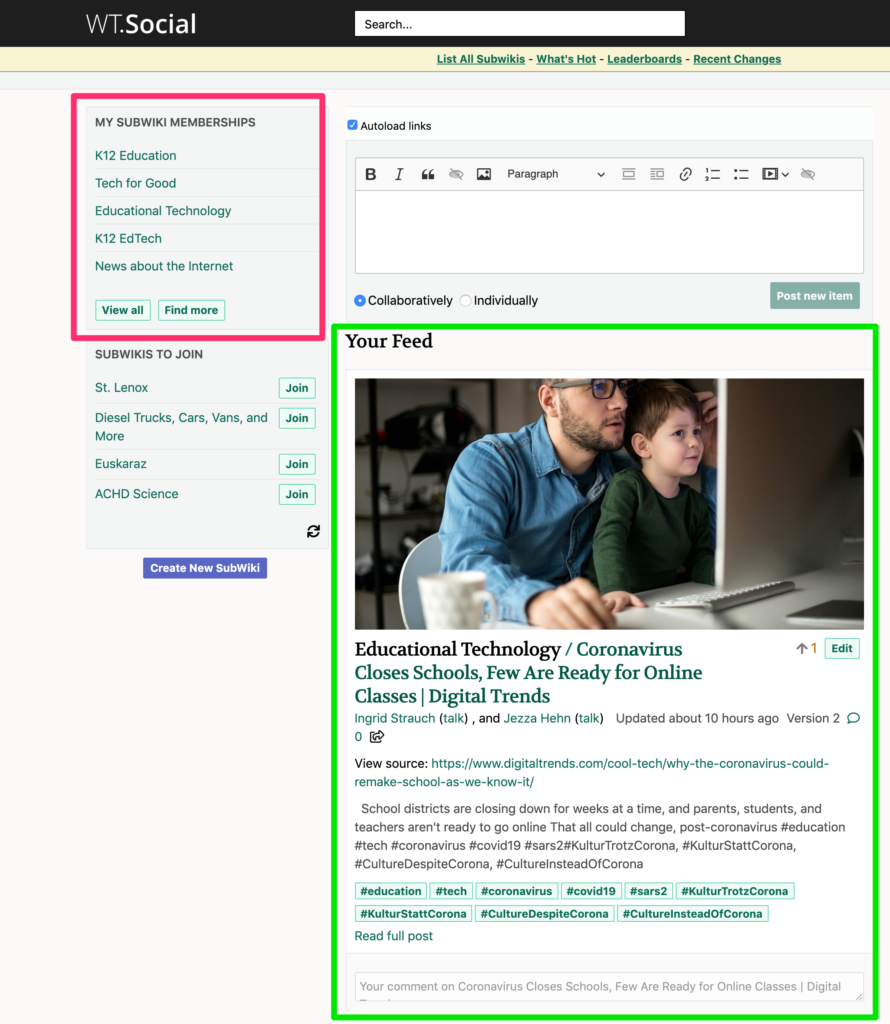
My recommendation would be wt.social. This service is still under development by Jimmy Wales and crew. You may recognize Wales as the developer of Wikipedia. I have explored multiple services on what others have described as the indie web and I think this service has a reasonable chance of gaining traction. One way to understand wt.social is as an alternative to Facebook. I see it a little differently. I would describe the service as a way to identify and subscribe to topics maintained by different groups that collectively result in a feed. In the following image, you should be able to see what I mean. I have subscribed to several topics (subwikis in the red box) that generate a feed (green box).
I endorse the diversification of our collective use of social media for multiple reasons. Among my personal reasons is the need to oppose monopolies as a way to encourage continued development and as an opposition to the collection of personal information as a way to support most existing services (this is different from the issue of displaying ads).
If you decide to give wt.social a try, you will encounter a request to subscribe to the paid version. This may speed up your membership, but I did not pay and I was granted membership within 4 days. My concern which I have shared with the founders was that I would be willing to commit funds ($20 – I have been donating this amount to the startups asking for contributions), but the subscription options available seemed more than the service justified at this point. As a startup, this is the dilemma – the business needs funds to ramp up and the product has yet to get to a level warranting substantial payments. I think as a practical matter this is now, even more, the case than it was a few months ago. People are going to be resistant to adding another expense in uncertain times.
If you decide to give wt.social a try, take a look at the k12-edtech subwiki I have established. This may look like a personal blog at present. This is not the intention. The subwiki offers a place for all members to submit content. I just established the topic. To assure others that some content would be available, I uploaded posts from my blogs. There are too many existing subwikis that have nothing in them when you visit. This is a startup problem and seeding this wiki with content I had available was my solution. This is intended to be a shared space.
Posted inUncategorized|Comments Off on Explore a new tool
A couple of popular edtech bloggers (Byrne, Ferlazzo) have just put up posts explaining how educators can develop interactive lessons for online learning making use of existing video sources. I have been writing about this topic for several years explaining the process as “layering”. By layering, I mean adding instructional elements on top of existing online content. My definition goes further to focus on services that allows such tactics while still providing the original content developers with the hits and ad exposures they assumed when offering their content. I think the ethics of using content developed by others requires the honoring of the expectations they had when offering this content.
My resources are offered under the heading of “Layering for Learning” and the related ideas and tutorials focus on not just video, but also the educational development of static web content. I have also written multiple blog posts on this topic and these are available by searching “layering” on my educational blogs. You can also just click the tag associated with this post.
Several online technology companies are making their services available at no cost for the remainder of the school year. My favorite among them is probably Newsela. The details of the new offer is explained in the front page when connecting to the site.
If you are unfamiliar with Newsela, it is a service providing multiple reading levels of the same news stories. The stories come with comprehension questions and instructional suggestions. Here is a more comprehensive description I wrote a couple of years ago.
Posted inUncategorized|Comments Off on Newsela opportunity
I wonder if the general public understands the demands of switching from face to face to online instruction. I wonder if profs unfamiliar with teaching a given type of class understand. Many who have never taught online are now expected to do so.
There are plenty of companies and tech experts willing to help or rather offer advice (free services from the tech companies). Of the different things I have read on this topic, this post from The Conversation is one of the best.
For the record, I have taught online classes for many years. I have also taught those large introductory lectures with hundreds of people. I can certainly imagine what I would say to someone wanting to teach smaller classes. In my opinion, it is easier to transition a small class to a small online class and duplicate the class components necessary for effective instruction.
It might surprise many out of education that I am not certain how I would teach a large class. Many might assume this would be the easiest class to transition – just lecture into your computer and put your video online, give students your email address and away you go. I again refer folks to The Conversation post. There are so many things people assume that are wrong. First, the large lecture classes I teach all contain multiple small group sections to allow for discussion (sometimes these smaller breakout sections are called discussion sections and sometimes labs). I don’t teach these sections, but I am responsible for developing the activities for the grad students who engage with the students. So, you can’t just post a couple of videos for the week and you are done. The assistants assigned to the course would also have to be brought up to speed in how they should engage students in discussion and assign and evaluate writing activities an projects.
The biggest problem with online courses is evaluation. Again, the task is somewhat easier with a smaller group, but there is always the challenge of cheating. How do you know if students are collaborating, using their book, or Googling responses to multiple-choice or essay questions? When I taught a course that relied on essay exams, the course made use of paid proctors. Maybe someone at the local library would watch someone taking an exam. Perhaps an employer would take on this responsibility. These individuals had to be vetted. I just don’t see this as practical when working with 200-300 students. Multiple-choice items have their flaws, but so does the cost efficiency of such evaluation methods when working with hundreds of students. It is easy enough to make use of a tool for delivering online MC exams. Most profs have never done this, but they can probably figure it out. There is still the issue of proctoring. How do you watch 200 students take an examination? I understand that there are approaches, but I have yet to see one that impresses me.
So, we do what we have to in the short run. I think online instruction can be of high quality, but if one considers that there are multiple stakeholders in instruction, I have yet to see what I think is a quality approach with large numbers of students. Thinking about the learner is important. But, it is also important to understand that the grades awarded are taken as an indicator of competence by others; e.g., employers, admission officers, selection programs.
Posted inUncategorized|Comments Off on Profs working from home
I follow some sites that explore feeding birds and the pro and con consequences of this human involvement in nature. This recent analysis of this hobby from Popular Science caught my attention.
My interest in this topic goes way back and I see I posted on this same topic in 2012. The reason for this interest has my roots in my original training in biology and the later interest in technology. I did some work for North Dakota Game and Fish way back working in promoting what at the time were called OWLS sites. An OWL was an an outdoor wildlife learning site that Game and Fish was giving schools small grants to develop. Game and Fish had a small division focused on “watchable wildlife” and the director was interested in my ideas about sharing information (images and data) using technology. Feeding birds and conducting related data collection were activities being promoted.
Not all schools have the opportunity to put out and observe feeder activity, but there are certainly opportunities here for classroom activities should this be possible.
Posted inUncategorized|Comments Off on Outside your window
We use cookies to ensure that we give you the best experience on our website. If you continue to use this site we will assume that you are happy with it.
You can revoke your consent any time using the Revoke consent button.






You must be logged in to post a comment.