Harvard’s Shoshana Zuboff has written some of the most influential books explaining how society has been impacted by digital technology. Her first, The age of the smart machines, explored how work was and would be influenced. Her most recent work, The age of surveillance capitalism explores the consequences of the trade of free access to online content and services for personal information. Following the greater public awareness that occurred in the run up to the Presidential election of 2016, everyone is growing more aware of the collection and use of the residue generated by their online activities and what is done with these data.
I have read both of Zuboff’s books. They are understandable, but quite long. If you don’t want to dedicate the time required for the in-depth version, this recent Guardian interview with Zuboff offers a reasonable substitute. You may be intrigued enough to purchase the book.
Posted inUncategorized|Comments Off on Surveillance Capitalism
This TedEd presentation considers the issue of political identify (partisanship) and how it can cloud the ability to evaluate an issue that has been politicized (gun ownership). The presentation uses one of the best examples to explain partisanship I have found – that of sports fandom and describes the familiar situation in which fans of competing teams witness the same controversial call. I found this same explanation used in the citation I provide at the end of this post.
The lesson includes a presentation, additional resources, and suggested activities.
The component of this lesson I think could be improved involves the use of identity rather than partisanship to explain the power of this type of bias. As a psychological construct identity is often described of as at the core of how we see ourselves and protecting the way we have come to see ourselves is a strong motivator. This perspective is emphasized in one of the supplemental readings offered and I believe to be the best way to explain why political views are so powerful.
Flynn, D. J., Nyhan, B., & Reifler, J. (2017). The nature and origins of misperceptions: Understanding false and unsupported beliefs about politics. Political Psychology, 38, 127-150.
Posted inUncategorized|Comments Off on Teaching political partisanship
When at home, I walk by the Best Buy Headquarters on my way to the coffee shop where I write nearly every day. It is common for Best Buy employees to hang out in the coffee shop and I catch snippets of their conversation. My attention automatically is captured when I hear a conversation related to technology.
I missed this. Best Buy sponsors Teen Tech Centers in multiple locations throughout the country and there are five in the Twin Cities. The story that led me to description of these tech centers was focused on teenagers helping older folks learn to use their phones and tablets. I understand the importance of the tech life-long learning needs of my age cohort, but I also like the emphasis in the piece I cite above which is on expanding how young people understand the use of technology.
Libraries, Apple stores, and now Best Buy offer programs to help everyone learn to use their devices.
Posted inUncategorized|Comments Off on Best Buy Teen Tech Centers
I am probably most accurately described as an Internet utopian. When the Internet matured to the point that most folks who were online could not only consume, but also contribute to online discussions, I thought what was called Web 2.0 or the participatory web would engage folks in important issues because they would now have a voice. What occurred was unanticipated and to this point disappointing or at least this is where things seem according to many. Online activity is argued to be secluded in echo chambers and limited by filter bubbles. Rather than expand discussion, present online experiences are described as both more rancorous and narrow. This post is my attempt to outline a quantitative study to evaluate a specific issue bearing on the current state of online affairs. This issue concerns how different channels for access to online news have influenced the breadth of perspectives that are considered.
The study I am attempting to summarize is available using the citation I will add at the end. I admit that some of the analysis was beyond my experience and understanding. The researchers use some statistical methods I did not study.
The researchers had access to online data generated by users who had installed the Bing Toolbar for Internet Explorer and opted in to allow data collection. I am guessing this is a Windows extension for IE and I don’t have enough Windows experience to comment. The willingness of users to share their data must be considered when interpreting the results.
The researches started with data from 1.2 million readers. They set a standard for the number of online news stories and opinion articles from the top 100 news sources they identified of 10 articles and two opinion articles in a three month period to operationalize those who might be described as online news consumers. It made little sense to study the online news reading of individuals who read very little news online. Fourteen percent of the original number met this criterion for news and four percent for both news and opinion articles. This generated a large set of users, but a small proportion of those who generated data.
These data alone are enlightening. It would be difficult to argue that online reading plays a large role in influencing anything because of the small number of individuals meeting these minimum standards. Ten articles in three months? Note as a way to think about this that the New York Times allows users to read 10 articles each month without paying the subscription fee for online access. I reach my limit in most months and get cut off because I do not subscribe to the Times.
My interpretation of the findings is that what we search for and find through social media is likely to be more biased than what we encounter by going directly to news sources. However, of the variable perspectives that we do experience, more of this variability is the result of the use of search and social sources.
How does this make sense, we go to the same direct sources repeatedly. This source will be consistent in orientation. Search and social will be biased by our selection of those we follow and our record of using these services, but offers some chance of a diversity of perspective. Does this have to do with which channel gives us the most control?
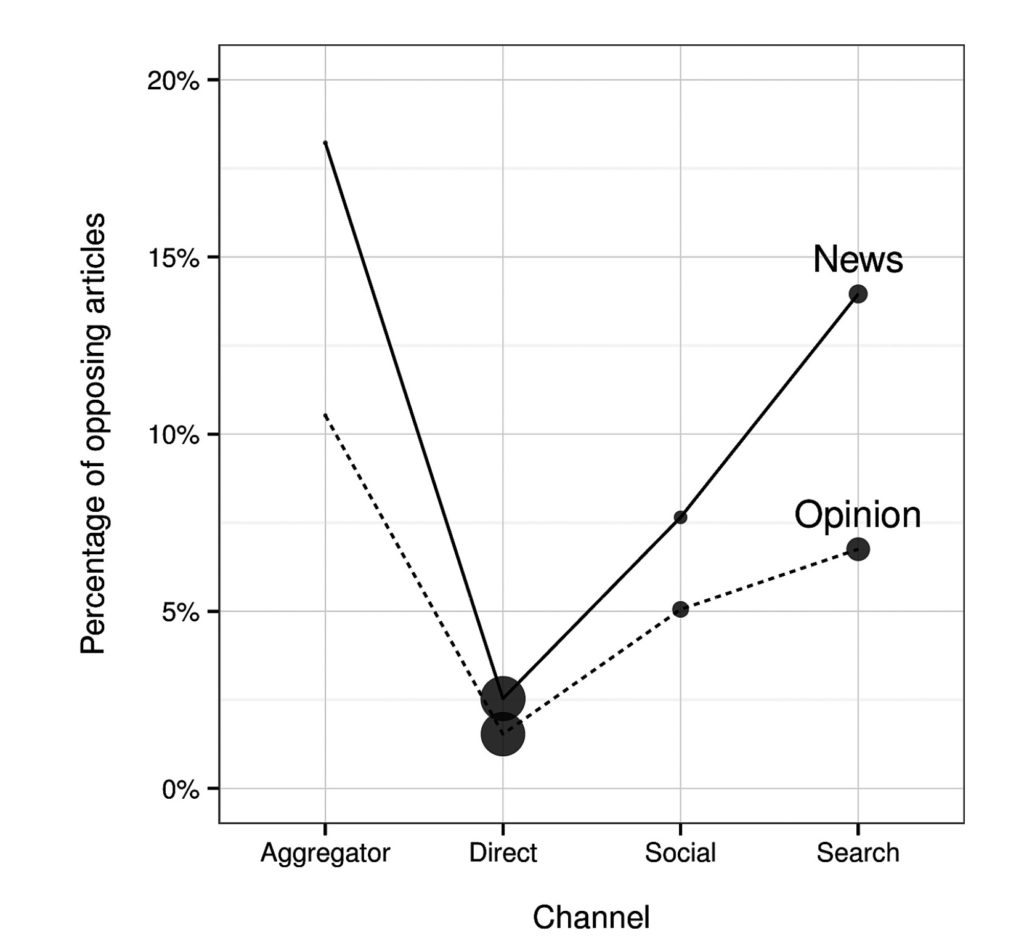
These two charts from the study present the data. In this chart, segregation represents how narrow the perspective of readers are who read content from a particular channel. It offers some support for the notion that those who find news articles through search and through social recommendations are getting news sources that are more typically read by those with a narrow view. Note, however that most of what is read (the size of the dots) is dominated by going directly to a news source (e.g., I read the NYTimes which is more liberal, I read content from Fox News which is more conservative). So, the Internet provides access to these sources, but search and social recommendations don’t add much, but what is added tends to be that content read by individuals with a similar view.
However, when viewed articles offering a different point of view are studied, it appears that social and search is most likely to provide that content. What you read directly, is less diverse than what you encounter when you do not directly control access.
What do I think this shows? I think it shows the limitation of self selection. I think it also shows how much influencing personal opinion may come from commentary unlinked to a news source. You can consider my position as you view Facebook or Twitter. How much of what you consume is social commentary only – comments or only the comment when a comment comes with a link to a news source?
Flaxman, S., Goel, S., & Rao, J. M. (2016). Filter bubbles, echo chambers, and online news consumption. Public opinion quarterly, 80(S1), 298-320.
Posted inUncategorized|Comments Off on Does social media constrict or expand our perspective
I tend to assume that educational experiences are essential to addressing fact based concerns. In the U.S., education has evidently been unsuccessful in convincing the general public that this country must act to address this problem. With a well-educated population, this lack of understanding and/or motivation, this situation is perplexing.
This post from The Conversation offers commentary on possible reasons U.S. citizens aren’t motivated by the climate change issue. I admit I know little about this source, but I don’t doubt the scientific research on changing climate so I am willing to read anything on the topic of acceptance.
The Conversation author argues that the unique position of the U.S. reflects political polarization and mistrust. The author argues going back to Al Gore that the commitment to addressing climate change became associated with Democrats and this divide has only been made wider in the era of Trump. The party differences in the rated importance of this issue are immense. The author argues that this politicization makes climate change an identity limiting the proportion of those who can argue for the urgency of the problem.
The second issue involves even among what would seem a well educated population the willingness to trust the science. Again, trust seems to have a political component:
”With its market-oriented, pro-business, and pro-religious agenda, the Republican party is naturally more distrustful of intellectuals and academics, including scientists.”
How Republicans and Democrats come through common educational experiences and end up with such different attitudes is certainly a serious conundrum for educators. Scientific facts are not partisan.
Posted inUncategorized|Comments Off on Attitudes toward climate change and education
Reimagining how familiar study tactics such as highlighting and note taking can be improved continue to attract my attention. I am particularly interested in how technology can augment these traditional study tactics. I also continually argue that there is an important distinction between reading and studying that is often ignored by those who continue to argue for the advantage of paper. With listening/watching a presenter, this distinction is more obvious. It is not just the initial exposure that is important, it is what can be taken from this exposure study.
I am not impressed by all innovations and not always clear on why an innovation adds much. For example. this description of the Hamline Notebook argues for the paper-based collection of notes and then the digitization of these notes.
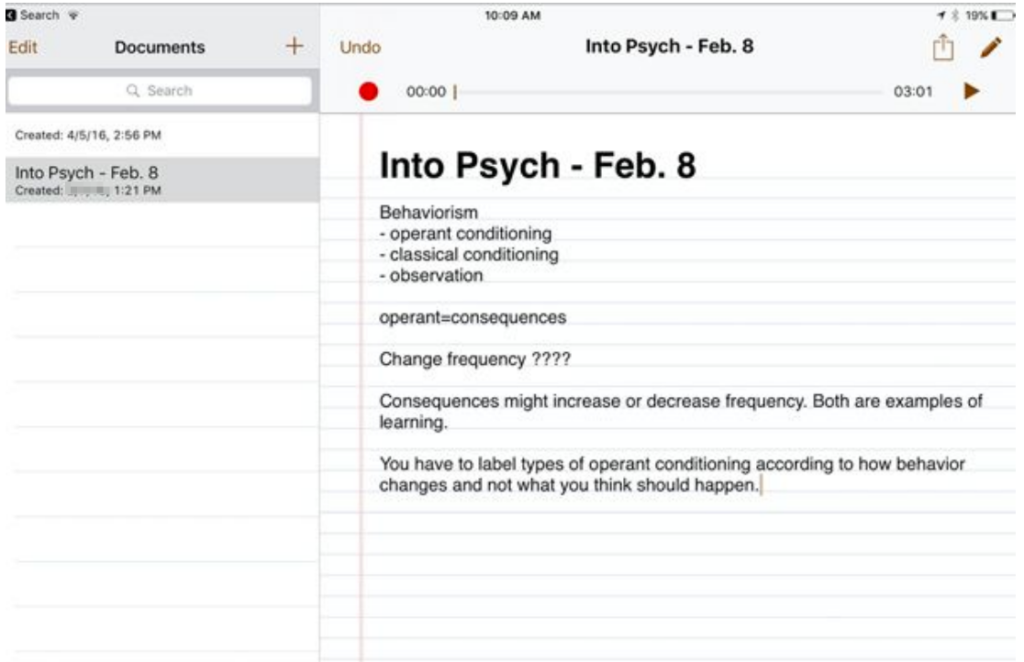
I have suggested for some time that students use a note-taking system that allows the simultaneous taking of notes and recording of the audio content of a presentation. One system for doing this is SoundNote. The advantage in systems that do this is the linking of the notes with the sound. When reviewing notes and encountering a confusing annotation or what seems to be missing information, the notetaker can select the nearest preceding annotation and listen again to the audio. This system offers an efficient method for addressing the memory load generated by simultaneously attempting to understand and record information.
Posted inUncategorized|Taggedstudy|Comments Off on Innovations in note taking
We use cookies to ensure that we give you the best experience on our website. If you continue to use this site we will assume that you are happy with it.
You can revoke your consent any time using the Revoke consent button.



You must be logged in to post a comment.