Ethics and AI

AI has raised a significant number of ethical issues all of us should consider. I think about this topic in terms of my responsibilities as a content creator and also wonder about the responsibilities of the companies who offer the AI services. There are probably other categories of participants that are possible. Perhaps we as consumers should consider how our consumption activities influence the direction of this emerging technology.

The issues at the level of AI companies are widely discussed and probably something I am not qualified to evaluate. There is the issue of whether these companies can take advantage of the content we all can access to build their services without compensation to content creators. Are these companies different from any of us as individuals who can consume this content and then develop products and services based on these inputs? We are bound to obey copyright in our production of new material, but like the AI companies there is an important difference between “based on” and “copied”. 

There is also the issue of unknown future consequences. It is often argued that AI and digital technologies move faster than the impact of these technologies can be evaluated and perhaps controlled through legislation. I see this as one limitation of the cost required to create present LLMs. I tend to think of Universities as playing an essential role in many advances. The focus on basic research questions and more care in evaluation without a profit motive serve an important public service. Universities simply do not have the resources to play this role in this situation.

As a content creator, I make use of AI. I tell myself my AI-based activities are partly exploratory because I create content intended to inform educators and if I want to offer reasonable insights I must invest considerable time in understanding the issues associated with AI tools. My activities must involve actual use in addition to reviewing what others have to say. I could invest this time and isolate this exploration from distributing any content I generate, but I cannot resist. What I will do is offer the following descriptions to provide visibility into any content you might consume. Visibility seems a reasonable ethical expectation.

I will divide my visibility remarks into two categories – text and images. The words you see in my posts are nearly all entered onto the screen through my keyboard and out of my mind. I do not use a tool such as ChatGPT to formulate the text you read based on my crafted prompts to direct what is returned from its general knowledge base. What I do on some occasions is to use a tool called Smart Connections to summarize notes I have taken from the sources I have read and then stored in Obisidian. Mostly, these are notes and highlights based on research articles and books I read. I have described this workflow in depth in a previous post. Perhaps I can claim that I do my own thinking, but I sometimes use AI to reduce the time required to translate the result of this thinking to words on the screen. 

Images are different and examining where the images I use come from is what encouraged these comments on AI and personal ethics. I tend to use images in my posts as a way to activate the existing knowledge of readers. This is me as a cognitive psychologist talking. There is value in connecting new information with what a learner already knows and an image can stimulate this process.

The problem I have with images is that I can appreciate the goal of including relevant images, but I do not have the personal skills to create images. I can’t draw and I cannot always place myself in appropriate situations to capture images with a camera. Of course, there are people who are good at this sort of thing and there are outlets you can use to secure appropriate images.

For a long time, I paid for a subscription to the Noun Project. The service provides a database of images and compensates artists based on how frequently their images are downloaded. 

I now pay the monthly $20 subscription fee for ChatGPT and a couple of other AI services. ChatGPT includes DALL-E. I did not commit to these services to generate images, but since I pay the money for other reasons I find DALL-E is an easy way to secure images I can use. I can both directly impact the content of such images and the quality is clearly superior to the simple line drawings I could locate through the Noun Project.

Here is an example of what I mean. I recently wrote a post about whether the Presidential debates are actually debates. I used the following image from DALL-E. I could have used images from the Noun Project.

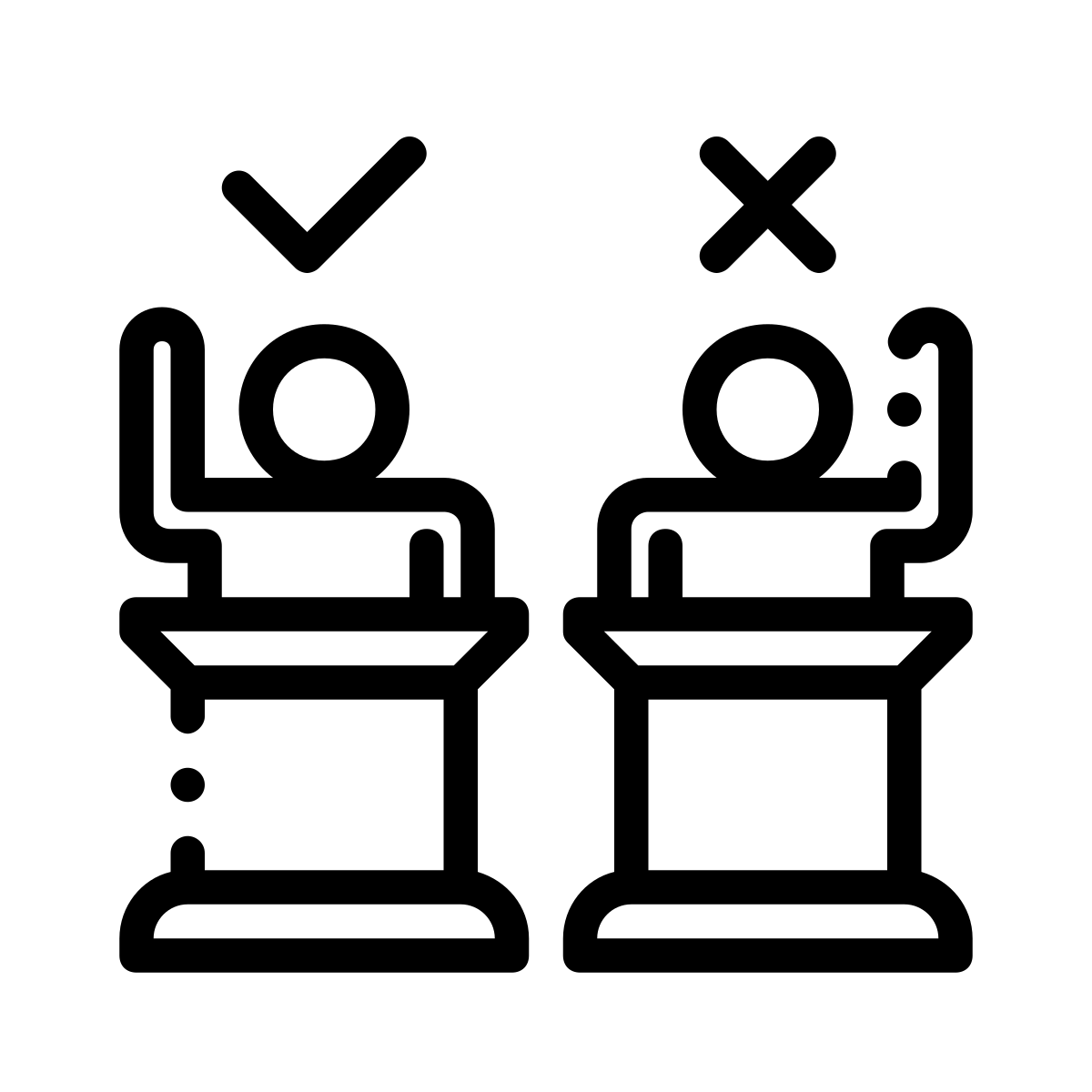
So, now here is the issue. I can pay ChatGPT for images or I can continue to compensate artists who create images. Part of the decision I must make must be based on my personal finances. The cost of DALL-E images is available to me at no additional cost and these images are more focused and attractive. ChatGPT provides these images without compensating the artists on which this technology was developed. What are the long-term consequences to content creators based on how I and thousands of others make such decisions? What are the long-term consequences when there is less and less original content even being created?

Loading

Posted in Uncategorized | Tagged , | Comments Off on Ethics and AI

Net Neutrality is back

I became interested in net neutrality in the earlier days of the Internet. I found at least one previous post from 2008. Net neutrality proposes that the company that provides you access to content on the Internet cannot intervene in what you watch or read. It was once described as any packet must be treated the same as any other packet. At the time, the concern was that most folks had access to only a single entry point (and sometimes no access point), and it should not be possible to manipulate what they accessed when there was not reasonable access to an alternative source.

At the time the FCC took this position, it was under Democratic control. When Republicans gained control, they reversed this decision. Now, I admit I did not feel I had a lack of control over what I could access under the Republican FCC, but I objected because by removing the neutrality ruling this manipulation was possible.

This past week the FCC has again reinstated the requirement of neutrality. Under the Biden administration, the FCC is now back to 3-2 Democratic commissioners. Should the government have a role in requiring neutrality? Given the tremendous influence of the information we access online, I would argue neutrality must be guaranteed. The potential for abuse seems so obvious and so damaging this seems like a matter that should not be associated with a political party.

The time it took to get to this change in policy must say something about how our government works. For a time, the newly nominated commissioner was not approved to be seated. When there are complaints about why political actions are happening now and why not two years ago, this makes a good example. Resistance to action needs to be properly attributed.

Loading

Posted in Uncategorized | Comments Off on Net Neutrality is back

Educational Trends

I have written about the use of technology in classrooms since the mid-1990s. Looking back over some of the topics that interested me, it seems that some topics that were emphasized at one time and would still be equally as valuable now seldom show up in what I would describe as the “online discussion”. Two examples that I would place in this category would be a) project-based learning and b) the classroom use of digital probes.

I have been thinking about how the observation that such trends exist might be demonstrated. I remember years ago that Google made data available about the frequency of search terms and I looked to see if I could still find such data. Google still offers what it calls Google Trends.

My exploration involved the following: a) science of reading, b) project-based learning, c) computer literacy, and d) classroom AI. A direct comparison among search goals is difficult because some issues are likely to be searched using a consistent phrase and others with a variety of terms. I think Google recognizes this challenge and differentiates search term from search topic. However, with the topics I wanted to investigate both term and topic were not always available and a consistent approach would not work. I decided that focusing on relative trends would be more meaningful than comparing relative frequency at a point in time. I have no idea if this is true or not.

This graph compares data from 2004 through the present. The blue line represents “project-based learning”, the red line “science of reading”, the yellow line “computer literacy”, and the green line “classroom AI”. Again, the trends rather than the relative frequency seem most useful because of the confounds I have already mentioned. The Science of Reading and Classroom AI (red and green) have shown recent increases in interest. Computer literacy (much more general than something such as learning to program) and project-based learning have shown declines (blue line, yellow line).

This tool would seem interesting to explore within a classroom setting. What trends might interest students?

Loading

Posted in Uncategorized | Comments Off on Educational Trends

Great Review of AI in Education

Here is a recommendation for educators at all levels interested in a broad perspecctive on present AI applications in education. Lawrence Holt has updated his and colleagues’ existing work titled “A map of generative AI for education”. This work describes the multiple ways AI is being used by educators, learners, and administrators and provides links to a large selection of applications available to implement these applications. This is a great and complete work identifying many applications and services I had not tried. For any educator, you will learn something new from this content.

As a side note, this resource is provided through Medium. Medium is a subscription service asking that readers pay $5 a month for access to all content. Compared to approaches such as Substack that charge a similar amount for each author you follow, this is a great bargain. With Medium, authors receive compensation depending on the popularity of their contributions. The $5 is divided based on what you read with a percentage going to Medium. I do publish some of my longer articles on Medium and I have yet to generate enough revenue to cover the cost of my membership. I don’t expect to generate a lot of income. I value the principle that those who invest time producing quality content should be compensated in some way. The article I link here is a great example of why. The research that went into this work must have been extensive and assumptions that this work does not deserve compensation is absurd.

I bring up this point based on a personal observation. I am an educational technologist so I write both about technology and about education. With Medium, I find that what I write about technology receives a good deal of attention while what I have to say about education less so. My true expertise would suggest the opposite reaction should be the case. My hypothesis is that this response reflects core values and expectations.

Online content and how it is delivered seems to be at a cross road of a sort. Free services are criticized because these services collect information about readers that allows targeted ads and manipulative propaganda. This is especially the case when 3rd party cookies are allowed, These criticisms are legitimate. The alternative is really subscription-based services.

Loading

Posted in Uncategorized | Comments Off on Great Review of AI in Education

AI and Choose Your Own

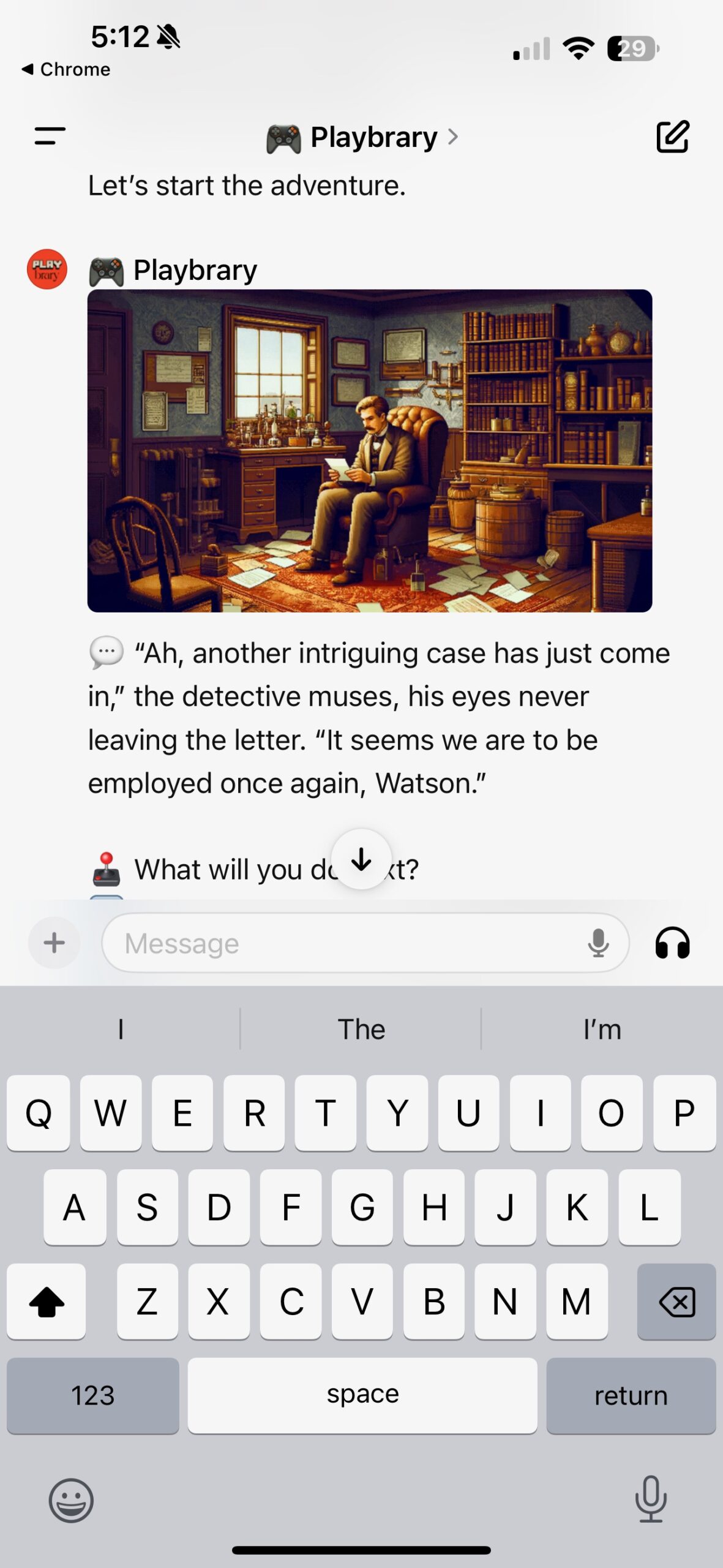
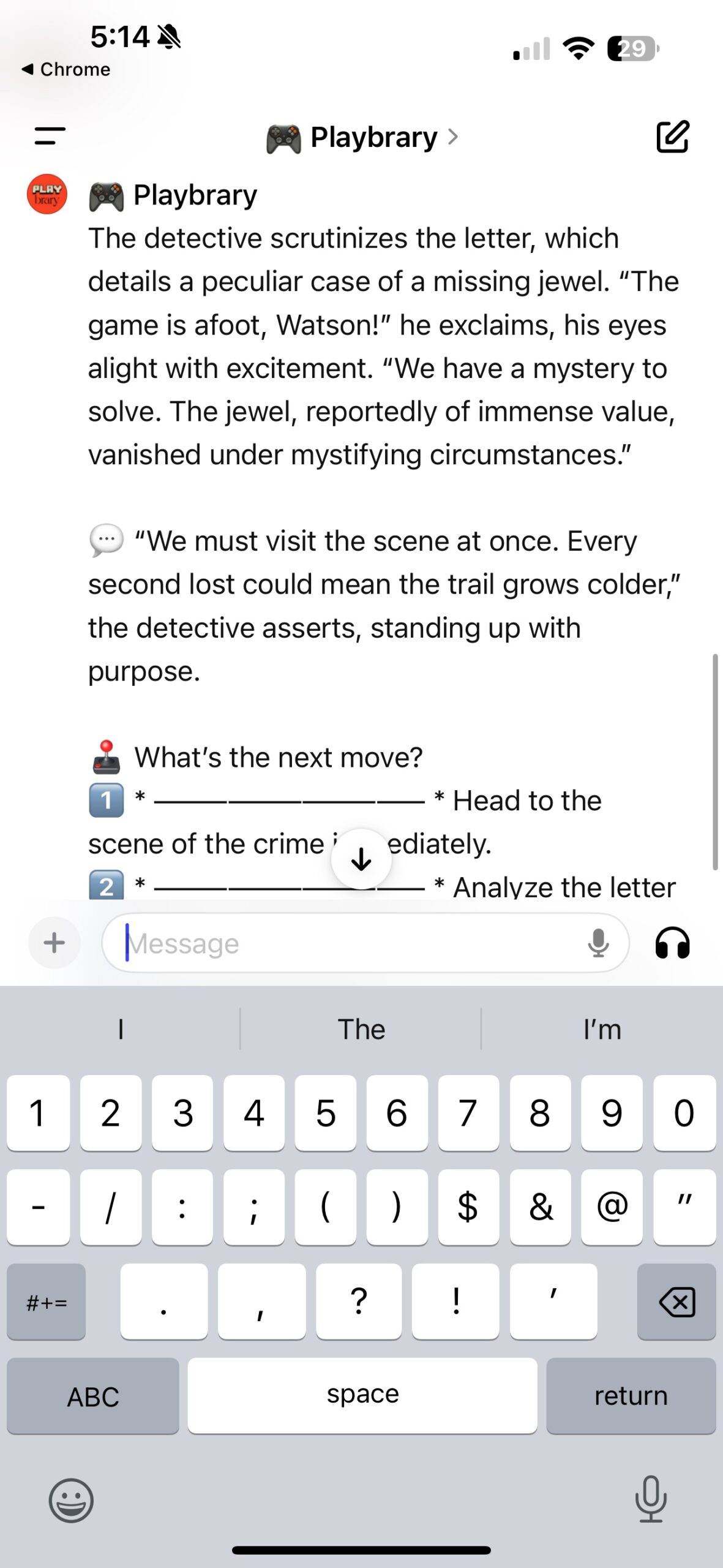
I found a notice that the National Library Board was experimenting with AI as a way to increase interest in reading. An AI activity named Playbrary was their first venture. The application uses ChatGPT to turn public-domain classics into choose-your-own adventures. You don’t need the paid version of ChatGPT for the text version and if you have the paid version of ChatGPT the adventures will include some graphics. I explored the Sherlock Holmes adventure.

Screenshot
Screenshot

It was great fun and then I hit the end and was told to read the book and that would be fun too.

I started to wonder how ChatGPT did this and just for kicks tried the following prompt.

Prompt: I want to read a choose-your-own adventure story. Include an occasional image that supports the story. Wait after each choice for my response.

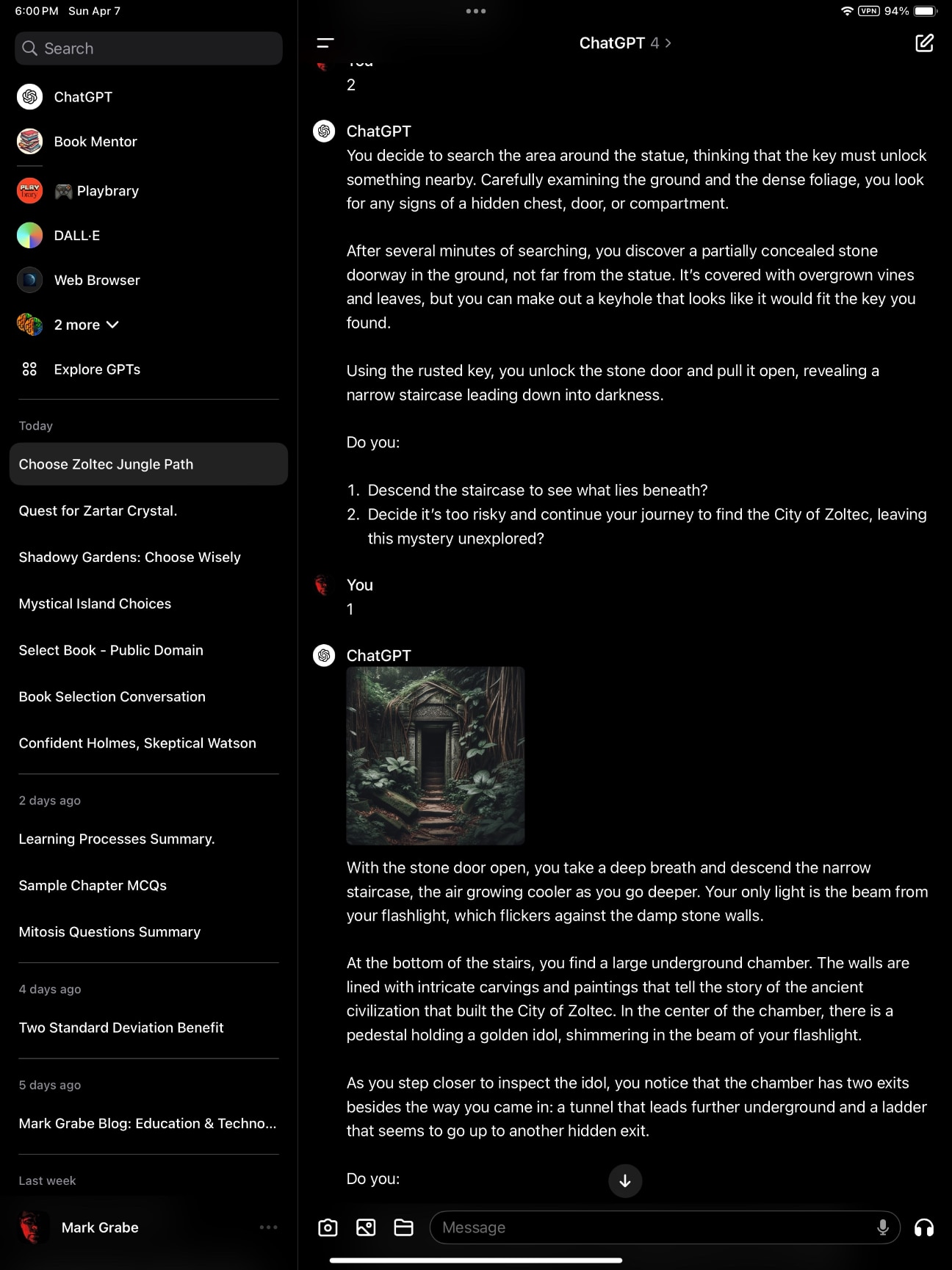
It turns out ChatGPT will create choose-your-own adventure games.

I don’t know if this is a good or a bad thing. I don’t know if it is a waste of the resources ChatGPT must bring to bear to do this. I just know it works.

You can request an adventure on pretty much any subject. I never got to the end of an adventure so I wonder if ChatGPT even knows where the story is going.

Prompt: I want to read a chose-your-own adventure story set in a middle school. Include an occasional image that supports the story. Wait after each choice for my response.

Loading

Posted in Uncategorized | Comments Off on AI and Choose Your Own

Sal Kahn AI Interview

Jason Howell and Jeff Jarvis interview Sal Kahn about the Kahn Academy’s AI tool. The interview includes descriptions of how Kahnmigo is designed to interact with learners, the capabilities it provides educators, and some of the topics covered in Kahn’s future book about AI in education.

Loading

Posted in Uncategorized | Comments Off on Sal Kahn AI Interview