
In a previous post, I mentioned TwinMind as an interesting tool that transcribes an audio input and then uses AI to summarize. While the technology is impressive and seems to work very well, my comments were mostly focused on what this tool allows and what it may prevent.
I certainly encourage you to take a look at TwinMind. The tool is available as an app and as a Chrome extension, with the Chrome extension being more capable. There is a free plan and a $10 a month pro version with the current free plan being ideally suited to student use. TwinMind was created by some of the developers of NotebookLM who decided to create their own company (nice description of origins and capabilities). It has several nice features for those concerned about privacy and operates on your device. The transcription and summarization capabilities do not require that any data be uploaded for assistance from a corporate AI service. I can’t say I use this tool personally, but I have been exploring its capabilities by opening my iPad and launching the app while I participate on my desktop in my weekly two-hour book club. The transcript, complete with “you knows” and (uhs) as well as the AI summary of both our small talk and book comments, was accurate (see sample summary below).
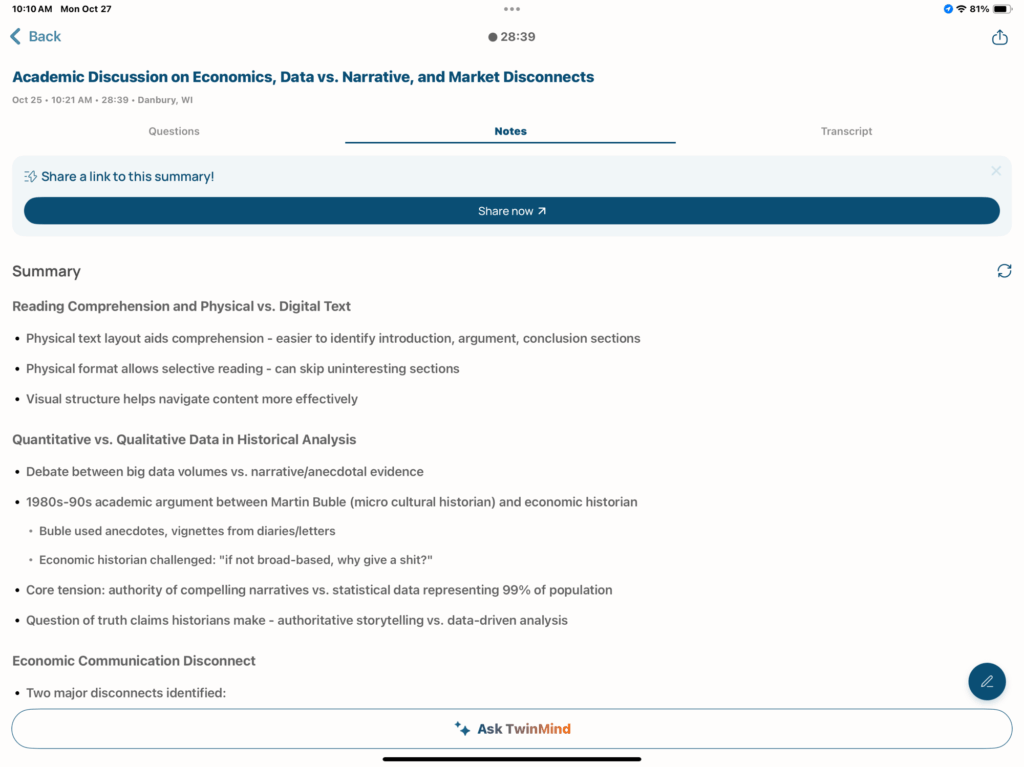
Concerns
Here is my objection. This tool would be great for applications such as having a complete transcript of a meeting (with summary) and perhaps sharing class notes with students unable to attend (perhaps the prof would generate and post to the course management system). However, there is value in taking your own notes that is avoided by relying on AI notes.
This study of the value of taking your own notes goes back decades and I address this research which I first studied in the 1960s, in multiple posts (here is just one). Taking notes requires thinking – selecting, paraphrasing, writing – and this thinking contributes to understanding and retention. You can review notes self generated or AI generated, but to this point the benefits of one approach versus the other has yet to be investigated. The closest comparison I can think of might be studies that provided what were called expert or instructor notes (e.g., Kiewra, 1985) and produced results superior to what students produced when relying only on their own notes (although using both personal and instructor notes produced the best results). Compounding the complexity of this topic is the issue of short versus long term benefit. Expert or AI notes may provide immediate benefit, but limit the development of personal skills important to functioning outside of a classroom environment. To my knowledge the benefits of AI have yet to receive much in the way of attention from researchers using sound methodologies. Asking learners what they think of the experience is not the type of work I trust.
Taking digital notes
How learners take notes (on paper or using a digital device) has its own controversy. I don’t intend to get into this debate in this post, but I back digital because I believe the opportunity to search, share, and reprocess offers advantages over time (one post).
I prefer a specific tool that allows simultaneous recording of audio from a presentation and links it to notes taken by the learner. This requires a digital approach. By connected, I mean the text in the notes is linked to the audio so that after saving the combination, selecting any given notes plays that audio at the point that the learner began taking that note. Because of this connection, the learner can review the audio later if a note does not make sense. When a learner is having difficulty interpreting a specific part of a presentation, I tell them to simply record something like ???? in their notes so they know what to listen to later when they have more time to focus on the problematic content.
I have made this recommendation for some years and see that the apps I originally recommended still work on my iPad, but some that were free now require a subscription. Interestingly in reference to my earlier comments about AI, many of the options I recommended that now require a subscription include AI, allowing summarization and interaction as added features.
Services I have used to record audio and take notes:
Summary
Like many application of AI in educational settings, it is possible to identify both opportunities and concerns. Notions such as second brain (storage of notes, annotations, etc.) recognizes the limitations of human cognition and the opportunities to augment cognition in ways that improve performance.
So many concerns for AI activity by learners fall into a common theme. Learners may use AI to replace an activity intended to develop a specific learner skill. By completing the task without personally exercising the intended skill, learners avoid the purpose of the task – learning a skill. This is obvious when used to avoid a writing task, but applies to a broader set of educational assignments. Taking notes is not necessarily a skill educators focus on developing, but researchers have studied how learners benefit in detail and in this case the activity itself is not the focus, but rather the benefits on understanding and retention that are improved because of the process.
I am not claiming reviewing AI summaries has no value, but am concerned that avoiding the process of taking the notes may be detrimental. As I have already stated, researchers have yet to investigate this topic. Note taking research isolates two major components – note making and note reviewing. Obviously, AI notes still allow for note review and the research on note taking indicates it is the less impactful of the two interrelated activities.
If I could presently create the ideal tool, I probably would add the opportunity to take notes in real time to something like TwinMind. The learner would then have personal notes linked to some type of audio or text transcript and the AI summary as a second study opportunity.
Reference
Kiewra, K. A. (1985). Providing the Instructor’s Notes: An Effective Addition to Student Notetaking. Educational Psychologist, 20(1), 33–39. https://doi.org/10.1207/s15326985ep2001_5

You must be logged in to post a comment.