
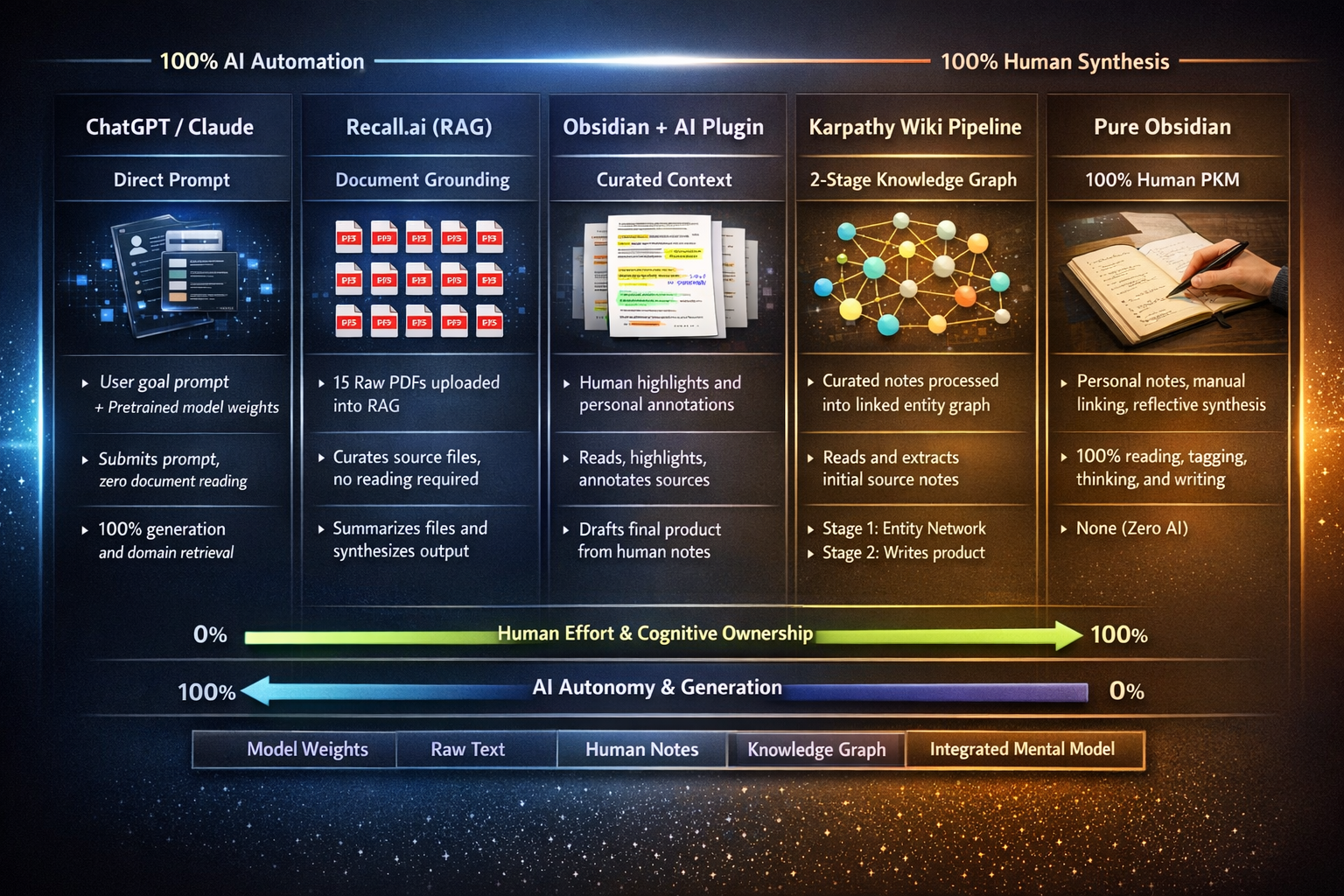
There are multiple ways to think about what using AI in writing could mean. Here is one approach. As I have studied and used AI in writing, I have noticed what I think is a continuum of categories that I can operationalize based on different AI tools and how they move from information to written product. Most of these tools are more flexible than I describe here, but I think the distinctions I identify make sense.
The products I am referring to range from a completed blog to ideas or an outline I might use to guide my own writing. Here is one example.
Assume my goal is to write a 1000-word blog post on how taking notes by hand versus using a keyboard influences student learning and understanding. Here are various approaches I might take and the tools/services I would use.
- ChatGPT or Claude. Submit the goal just stated to an AI tool as a prompt and accept the output as the written product. In this case, the input information is the knowledge base stored as the model within the system and the mechanism the system uses for translating that knowledge into a product. Beyond submitting the prompt, I need to do nothing else to generate an output.
- Recall.ai. This approach uses RAG to designate information sources that an AI prompt then uses to generate a product. Given my goal, I might submit, say, 15 PDFs of journal articles relevant to the topic I have in mind. The AI tool then creates a summary (I can control brief vs extended) of each article. Once completed, I submit the prompt explaining my general goal. The one thing I control is the information input to the system. I don’t have to read the documents and the AI system creates an output based on the designated content based on the request identified in the prompt.
- Obsidian and AI plugin. I read, highlight, and annotate 15 PDFs of journal articles on the topic of interest. Highlights and annotations are first exported from the tool I have used to read these articles and are then stored as a note or notes within Obsidian. The AI plugin in Obsidian then uses the same prompt identified earlier to generate the written product. In this approach, I have selected the articles, designated information I think is relevant (highlights), and added my own insights as annotations. The AI uses the information I designated as relevant and my annotations to generate an output.
- Obsidian to Karpathy Wiki to Product. I read, highlight, and annotate 15 PDFs of journal articles on the topic of interest. Highlights and annotations are exported from the tool I used to read these articles and stored as notes in Obsidian. AI is now used in two distinct stages. First, the AI runs on the content extracted from the original PDFs to identify key concepts, entities (e.g., researchers), and summaries of individual sources. The concepts, entities and summaries are linked by AI to establish relationships – e.g., which researchers conducted which studies, which studies reached a given conclusion or contradicted a given conclusion. The second use of AI applies the goal prompt to this more organized information to produce the final product. (Note: The goal of this process is really to be able to add new resources over time and not have to process the entire batch of inputs each time a new prompt is submitted. This approach offers an efficiency and cost advantage. However, I am focused here on initially identifying themes and concepts, then using them as distinct inputs for the final product as a different approach and possible parallel to how human writers function.)
- Obsidian. I read, highlight, and annotate 15 PDFs of journal articles on the topic of interest. I first export highlights and annotations from the tool I used to read these articles and store them as notes within Obsidian. Once stored, these notes are tagged, linked, and new related notes are generated by thinking about the content already stored. I write the final product to meet my proposed goal using this content. Obviously, there is no AI use at this end of the continuum I have constructed but I wanted my list to move from total AI to total human.
I have used most of these approaches, except for simply posting something written without any input beyond my prompt. I wonder objectively which of these approaches produces the product of the highest quality, but that is likely a nuanced question and I will leave it for others to explore for now.

Pingback: AI (Grammarly) and Writing: Good or Evil? – Learning Aloud